

This article aims to clarify the main differences between these two types of instrument and offer a simple framework for choosing according to your needs and the quality you seek.
The instruments discussed here complement each other. One, made from a metal alloy, has rich harmonics and is versatile, while encouraging a sense of grounding. The other, made from quartz, produces a pure, focused note often used to work with a particular chakra.
We will cover their origins, materials, sound quality, perceived effects, practical uses, selection criteria and cost. Listening and trying them remain essential, since perceptions vary from person to person.
In France, they are becoming increasingly popular for meditation, relaxation and guided sessions, both at home and among wellness practitioners. This article draws on traditional craftsmanship and contemporary sound therapy practices; it does not replace medical advice.
For a closer comparison and practical guidance, also read about whether a crystal bowl is more powerful. The following sections examine history, manufacture, acoustics, bodily sensations and sizes.
Tibetan bowls or crystal bowls: key differences
Here is a straightforward, practical overview of the composition, sound and uses of these instruments.
At a glance: composition, sound and uses
Composition: one is forged from metal alloys (copper, tin, brass, bronze and sometimes iron); the other is made from highly pure quartz (≈ 99.98%). These materials directly influence quality and sound character.
Sound: metal bowls offer a rich texture full of earthy harmonics. Quartz bowls produce a clear note, often dominated by a single fundamental, suited to focusing on an energy center.
Which instrument suits meditation, relaxation and sound therapy?
For grounded meditation and sound massage, metal singing bowls are versatile and can accommodate slightly dissonant combinations.
For work focused on a chakra or a specific therapeutic session, a tuned quartz bowl (A 440 or A 432) can support mental clarity and a sense of uplift.
- Practical guide: if you are starting out or have varied needs → choose an alloy bowl.
- Focused work: for a particular note associated with a chakra → favor a crystal bowl; see how to choose a crystal bowl.
Finally, resonance depends on diameter, thickness, the mallet and playing technique. Larger instruments produce a more enveloping sound; your choice may change as your practice develops.
Origins and history of singing bowls
An ancient origin is often claimed, but the chronology is more nuanced. Popular accounts place these instruments in the Himalayas and Buddhist practices, while modern research notes a lack of strong written evidence before the 1960s.
Oral tradition and travelers: accounts from priests and travelers describe ritual uses in Nepal and Tibet. These accounts exist, but academic documentation remains patchy, with no continuous archival record.
The second path is industrial. Quartz instruments appeared in the West in the twentieth century. Crucibles from the semiconductor industry proved highly resonant.
In the 1980s, musicians and practitioners widely adopted these quartz pieces. Today, these two paths—one artisanal and Himalayan, the other industrial and Western—converge in meditation, relaxation and sound therapy.
To explore their varieties and origins further, read about the types of Himalayan singing bowls.
Materials and manufacture: metals and quartz
Materials and manufacturing techniques largely determine each instrument’s sound and durability.
Traditional alloys: pieces made from copper and tin form the historical basis. Brass and bronze variants change the sound’s character: bronze brings deep warmth, while brass gives a brighter attack.
Hand hammering affects sustain and the richness of harmonics. Modern, partly mechanized methods produce more consistent wall thickness and a steadier response.
Quartz and crystal: bowls made from pure quartz (≈ 99.98%) are molded and then annealed. Frosted finishes are common; transparent versions cost more and require strict industrial quality control.

“The material guides the sound: metal means harmonic complexity; quartz means a focused note.”
| Characteristic | Metals | Quartz / crystal |
|---|---|---|
| Composition | Copper, tin, brass, bronze | Pure quartz ≈ 99.98% (quartz crystal) |
| Manufacture | Hand hammering or modern production | Industrial molding, annealing, frosted or transparent finish |
| Sound | Rich in harmonics | Clear, focused note (A 440 / A 432) |
| Durability | More resistant to knocks | Fragile; handle with care |
Practical tip: if you often transport your instrument, choose a metal Tibetan bowl; for focused work in a practice room, pure quartz crystal singing bowls may be more suitable.
Sound quality, fundamental note and harmonics
How an instrument vibrates shapes its immediate effect on listening and the body. The fundamental note is the dominant frequency perceived; harmonics are the components that color the timbre.
Fundamental, harmonics and resonance: richness and purity
Metal instruments offer a fundamental accompanied by a broad range of harmonics. This creates an impression of breadth and space.
Quartz instruments produce a more isolated note. Their purity makes it easier to focus on a particular frequency.
Timbre and perceived frequencies: low, middle and high
Low and middle tones encourage grounding and physical relaxation.
High tones bring clarity and a feeling of lightness. Your choice of timbre guides how you use the instrument in meditation or therapy.
Influencing factors: diameter, thickness, mallet and surroundings
Diameter and mass affect perceived pitch: a larger instrument produces a deeper, more enveloping sound.
Thickness changes projection and sustain. The mallet (felt, leather or silicone) affects the attack and the presence of higher frequencies.
Room acoustics, how the instrument is placed and temperature can all affect the accuracy of its note.
| Factor | Main effect | Practical consequence |
|---|---|---|
| Diameter | Pitch / enveloping quality | Larger models → deeper, fuller sounds |
| Thickness | Projection / sustain | Thick walls → long sustain; thin walls → distinct attack |
| Mallet | Attack / higher harmonics | Soft felt → fewer high tones; hard mallet → more brightness |
| Surroundings | Reverberation / clarity | Reverberant room → fuller sound; noise → masked note |
Tip: try and record your instruments to compare the balance between the fundamental and the harmonics. To learn more about notes and chakras, read about notes and chakras.
Effects on body and mind: grounding, clarity and energy
The perceived effects of vibration extend beyond hearing: they can involve breathing, posture and attention.
Meditation, relaxation and a sense of well-being
Sound affects the body through perceived vibrations. It often helps people slow their breathing and focus their attention.
In practice, guided meditation with metal instruments can encourage grounding and stability. Quartz instruments are associated with a sense of clarity and uplift.

Energy work: chakras, frequencies and “cellular work”
Some practitioners associate particular frequencies with chakras. The distinct notes of a quartz instrument can make this kind of focus easier.
People report muscle relaxation, a release of tension and improved sleep, but these effects are subjective and are not medical outcomes.
Good practices and precautions
- Start at a moderate volume and pay attention to your body’s responses.
- Avoid tones that are too high or too low around sensitive people.
- Handle fragile instruments carefully and keep them away from implants sensitive to vibration.
- Alternate mallets and instruments to try different sound characteristics.
- Favor short, regular sessions over occasional intense exposure.
“Listening carefully to yourself remains the best guide to adjusting the instrument, note and duration of your practice.”
Uses: sound massage, space cleansing and therapy
This section looks at practical applications: sound massage, space cleansing and therapeutic work.
Versatility and sound massage
Typical approach: place the Tibetan bowl near the body (head, heart or pelvis), then begin with gentle strikes.
Continue by slowly rubbing the rim to encourage grounding and gradually release tension.
Increase the intensity cautiously and seek verbal or nonverbal feedback.

Using notes and tuned sets for focused work
A set of crystal bowls tuned from C to B (A 440 / A 432) lets practitioners address energy centers in sequence.
Benefit: harmonic consistency supports immersion and makes transitions between frequencies easier.
Sizes, resonance and cleansing
Small models (around 20 to 25 cm) produce high tones suitable for cleansing a room or for a short practice.
From about 27.5 cm upward, the sound becomes deeper and more enveloping, making these bowls suitable for therapy sessions and sound baths.
“Increase the volume gently; avoid sudden peaks and note how you feel after each session.”
- Combine instruments: low Tibetan bowl → middle-to-high crystal bowl → return to the low tone to settle the experience.
- Favor simple chords and pleasing intervals in group meditation.
- Keep a journal of your sensations to refine your choices of sizes and notes.
How to choose: needs, budget, experience and durability
First, identify your needs. Personal practice, workshops and therapeutic sessions call for different choices. Clarifying your purpose helps you avoid an unsuitable purchase.
Beginners, personal practice and guided sessions
For daily use or an introduction, choose a versatile Tibetan bowl. It is forgiving of imprecise technique and remains affordable.
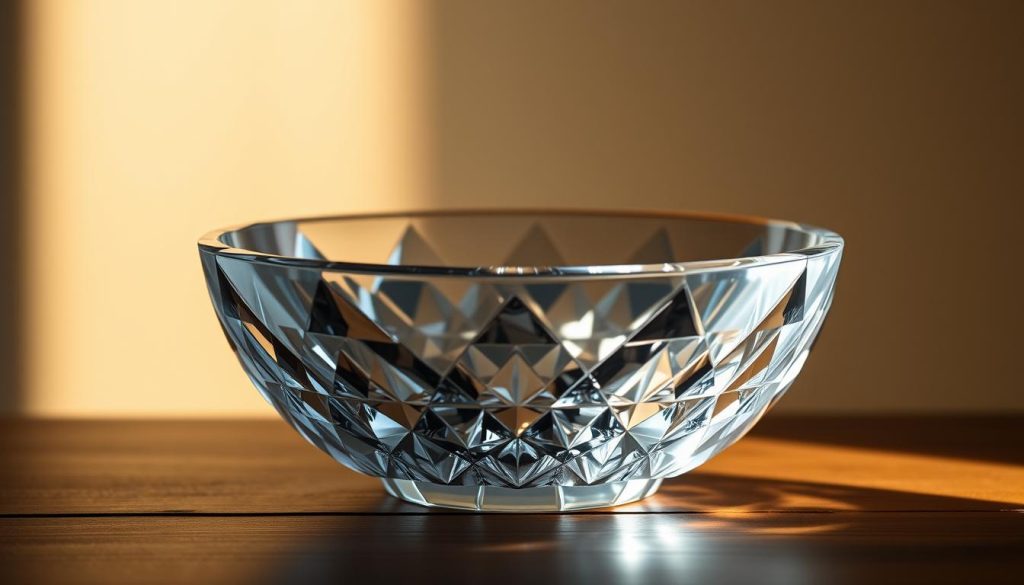
If you work in a practice room and focus on a particular frequency, a crystal singing bowl may be more suitable. It requires a steady technique.
Price, the strength of metal and the fragility of crystal
Metal models are often sturdier and less expensive. They suit travel and workshops.
Crystal pieces generally cost more and need greater care. They offer a precise note but can be fragile.
| Criterion | Metal | Crystal |
|---|---|---|
| Price | Affordable | Higher |
| Durability | Very sturdy | Fragile; needs protection |
| Ease of playing | Forgiving | Requires steady technique |
| Recommended use | Beginners, workshops | Focused therapy, practice room |
“Always try before you buy: listening, physical sensation and the stability of the fundamental help confirm quality.”
Tip: start simply. A good Tibetan bowl can later be complemented by a crystal instrument to broaden your range of sounds.
Conclusion
In summary: two approaches to sound serve complementary purposes in meditation and sound therapy.
Metal instruments offer rich harmonics and durability suited to beginners and workshops. Quartz versions produce a precise note useful for focused work within a particular scale.
Combine the two to bring together grounding and clarity. Try several models, and observe your breathing and the sensations in your body.
If you are unsure, learn how to choose a Tibetan bowl, then add a crystal instrument to broaden your range of sounds.