
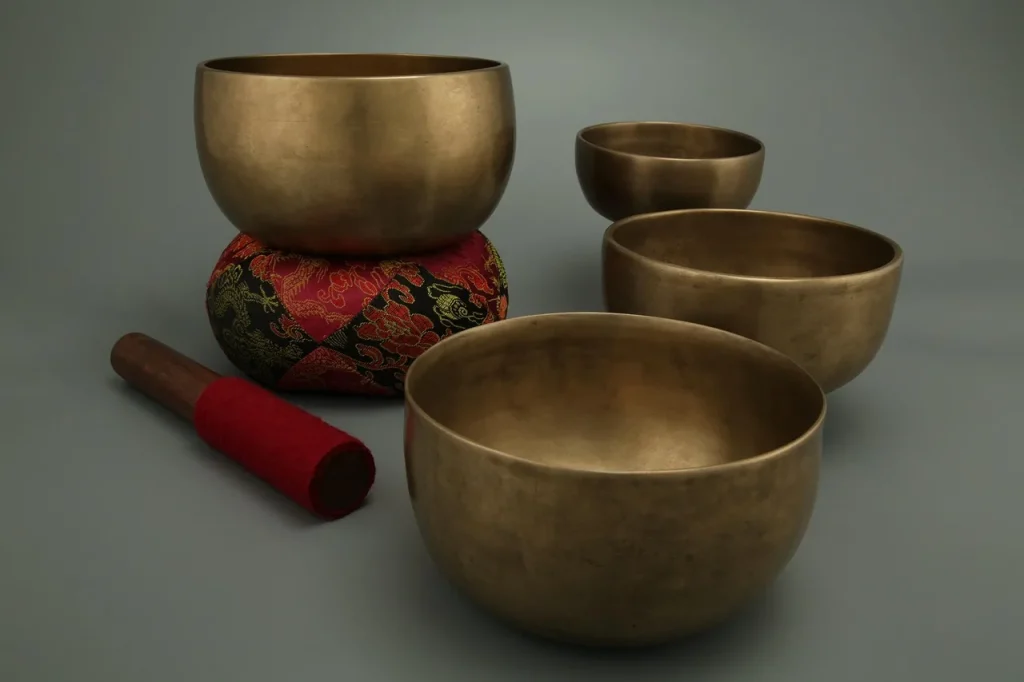
This article explains how to assess a bowl’s authenticity by considering several concrete clues together rather than relying on a single feature.
With no official standard, authenticity is judged by the manufacturing method (hammering or casting), patina, understated design, composition (bronze: copper and tin), and price. Older pieces show tool marks and slight irregularities. Cast models are too uniform.
The seven-metal myth largely dates from the 1960s; historically, bronze was predominant. Himalayan origin (Tibet, China, Nepal, Bhutan, or India) and the seller’s ability to document provenance remain essential.
Sound quality—harmonics and sustain—helps you decide, but a beginner can be mistaken. To learn more, follow this guide and discover how to recognize a genuine Tibetan singing bowl step by step.
Why use a practical guide to authentic Tibetan singing bowls today?
Today’s market combines craftsmanship and mass production, making it more difficult to choose an instrument.
Since the 1960s, Western demand has led to industrialized production. More than half the bowls in circulation may be copies intended for tourists, often produced on a large scale.
“There is no official certificate”: buyers therefore need to learn, compare, and ask the right questions. A price that is too low can be a warning sign, but it is not definitive proof.
The value of information is clear: the better you understand manufacturing, alloys, and plausible wear, the less likely you are to make a mistake. Choosing workshops that respect their workers improves quality and social impact.
This approach takes time: your eye and ear become more discerning. This article aims to offer a pragmatic, step-by-step method for choosing instruments suited to long-term use.
True or false: how to recognize a genuine Tibetan singing bowl
Before buying, a few visible and audible signs can help you quickly distinguish a handmade piece from an industrially produced one.
A quick visual check
What to check:
- Visible hammer marks and small surface irregularities.
- Slightly uneven rims and varying thickness.
- A matte surface without an industrial mirror-like polish.
- An understated design without excessive acid-etched decoration.

What is not enough on its own
A high price, a “seven metals” label, or decorative engraving does not guarantee quality. These isolated signs are unreliable if the provenance and composition cannot be verified.
| Clue | Meaning | Reliability |
|---|---|---|
| Visible hammer marks | Hand-hammered construction | High |
| Very even rims | Likely industrial casting | Moderate |
| Rich tone and long sustain | Good resonance and a singing instrument | High |
| “Seven metals” label | Claim without traceability | Low |
Tip: consider construction, appearance, sound, alloy, and origin together. To learn more, read our complete guide to recognizing a genuine bowl.
Construction: hand-hammered bowl or industrial casting
The way a bowl is shaped reveals the main differences between a handmade piece and a mass-produced one.
Hammer marks and surface appearance
The traditional technique combines repeated heating with coordinated hammering by a team.
The metal disc is rotated while the strikes follow a rhythm.
The process leaves small hammer marks and a surface that is not perfectly smooth.
Practical clue: examine the wall under light coming from the side to spot small bumps and irregularities.
Rims, thickness, and regularity: signs of machine production
Cast pieces have a perfectly circular shape, uniform thickness, and clean edges.
These features result from standardized molds and industrial polishing.
The trap of a reproduced “hammered” appearance
Some mass-produced bowls imitate hammer marks.
But a cast texture lacks the fine, spontaneous variation of handwork.
Comparing several pieces helps: two handmade instruments will never be identical.
- Tip: check whether the price matches the quality; craftsmanship takes time.
- Sound quality often reflects the method of construction: hammered instruments have richer harmonics.
- To learn more, read our practical guide to recognizing a genuine bowl.
Origin and traceability: Tibet, Nepal, Bhutan, India
The region of origin often influences an instrument’s quality, sound, and value.
Plausible countries of origin: look for artisans based in Tibet (an autonomous region of China), Nepal, Bhutan, or India. These places have religious and craft histories connected with bowls and meditation practices.
Traceability: a reputable seller provides the workshop’s name, details of the manufacturing process (casting metal discs and then hammering them), and evidence of local sourcing. This information helps verify provenance.
Warning signs from a seller or on an online shop
- Several identical pieces (the same engravings and dimensions): possible mass production.
- Uniform acid-etched engravings or perfectly even rims: possible signs of industrial casting.
- An unusually low price without a credible logistical explanation.
- A site filled with mass-imported products: a sign of poor traceability.
Practical tip: ask the seller questions. Request the composition, manufacturing steps, and history of the piece. If the answers are vague, proceed cautiously. To learn more, read our complete guide to recognizing a genuine Tibetan singing bowl.
Metal composition: bronze, copper, tin, and the “seven metals” myth
Understanding the metals helps distinguish traditional pieces from modern products.
The reference alloy: historically, bronze—an alloy of copper and tin, sometimes with small traces of iron—was the basis of older instruments. This alloy supports stability and a rich sound.
Debunking the myth: the “seven metals” legend became popular relatively recently. When other metals are present, their quantities are often tiny and prove nothing on their own.

Telling bronze from brass by color
Visually, bronze tends toward warm brown. Brass (copper and zinc), common in industrial production, appears golden yellow or silvery after polishing.
Traditional alloys and warning signs
- Useful clue: ask the seller about the composition; a professional should know it.
- Brass, stainless steel, and other inexpensive alloys often indicate modern manufacture.
- Examine wear and oxidation around the rim: they can sometimes help identify the metal.
Conclusion: composition directly affects sound quality. A well-made alloy offers richer harmonics and better sustain.
Design, patina, and age: reading the bowl’s history on its surface
An instrument’s surface often tells you more than its price: patterns, patina, and wear reveal its history.
Subtle engravings and acid-etched decoration
Older models often have hand-engraved inscriptions: names, short prayers, or discreet symbols. These marks are irregular and imperfect.
By contrast, sharp, regular acid-etched decoration offers misleading precision. It may be attractive, but it is often characteristic of modern production.
Natural patina, wear, and plausible hairline cracks
Natural patina varies across the surface. Areas that have been touched often are shinier, while other areas are darker.
Small internal cracks or fine scratches can develop over time. Sometimes a spot of verdigris suggests use with food; interpret it in context.
Watch for artificial aging
Aging in an acid bath gives a uniform, superficial color. It does not produce consistent signs of use.
Tip: ask the seller for close-up photos of the rim, base, and marks. Compare several pieces to sharpen your eye.

Testing the sound: harmonics, sustain, and vibrations for meditation
A simple procedure of striking and rubbing lets you assess harmonics and vibrations. This quick test gives you a useful indication of acoustic quality before buying.
Step-by-step procedure:
- Place the instrument on your palm or a stable cushion.
- Strike it gently with a hard wooden mallet and listen to the attack and sustain.
- Rub the rim with a steady motion to make the bowl “sing.”
- Notice how long the sound lasts, whether harmonics are present, and whether there are any unwanted noises.
A good singing bowl produces a melodious sound rich in harmonics, with steady vibrations and long sustain.

Audible signs and comparison
Positive signs include rich harmonics, steady vibrations, long sustain, and no unwanted buzzing. An industrial model will often sound hollower and more monotonous, with shorter sustain.
“Practice and comparison remain the best ways to train your ear.”
Tools and practical tips
- Try several mallets: hard wood for clarity, felt or suede for a softer attack.
- Size affects pitch: large bowls produce low fundamental tones, while small ones produce higher tones.
- For an objective measurement, use a spectrum analyzer: it reveals partial frequencies and harmonic richness.
- Use a steady motion without excessive pressure to prevent the mallet from “buzzing.”
| Feature tested | Good sign | Warning sign |
|---|---|---|
| Attack | Clear, without a metallic clang | A sharp clack or muffled sound |
| Sustain | Long and steady | Short; the sound fades quickly |
| Harmonics | Several distinct partial frequencies | A single frequency and flat sound |
Final note: your ear improves with practice. Compare several pieces in the same setting and, if needed, use a visual tool to check their acoustic signatures.
Price, ethics, and where to buy a Tibetan singing bowl with confidence
A fair price often reveals more than the label itself. An entry-level price of around €30 almost always indicates a mass-produced cast piece.
Price alone does not prove authenticity. But a very low price can be a warning sign. Look for consistency among the price, description, and close-up photos.
Choose sellers who identify the workshop and manufacturing process and provide close-ups showing the hammer marks. Ask about provenance and quality control.
Craftsmanship and working conditions
Favor responsibly sourced imports. Inexpensive mass-produced bowls often come from production lines where workers’ rights receive little respect.
Specialist shops and hands-on tests
Listen to and handle several pieces in a shop. Testing them remains the best way to judge their quality and suitability for your practice.
| Clue | What it means | Recommended action |
|---|---|---|
| Price around €30 | Likely industrial casting | Ask about composition; decline if the answer is vague |
| Moderate price | Possible local craftsmanship | Check close-up photos and traceability |
| High price | Possibly handmade | Confirm the workshop’s name and listen to the instrument |
Conclusion: an informed purchase combines a reasonable price, observable quality, and verifiable ethics. Contacting the workshop or importer can resolve many doubts.
Practical buying advice: size, mallet, use, and care
Choosing the right size and accessories changes the experience. Large models produce low tones and are often easier to make sing. They are better suited to bodywork and deep relaxation.
Small models produce high tones that are useful for musical accents or in confined spaces. Match the size to the room: large spaces benefit from low frequencies, while small spaces call for less overpowering timbres.
Mallets and accessories
A hard wooden mallet produces a clear attack. Felt or suede models soften the attack and enrich the sound’s texture.
Cushions: they stabilize the bowl and help keep the sound and vibrations from being dampened. Choose a firm but yielding support so the instrument can vibrate freely.
Technique, care, and quality checks
Use steady pressure and an appropriate speed to make the instrument sing. Listen for harmonics rather than seeking a single note; associations between notes and chakras are only guides.
Care: dry the bowl after use, avoid prolonged moisture, and clean it gently to preserve the patina and metals. Check its construction: smooth rims without burrs, no chemical smell, and consistent hammer marks are signs of quality.
| Item | Advice | Why |
|---|---|---|
| Size | Large for bodywork, small for accents | Low or high tones and ease of making the bowl sing |
| Mallet | Wood, felt, or suede depending on the desired timbre | Control over attack and texture |
| Cushion | A stable, yielding support | Allows vibrations to develop |
Conclusion
In conclusion, authenticity is assessed through a combination of visible, audible, and documented details.
Remember the essentials: look for hammered construction, understated design, plausible patina, a copper-and-tin alloy, and traceable provenance to identify a genuine Tibetan singing bowl.
Sound remains decisive: a good singing bowl has long sustain, harmonics, and steady vibrations that can support meditation and bodily well-being.
A low price is a warning, but it is not enough to reach a conclusion. Test and compare several instruments, ask about their composition, and request close-up photos. A spectrum analyzer helps assess harmonics objectively.
Come back and share your experience in the comments: use this article as a practical checklist when buying in a shop or online.