
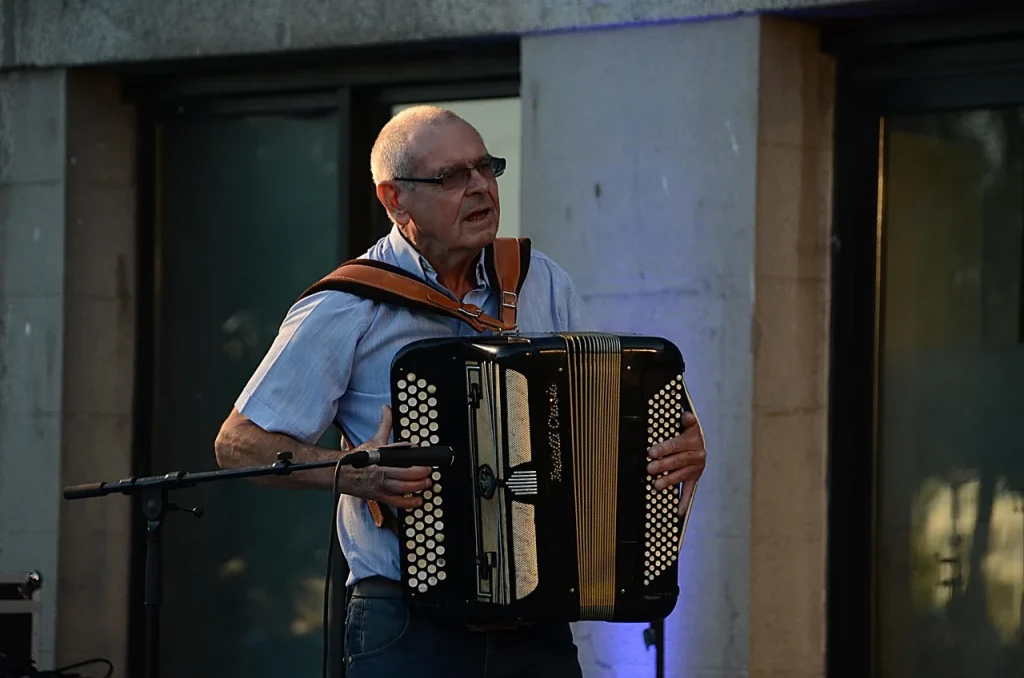
André Verchuren, born on December 28, 1920, is an iconic figure in French music. With more than 70 million records sold, he is the world’s most famous accordionist. His musical journey began in childhood, under the influence of his father, an accomplished musician. This passion for music was passed down through three generations.
André’s grandfather, Petrus Verschuere, and his father, Raymond, both helped shape his love of the accordion. The king of musette, as he is often called, captivated audiences with his talent and passion. His two sons, Harry Williams and André Junior, continue to carry on this musical legacy.
In this article, we explore his family’s origins and his remarkable career, as well as his involvement in the Resistance. The legacy left by this music-loving family is immeasurable.
Family origins and a passion for the accordion passed down through generations
Music has always been central to the lives of the Verschuere family. This line of accordionists has deep roots in Belgian and northern French culture. André’s grandfather, Petrus Verschuere, left Knesselare to work in the mines of Pas-de-Calais while continuing to play the accordion. He passed his passion for music from one generation to the next.
A Belgian and northern French line of accordionists
Petrus Verschuere, born in 1865, was an accordionist and jewelry seller. His journey brought him to Pont-à-Vendin, where he continued to play despite the hardships of life as a miner. His determination marked the beginning of a family tradition.
His son, Raymond Verschuere, followed in his footsteps. Born in 1894, he became a professional accordionist. After settling in Neuilly-sous-Clermont, he met Marie-Clémence Massez, a seamstress from Uny-Saint-Georges. Together, they raised a family in which music held a central place.
André Verchuren’s first steps as a child accordion prodigy
André began playing the accordion at age 4 under his father’s watchful eye. At 6, he earned his first fee playing at a dance in Ponchon, accompanied by his mother on drums. These early experiences nurtured his love of performing.
By age 12, he was teaching at his father’s accordion school, which had as many as 180 students. His extraordinary early years culminated in 1936, when he won the prestigious international accordion competition in Soignies at just 16.
A musical legacy carried on by his sons
The family’s passion for music did not end with André. His sons, Harry Williams and André Junior, also pursued musical careers. Harry became a music producer, while André Junior followed his father onto the stage.
This continuity highlights the importance of the Hauts-de-France region and Picardy in the family’s musical history. The Verschuere family’s dedication and talent have left a lasting mark on the world of music.
| Name | Role | Age when introduced to music | Achievements |
|---|---|---|---|
| Petrus Verschuere | Grandfather | Not specified | Accordionist and miner |
| Raymond Verschuere | Father | Not specified | Professional accordionist |
| André Verchuren | Son | 4 years old | International accordion competition in Soignies (1936) |
| Harry Williams | Son | Not specified | Music producer |
| André Junior | Son | Not specified | Followed in his father’s footsteps |
The musical and broadcasting career of André Verchuren and his sons: a family devoted to the accordion
André Verchuren’s rise in the music world was rapid. At just 16, he won the international accordion competition in Soignies in 1936. By playing the overture to Les Saltimbanques while standing, he defied the conventions of his time.
In 1950, his appearance on Swing contre musette on Radio Luxembourg changed the course of his career. Entered by his friend Tony Murena, he won a memorable contest at the Moulin-Rouge, captivating 10 million listeners. That victory opened the doors to major venues.
André signed with the Decca and then Festival record labels, marking the start of an exceptional recording career. In all, he recorded 777 albums and reached millions of fans around the world.
His media presence grew through 17 years of broadcasts on RTL and 13 years on Europe 1. He became a fixture of the French music scene. His biggest hit, “Les Fiancés d’Auvergne”, released in 1961, sold 10 million copies and remained at the top of the charts for 11 months.
André toured extensively, giving more than 10,000 shows to a total audience of 40 million. On average, he performed 150 shows a year and traveled millions of miles on the road.
Throughout his career, he received numerous honors, including an Académie Charles-Cros award and the Sacem Grand Prize for instrumental popular music. In 1958, he was also the first to receive a Gold Record.
André Verchuren shaped musette music and created the “bal-music-hall” format. In 1956, he became the first accordionist to perform at the Olympia for three weeks, making music history.
| Event | Year | Details |
|---|---|---|
| International accordion competition | 1936 | Won in Soignies at age 16 |
| Swing contre musette | 1950 | Contest at the Moulin-Rouge, 10 million listeners |
| Albums recorded | Various years | More than 777 records |
| Radio broadcasts | 17 years on RTL, 13 years on Europe 1 | A leading figure in radio |
| “Les Fiancés d’Auvergne” | 1961 | 10 million copies sold |
| Tours | Throughout his career | More than 10,000 shows, 40 million audience members |
André Verchuren’s personal commitments, Resistance work and family life
A musician’s involvement in the wartime Resistance often reveals lesser-known sides of his character. During the Second World War, André Verchuren joined the Resistance. He helped Allied airmen hide from the occupying forces. This act of bravery showed exceptional courage.
Resistance fighter and deportee: a story of courage
Denounced in June 1944, he was arrested by the Gestapo. After being tortured, he was deported on July 2, 1944, aboard the “Death Train,” a tragic convoy bound for Dachau. On July 14, he led his fellow prisoners in singing La Marseillaise, defying the SS at the risk of his life. This heroic moment remains etched in memory.
Transferred to Neckarelz on July 24, he endured further hardship. It took years of hard work to overcome the physical effects of his deportation. Eventually, he regained the dexterity needed to resume his career as an accordionist.
Personal hardships and their effect on his career
His personal life was also marked by tragedy. He married Mireille Roux in 1946, but they divorced in 1950. In 1953, he married Micheline Butot, who died tragically in a car accident in Normandy in 1974. André was driving at the time.
This devastating loss had a profound effect on his life. He stopped performing for several months. He received a three-month suspended prison sentence for involuntary manslaughter, a tragedy that affected him for years.
Awards and honors recognizing an extraordinary life
Despite these hardships, he received numerous honors. He was made an Officer of the Legion of Honor and a Commander of the National Order of Merit. His bravery also earned him the Military Medal and the Volunteer Resistance Combatant’s Cross. In addition, he received a certificate of recognition from President Eisenhower for his service.
He died of cardiac arrest on July 10, 2013, in Chantilly, aged 92. His musical legacy and courageous service remain part of history.
Conclusion: the legacy of a family devoted to the accordion
The musical legacy left by this great accordionist is immeasurable. With more than 70 million records sold and 777 albums recorded, his influence endures. His funeral, held on July 17, 2013, at the Church of Notre-Dame-de-l’Assomption in Chantilly, showed the impact he had on generations of listeners.
He rests in Bourillon Cemetery alongside his wife, Micheline, and his parents. His sons, Harry Williams and André Junior, continue to pass on the family’s passion. The “king of musette” got more than 40 million people dancing around the world.
Signature songs such as “Les Fiancés d’Auvergne” remain popular, showing the enduring appeal of his work. The Verchuren family story evokes a festive side of France, where music and dancing hold a central place.