
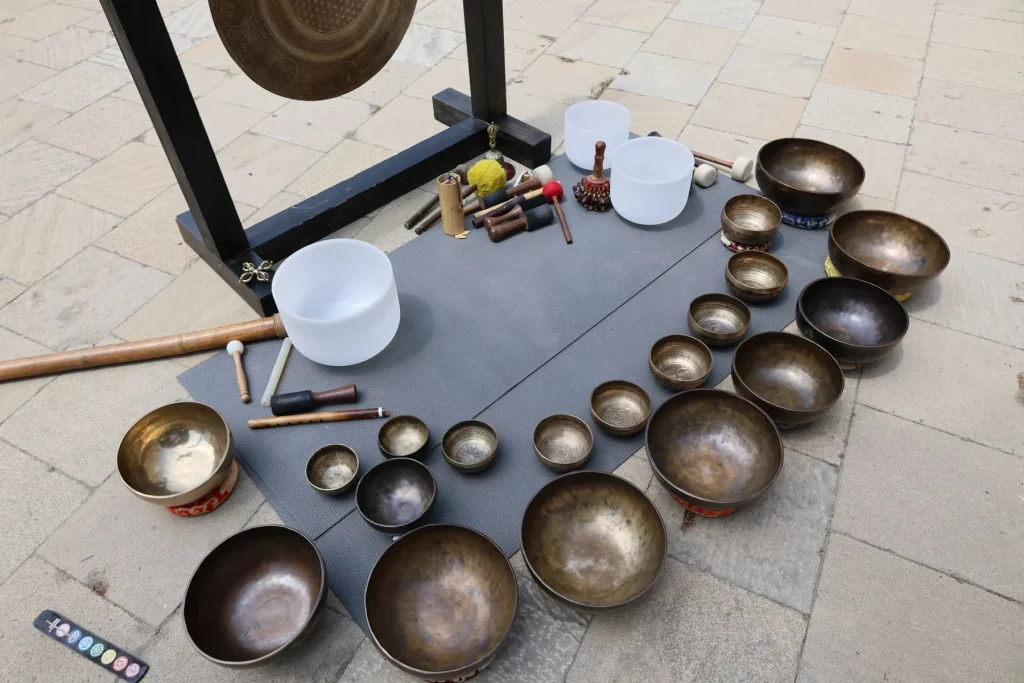
An immersion guided by sound to rediscover calm and well-being. This practice invites you to take a deep pause, carried first by one bowl and then by several bowls resonating around and on the body.
Originating in the Himalayas, each instrument is shaped by hand and has a unique vibration. The sounds spread through the body, which is mostly water, encouraging relaxation and letting go.
You remain fully clothed on a massage table during the session, in a gentle, respectful setting. The practitioner adjusts the sequence to how you feel, creating a personalized experience without intruding on your comfort.
You do not need to know how to meditate: meditation may arise naturally, supported by the tones. For more about what happens and how to prepare, see this practical guide to sound massage and the practice.
Why try a Tibetan singing bowl sound journey today?
The sound waves produced by a bowl create a space for calm that requires no prior training. They encourage quick relaxation and help release stress built up through a busy life.
Within the first few minutes, one bowl and then several create a soundscape that eases mental overload. This sequence guides you toward letting go and makes a natural form of meditation more accessible.
Vibrations spread through the water-rich body. They gently ease tension, create a feeling of warmth, and improve breathing. On a mental level, people may notice greater clarity and a steadier sense of presence.
Reported benefits:
- Inner peace and renewed energy.
- Help managing stress and supporting well-being.
- An experience suited to important moments in life and useful for preventive self-care.
“When words fail, letting sounds work can complement meditation and other healthy habits.”
To explore the effects and personal accounts further, see our practical guide to sound baths and well-being.
The history, making, and metals of Tibetan singing bowls
In workshops in Tibet, India, and Nepal, these instruments are shaped using longstanding skills. Their history is tied to ritual practices and craftsmanship passed down through generations.

Craftsmanship from the Himalayas
Traditional production begins with a heated sheet of alloy, which is then hammered by hand.
Repeated blows leave visible hammer marks, giving each piece a unique imprint. The technique gives every bowl its own tone and sustain.
The seven-metal alloy and its symbolism
The classic mixture combines silver, copper, tin, iron, mercury, gold, and lead.
Symbolism: these metals correspond to the seven planets, seven chakras, and seven days, linking cosmology and energetic balance.
- Modern development: Western interest grew during the 20th century.
- Techniques: from traditional hammering to modern methods, craftsmanship remains central.
- Choosing a bowl: consider its origin (Nepal or India) and the richness of its harmonics.
| Criterion | Production | Effect on sound |
|---|---|---|
| Hand hammering | Heated sheet, then hammered | Warm tone and visible hammer marks |
| Seven-metal alloy | Silver, copper, tin, iron, mercury, gold, lead | Rich harmonics and symbolism |
| Origin | Tibet / India / Nepal | Sound quality and authenticity |
“Every bowl tells a story of hands and years of practice.”
Tibetan singing bowl sound journey: what to expect
The session begins in a quiet, soothing atmosphere. The lighting is soft, the temperature is comfortable, and you lie down fully clothed on a massage table.
Setting, posture, and duration
You stay in a neutral, still position to make it easier to welcome relaxation. The practitioner places seven singing bowls, Koshi chimes, and sometimes a drum around you.
A typical session lasts 60 to 75 minutes, including a short welcome and time to absorb the experience. Shorter options are available if you are trying it for the first time.
Sounds, vibrations, and resonance in the body
The bowls produce rich sounds, alternating between low and high notes. Striking and rubbing them changes the texture of the sound.
Placed around or on the body, they produce vibrations said to travel deep into the water-rich body. Imagine a stone thrown into a lake: concentric ripples pass through the whole system.
After the session: absorbing the experience and effects over the following days
Sensations may range from a pleasant heaviness to tingling, warmth, or a feeling of floating. Breathing slows, and time may seem to stretch.
Drinking water and taking a gentle walk are recommended. The effect may last a few days, sometimes up to three weeks, with better sleep and greater mental clarity.
What happens during a session, step by step
Before the treatment, a short conversation helps identify your needs and tailor the practice.
Initial conversation and assessment
The session starts with a conversation about your medical history and expectations. A brief questionnaire may help identify areas of tension and energetic sensitivity.
Placing the instruments around and on the body
You remain fully clothed and lie on a massage table. Seven Tibetan singing bowls are placed around your body; if appropriate, some are then placed on specific areas.
Energy harmonization and chakras
The practitioner combines striking and rubbing to vary the volume and sound textures. The intention is to bring harmony to the energy centers and support the balance of the chakras.
The session respects your comfort: mention any discomfort so the practitioner can adjust the technique immediately.
“The connection between practitioner and client is central to the treatment’s effectiveness.”
| Stage | Approximate duration | Purpose |
|---|---|---|
| Welcome and assessment | 10 to 15 min | Identify needs and limits |
| Instrument placement and gradual increase in intensity | 15 to 25 min | Create a field of vibration |
| Peak, then gradual decrease | 20 to 30 min | Absorb the experience and return to yourself |
Preparing for your experience: practical tips
Preparing before you arrive can help you get more from the experience and deepen your relaxation. Wear light, comfortable clothes to help you unwind.

Clothing: choose loose clothes without a belt or anything tight. You remain clothed on a massage table during the session.
Hydration: drinking before and after helps you absorb the effects. Water supports the body’s natural processes and helps you reconnect with your body.
Quick practical tips
- Arrive on time so you can settle in, and turn off your phone.
- Come with a clear head: avoid alcohol and stimulants so you can better notice the effects.
- Set a brief intention; it can help guide how the experience unfolds.
- Tell the practitioner about any sensitivities or health concerns.
“An open mind and simple preparation often allow a deeper experience.”
| Aspect | Recommendation | Why |
|---|---|---|
| Clothing | Loose clothes, no belt | Comfort and the flow of energy |
| Hydration | Drink before and after | Support for the body’s natural processes and for absorbing the experience |
| Time | Arrive 10 min early | Give yourself time to settle and make the transition from daily life |
Everyone absorbs the experience differently. Go at your own pace, and ask for resources if you would like to learn more about the practice and relaxation.
Benefits and limits: what the practice may offer
This treatment uses vibration to encourage deep relaxation of body and mind. It aims to make relaxation accessible from the first session and adaptable to each person’s needs.

Relaxation, sleep, concentration, and vitality
Commonly reported effects include muscle relaxation and a calmer nervous system. This may make it easier to fall asleep and improve sleep quality.
The practice may also support concentration and greater mental clarity. Many people describe a lasting boost in vitality after a session.
Pain, stress, and emotional balance
Sound massage may help reduce stress, calm anxiety, and ease back and joint tension and headaches. Blood and lymphatic circulation may improve, supporting recovery and the body’s natural processes.
- Deep relaxation: released muscle tension and restorative rest.
- Pain: possible relief alongside medical care.
- Duration: immediate effects that may last up to three weeks for some people.
This is a wellness treatment and does not replace medical advice.
Limits: this treatment does not claim to diagnose or treat a medical condition. Listen to your body and adjust the frequency and intensity as your condition changes.
Contraindications and precautions to know about
Some conditions may make the practice unsuitable or call for adjustments.

Major contraindications:
- Pregnancy, especially during the first three months (increased risk): avoid placing bowls directly on the abdomen.
- An implanted device (such as a pacemaker) or a serious heart condition.
- Epilepsy and severe neurological conditions.
- Severe psychiatric conditions (psychotic states or schizophrenia) that are sensitive to stimulation.
- Recent thrombosis or phlebitis, recent fractures, or dialysis.
If in doubt, the practitioner should avoid placing instruments on the body and offer a gentle session with the bowls placed nearby instead.
This massage is a wellness treatment and does not replace medical advice.
| Condition | Main risk | Recommendation |
|---|---|---|
| Pregnancy < 3 months | Unexpected physical reactions | Avoid direct contact and seek medical advice |
| Implanted device / heart condition | Interference or worsening of the condition | Do not proceed; consult a cardiologist |
| Thrombosis / fracture | Risk of clot movement or pain | Do not use local vibration techniques |
| Severe psychiatric condition | Sensitivity to stimulation | Recommend medical follow-up and a carefully adapted session |
Mention extreme fatigue, fever, or any recent change in your health before the session. For more information, ask for advice tailored to you or consult your healthcare professional.
Choosing a session format and planning ahead
The length and setting of a session directly affect the intensity of the experience.
For a first introduction, the 30-minute option (€37) offers a chance to try it.
The 60-minute session (€72) covers a complete cycle.
The 1-hour-15-minute option (€85) allows more time to work with tension.
Individual and group sessions, and frequency
In an individual session, the practitioner places seven Tibetan singing bowls around the body or, sometimes, on it.
They also use Koshi chimes and a drum to vary the intensity.
In a group session, listening together encourages guided meditation and a shared field of vibration.
- Guide: 30 min for an introduction, 60 min for a complete cycle, and 1 hour 15 min for a deeper experience.
- Indicative cost: €37 / €72 / €85, depending on the practitioner and city.
- Frequency: one session every two to four weeks for maintenance, or sessions closer together for a specific goal.
| Goal | Duration | Expected result |
|---|---|---|
| Occasional relaxation | 30 min | Immediate release of tension |
| Ongoing self-care | 60 min | Effects lasting several days |
| In-depth support | 1 hour 15 min | Work over several months or years |
Track simple signs: sleep quality, stress levels, mental clarity, and everyday energy.
Write down how you feel afterward to help plan your next session.
“Regular sessions can turn a one-off experience into a lasting benefit.”
Combining this treatment with meditation, breathing exercises, and walking can strengthen the effects of the massage and help you carry them into daily life.
Conclusion
In short, the experience brings together vibration, intention, and attention to the body.
This treatment, which involves no manual massage and uses handcrafted instruments from Nepal and India, aims to support well-being, harmonize the chakras, and encourage lasting relaxation.
The vibrations produced by each bowl and each Tibetan singing bowl reach the body gently. The effects may last up to three weeks. Regular sessions and a few minutes of meditation between appointments can help maintain this state.
In practice, combine sound massage with breathing and mindful walking. Note your sensations after each session to track your energy, stress, and sleep.
Benefits: mental clarity, calm, and presence. Always respect the contraindications and return when you feel the need.