
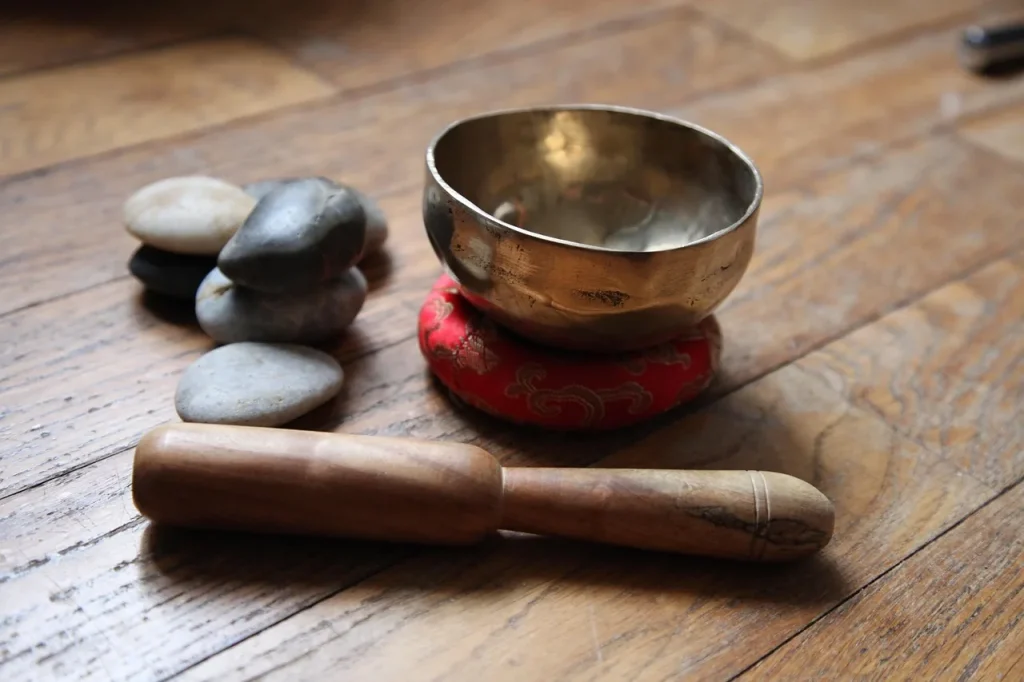
Goal: this article offers a practical path to understanding chakras and learning to use a singing bowl in everyday life.
The singing bowl is a traditional Himalayan musical instrument. It is used in meditation, sound massage and sound baths to help manage stress and regain focus.
We will explain the basics of the energy model, the bowl’s origins and materials, and how to choose one that suits your body and preferences.
Context: chakras are a model drawn from yoga and other traditions. This article is informational and makes no medical claims.
What you will learn: you will gain clear guidance on choosing a suitable bowl, practising safely and creating simple sessions at home.
This page is for curious beginners and practitioners who want to give their practice more structure and make it part of daily life.
To explore how musical notes are associated with energy centres, see this detailed resource on the correspondences.
Understanding chakras and the role of singing bowls
Energy centres, described from root to crown, provide a map for guiding sound practice.
The seven main chakras and their energetic roles
Overview: Muladhara (grounding), Svadhisthana (creativity), Manipura (willpower), Anahata (heart), Vishuddha (expression), Ajna (intuition), Sahasrara (consciousness).
This traditional model suggests areas of focus for a session. It is no substitute for medical advice.
Why sound vibrations can affect how the body feels
A Tibetan singing bowl produces harmonics that can be felt through the body. Its vibrations may support relaxation, breathing and renewed focus.
For example, using the note D for the sacral chakra can help you focus your practice on that area.
Use and context: Tibetan bowls, also called singing bowls, are Himalayan musical instruments used in individual or group sessions to encourage concentration.
Reported effects: calm, reduced tension and a clearer sense of inner space. These effects are subjective and differ from person to person.
For more on the associations between notes and energy centres, consult this resource on the correspondences.
Origins, materials and making of Tibetan singing bowls
Singing bowls come from a long tradition of craftsmanship in the Himalayan region. They are associated with Tibet, Nepal and Bhutan, where their use is linked to meditative rituals and the passing down of skills within families.

Alloy and symbolism: a traditional bowl often contains an alloy of seven metals. These metals—gold, silver, iron, mercury, tin, copper and lead—are associated with celestial bodies and contribute to the bowl’s range of harmonics.
Hammering and sound characteristics: hand-hammered bowls have visible marks and a warm tone rich in overtones. Small bowls sound higher; large ones sound lower. Wall thickness affects the response: thin walls give a quick attack, while thick walls sustain the resonance longer.
Machine-made brass or aluminium bowls offer precise tuning. Moulded quartz crystal bowls produce a very pure note, useful for focused work within this energy model.
Practical choice: choose according to your intended use (meditation, sound massage or a sound journey). Consider the tone you like, how easy the bowl is to carry and any engraved symbols that add spiritual meaning for you.
How to choose a Tibetan singing bowl that suits your needs
Choosing a bowl means listening to its sound as well as considering its size. First define your intention: grounding, creativity or a heightened sense of awareness.
Size, thickness and pitch
Small bowls produce high notes. They suit work focused on the upper chakras, such as the third eye and crown.
Large bowls produce low, deep tones. They are better suited to grounding and the sacral chakra. Thickness changes the attack and the length of the resonance.
Musical notes: from C to B
Each note can guide the practice: C for the root, D for the sacral chakra, E for the solar plexus, F for the heart, G for the throat, A for intuition and B for the crown.
Try several notes: what you hear and feel matters most.
432 Hz or 440 Hz
440 Hz is the modern tuning standard. Some people prefer 432 Hz because it feels more “natural” to them. There is no scientific evidence supporting that preference; choose what appeals to you.
Materials and how to try a bowl
Metal (a metal alloy) offers rich harmonics. Quartz produces a pure, steady note.
- Listen to how the sound builds and how long it lasts.
- Strike the bowl, then make it sing with different mallets.
- Feel the vibration in your hand and body.
Let the bowl call to you: if an instrument consistently makes you feel calm, it may be a good choice. Also consider its weight, diameter and portability for everyday use.
Essential accessories: wooden stick, mallet and cushion
A good stick and a suitable mallet bring out the range of sounds your singing bowl can make.
Differences in sound: a wooden stick produces a crisp attack and clear harmonics (yang energy). A suede or felt mallet gives a rounder, deeper, more enveloping sound (yin energy).
Grip and striking: hold the mallet near its end and keep your wrist relaxed. Strike close to the rim for a clear sound. Keep the fingers of the hand holding the bowl away from the rim so they do not dampen the vibration.
| Item | Effect on sound | Suggested use |
|---|---|---|
| Wooden stick | Clear, high-pitched attack | Cues, transitions and penetrating notes |
| Suede mallet | Round tone and deep bass | Relaxation and sound baths |
| Cushion (ring, disc or square) | Stability and isolation | Improves resonance and sound projection |
Choose a mallet at least as long as the bowl’s diameter; an unsuitable size can reduce sound projection and quality.
Try several combinations of sticks and mallets to explore the bowl’s sound. If you want to buy an instrument, browse the selection in this shop.
Using a singing bowl: striking it and making it sing
Learning to make a bowl sing starts with simple movements. Combine striking and rubbing to produce a stable, rich tone. Both methods can be used for meditation or a sound bath.

Controlled striking for a clear, even sound
Choose a mallet suited to the size of the bowl. Strike gently and consistently near the rim to produce a repeatable sound.
Let the sound fade before striking again. This prevents the tone from becoming overloaded and keeps the vibrations clear.
Circular rubbing for a deep, sustained tone
Angle the stick by about 20 to 30 degrees, apply even pressure and maintain a steady speed. Start with the wooden side, then try the suede for a more enveloping tone.
Adjust the pressure if the bowl “screams.” Building the volume gradually prevents breaks in the sound and lets the instrument sing gently.
Body position and bowl placement for meditation
Sit steadily and breathe calmly. Hold the bowl in your hand or place it on a cushion, depending on the setting and length of the session.
Place the bowl beside you for a more diffuse listening experience, or move around another person to spread the vibrations around their body.
- Mini ritual: begin with three gentle strikes, follow with one or two cycles of rubbing, pause, then listen attentively.
- Vary the stick or mallet, where you strike and your speed to find the bowl’s singing point.
- Notice the effect: relaxed shoulders and deeper breathing are useful signs.
Guide to chakras and Tibetan singing bowls: a step-by-step practice
Before you begin, create a calm setting where the bowl’s sound can unfold without interruption. Turn off your phone, dim the lights and set a clear intention: grounding, openness of the heart or mental clarity.

Prepare the space, set an intention and breathe
Take three slow breaths to settle yourself. Position the Tibetan singing bowl according to the area you want to focus on: between your thighs for the root, in front of your solar plexus or near your head for the upper chakras.
Move upward: from root to crown
Move from the root chakra up to the crown, choosing a suitable note (from C to B) or a bowl size that feels right to you. Focus on each point in ascending order to follow the model’s energetic progression.
Duration, listening to resonance and progressing
Aim for one to three minutes for each chakra. Listen to how the sound resonates in your body and spend longer on an area that seems to “call” for attention. Shorten the session if your attention wanders.
Choose the stick or mallet to suit your goal
Use the mallet to create an enveloping sound for the heart and solar plexus. Use the wooden stick to mark a transition or produce a clearer attack, particularly when focusing on the throat.
- Take care near the head: keep the volume moderate when working with the upper chakras.
- Suggested starting pace: once or twice a week.
- Closing: make one gentle strike, sit quietly for a moment, then take an energising breath to return to the present.
Tip: keep a session journal to record your sensations, responsive areas and how they change. This can help you refine your method and your use of the Tibetan singing bowl.
Meditation, sound baths and sound massage: deepening your practice
Sound practice can be simple or expansive, depending on your intention. One bowl supports concentration; a group of singing bowls creates an evolving harmonic soundscape.
Meditation: while seated, place the Tibetan singing bowl beside you and play it gently. Repetition can help steady your breathing and attention.

Sound bath: play around the body without making contact. Letting the vibrations surround the person can encourage muscle relaxation and deeper breathing.
Sound massage: place a bowl on a stable area (back, feet or abdomen). Support it if necessary, then strike it or make it sing with a suitable mallet.
| Format | Effect | Practical advice |
|---|---|---|
| One bowl | Focus and simplicity | Ideal for a short meditation |
| Several bowls | Rich soundscape | Move gradually between notes |
| Sound massage | Localised contact | Keep the bowl stable and the volume moderate |
Precautions: keep the volume moderate near the head, avoid painful areas and check that the person is comfortable. Never place a bowl upside down on someone’s head.
For an example session and practical resources, see a sample session.
How often to practise and what you may feel over time
How often you practise affects how you experience the vibrations. Start modestly: 10 to 20 minutes, two or three times a week. This gives you a basis for noticing early signs of relaxation.
Consistency and observation
After a few weeks, some people notice that they relax more quickly and find it easier to stay present. A sense of harmony may develop gradually and differs from person to person.
Listen to your body and make adjustments
Listen to your body: take a break if you feel tired, or continue a little longer if the session feels comfortable. Never force the volume or duration.
- A journal lets you record what you feel, along with the time, tools and length of each session.
- A Tibetan singing bowl can accompany yoga, breathing exercises or mindful walking.
- Keep a flexible rhythm: practise more during stressful periods and ease back when you feel balanced.
Practical advice: adjust the pace according to how you feel. For instrument ideas and offers, browse a practical selection related to this article.
Care, respect for the instrument and mistakes to avoid
Cleaning, protection and symbolic charging in sunlight
Clean the bowl with a slightly damp cloth. Avoid immersing it, as the metal may rust.
White vinegar or lemon can be used, but only sparingly. Rinse and dry the bowl immediately.
Store it on a stable cushion in a dry place with a moderate temperature, away from table edges.
Gentle sunlight may be used to symbolically “recharge” the Tibetan singing bowl. Avoid overheating it.
Preventing falls, rust and changes in sound
Handle large bowls with both hands. Check that they are stable before each strike, especially during a massage.
A fall can cause a crack that permanently changes the bowl’s sound. If its sound is damaged, it may be time to stop using it.
Play the instrument regularly to maintain its patina and familiar sound.
| Risk | Prevention | Consequence |
|---|---|---|
| Fall | Use both hands, a cushion and a secure position | Crack or uneven sound |
| Rust | Wipe clean, store dry and avoid immersion | Metal damage and corrosion |
| Excessive volume | Keep the sound moderate and take regular pauses | Listening discomfort and ear fatigue |
Conclusion
Using a singing bowl can become a practical way to create moments of calm.
Remember the essentials: understand the energy-centre model, choose a Tibetan singing bowl by its size, material and note, then learn to make it sing gently and regularly.
To refine your practice, alternate between singing bowls, sticks and mallets. Explore striking and rubbing over time to enrich the experience.
Keep safety in mind: use a moderate volume near the head, hold the bowl securely and care for it simply and regularly. Adjust how often you practise according to how you feel.
For more on using the bowl in daily life, consult this practical resource on using a singing bowl. The best way to use it is one that calms you and fits naturally into your life.