
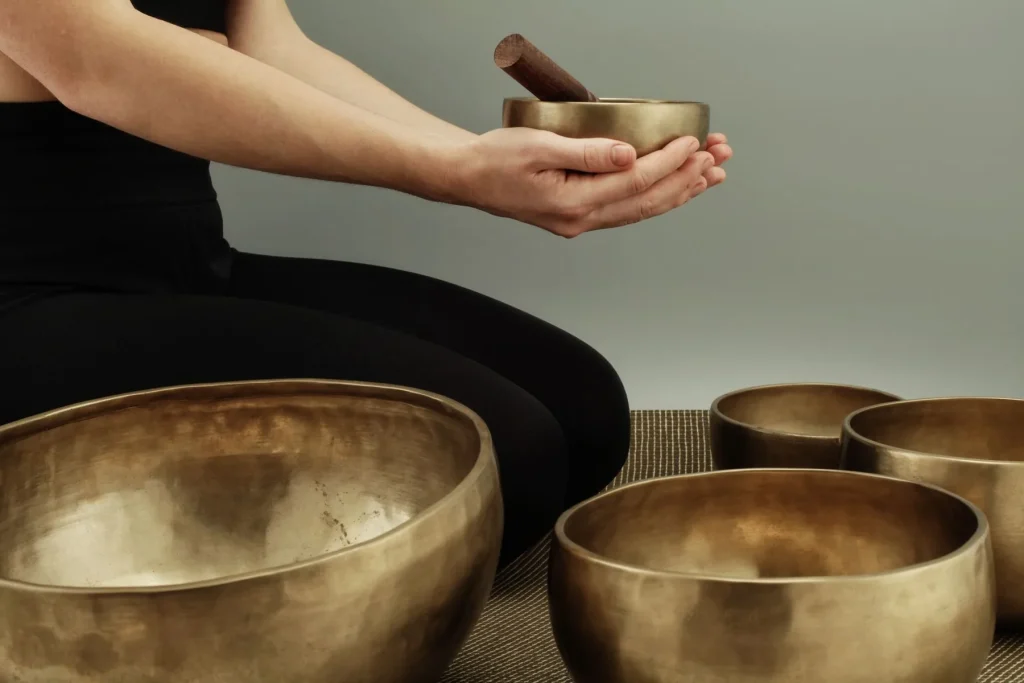
A step-by-step guide to your first Tibetan singing bowl sound bath, at home or with a practitioner. This guide focuses on safety, effectiveness and enjoyment.
What is a singing bowl sound bath? It is an immersion in sounds and vibrations that encourages relaxation of the body and mind. The experience can help reduce stress and may improve sleep.
This guide is for curious beginners, meditation practitioners, yoga teachers and wellness therapists. You will learn to choose a bowl, prepare your space and use striking and rubbing techniques for a 10- to 15-minute session.
A practical approach: ready-to-use sequences, precautions and checklists to help you avoid common mistakes. Every bowl responds differently; this guide gives your practice structure while leaving room to listen.
The content draws on practical experience and research into sound therapy. To learn more about choosing a bowl, see this practical guide to singing bowls.
Why take a sound bath today: goals, benefits and setting
Amid the pace of urban life, using a bowl offers an accessible way to pause and regulate your emotional state.
The goals are clear: managing stress, returning to mental calm, supporting sleep and feeling grounded through vibrations. A short session may be enough to notice immediate benefits.
Setting: choose a dedicated time, reduce distractions and keep the sound at a moderate level, increasing the volume gradually.
- Start with 10 to 15 minutes and a single bowl so you can pay attention to how you feel.
- Set a simple intention: relaxation or renewed focus.
- Avoid overload: use combinations of Tibetan bowls, crystal bowls, gongs and tuning forks sparingly.
Preliminary studies report reduced stress and improved sleep in some people. These effects are complementary to medical care and do not replace treatment.
In practice, simplicity is an advantage: one singing bowl is enough to create a calm inner space for meditation and deep relaxation.
Understanding sound therapy and Tibetan singing bowls
Understanding how sound works helps you choose and use a bowl. Sound therapy uses sounds and vibrations to encourage relaxation and a sense of balance in the body and mind.
When a bowl vibrates, it emits waves that travel through the air and through bodily tissues. A little water in the bowl makes patterns visible on its surface, illustrating how the vibrations spread in three dimensions.
Effects on the brain and vibrational “massage”
Listening to a continuous, soft and steady sound may encourage a shift toward alpha rhythms, associated with calm and awareness. Holding the bowl on an open palm also lets you feel its tangible vibrational massage.
Metal and crystal: the reality of alloys
Metal instruments produce warm, rich overtones. Crystal bowls produce a purer, more clearly defined frequency. The two types work well together in practice.
Tradition often mentions seven metals, but bowls made with alloys of 5, 7 or 12 metals are sold today. Prioritize sound quality and transparency over marketing claims about where or when a bowl was made.
“Listening for a clear fundamental tone, rich overtones and a long resonance remains the best way to assess a bowl.”

| Criterion | Metal | Crystal |
|---|---|---|
| Overtones | Rich, warm | Precise, pure |
| Tactile sensation | Deep vibration | More distinct vibration |
| Recommended use | Versatile sessions | Targeted addition |
- Function: opening your awareness to sound and adjusting volume.
- Techniques: striking and rubbing, depending on the desired effect.
- Choosing a bowl: check its fundamental tone, overtones and resonance time before buying.
Choosing a Tibetan singing bowl: metal or crystal, size, pitch and accessories
Your choice of bowl directly affects sound quality, vibration and how it feels in your body. Before buying, listen to the instrument and hold it. Try metal and crystal bowls to compare the warmth and clarity of their sounds.
Metal and crystal bowls: sounds, sensations and uses
Metal bowls offer rich overtones and a strong tactile vibration. They are well suited to deep vibrational massage.
Crystal bowls produce a clear sound and pure frequencies. They suit distinct sonic accents and layered sounds.
Size, note and resonance: matching bowls to areas of the body and chakras
Practical criteria include diameter, thickness, main note, resonance time and the absence of unwanted buzzing. A large bowl produces lower sounds that may be felt in the torso.
Medium bowls are versatile; small ones can be used near the head or extremities. In practice, place a low-pitched bowl near the pelvis, a midrange bowl near the solar plexus and a high-pitched bowl near the throat, then adjust their positions according to the recipient’s response.
Mallets, rubbing sticks and cushions: essentials for steady practice
- Felt mallet: for a gentle strike.
- Suede-covered stick: for steady rubbing without an overpowering sound.
- Ring cushion: stabilizes the bowl while allowing it to resonate.
A suggested minimum starter set is a versatile 20 to 24 cm Tibetan bowl, a suede-covered stick, a medium felt mallet and a small cushion. Later, try a second instrument with a lower or higher pitch.
Technique tip: for a continuous, controlled sound, favor steady pressure over speed when rubbing the bowl. Record short attempts to train your ear.
For more on choosing and using a bowl, see our practical guide to singing bowls.
Preparing your space and body for a successful sound bath
Preparation helps you become fully present. Choose a quiet room with dim lighting and a stable temperature. Close doors and windows, turn off notifications and allow time to settle in.

Atmosphere, quiet and safety
Conditions: soft light, a comfortable temperature and clear space to move around. Place each bowl on a stable support so it cannot tip over.
Safety: avoid slippery surfaces and hazardous corners. Let anyone nearby who may be sensitive to sound know what you plan to do, and tell neighbors if necessary. Consider children and animals, and choose a quiet time.
Posture, breathing and intention
Lie on your back with a cushion beneath your knees, or sit on a zafu. Relax your shoulders and jaw.
Begin with 1 to 2 minutes of slow breathing through your nose. Set a simple intention, such as rest or clarity.
Building the sound and placing the bowls
Start gradually: make the first sound quietly and raise the volume slightly if you feel comfortable. Lower it immediately if you feel discomfort.
If you are practicing alone, place one bowl near your feet, another near your pelvis, one near your solar plexus and another at a distance to one side of your head. Adjust their positions according to how you feel.
| Element | Advice | Why |
|---|---|---|
| Room | Quiet, with dim lighting | Encourages relaxation |
| Posture | Lying down or seated | Reduces tension |
| Volume | Increase gradually | Prevents the sound from becoming overwhelming |
| Placement | Near the feet, pelvis, solar plexus and head | Distributes the vibrations more evenly |
Final ritual: finish preparing with a short guided meditation focused on listening. Bring your attention to your body, then to the temperature of the air, before listening to the bowl’s first sound.
Tibetan singing bowl sound bath: a practical guide
Controlled strikes create a deep, safe space for listening. Here are two key techniques and a short method for a session alone or with another person.

Striking technique: producing vibration without overwhelming the sound
Hold the mallet loosely. Strike the bowl’s side with the mallet at a slight angle.
Use moderate force, then move the mallet away so the resonance can develop. Avoid rapid successive strikes that dampen the sound.
Rubbing technique: rotation, pressure and volume control
Start with a light strike. Hold the stick like a pen and place it against the upper part of the bowl’s outer wall.
Move it slowly around the bowl while maintaining steady pressure. Pressure matters more than speed for a stable volume.
Creating a sound bath for yourself: a simple sequence
Suggested 12-minute sequence: 2 minutes of grounding through breathing, 3 minutes with the sound near the pelvis and solar plexus, 3 minutes near the rib cage and throat, 2 minutes to either side of the head, then 2 minutes of silence to absorb the experience.
Begin with a low-pitched bowl, punctuate the sequence with a midrange bowl and finish with a high-pitched bowl. Leave 10 to 20 seconds between strikes.
Sound massage with another person or a practitioner
Place a small bowl on the stomach or back, using a soft cushion if needed. Check that the person is comfortable and strike the bowl very gently.
Bring a medium bowl near the shoulders to create an enveloping sensation. Be mindful of its weight, avoid sensitive areas and keep checking how the recipient feels.
- Timing: keep a slow pace, with 1 minute of rubbing for each area.
- Precautions: limit the volume and density of sounds, and adapt the practice to any ongoing care.
- Closing: allow 1 to 2 minutes of silence, then briefly note your experience.
A guided session: from welcome to reflection
The session begins with a short conversation to understand expectations, medical history and any possible reasons for caution.
Welcome and brief health history
Ask about sound sensitivity, volume preferences and goals such as rest, renewed focus or stress management.
Explain the role of the instruments and, if needed, ask for consent before placing a bowl on the person’s body.
Placing bowls around and on the body
Begin with 2 to 3 minutes of guided breathing, then arrange bowls around the feet and pelvis.
A suggested progression is pelvis, solar plexus, chest, throat and head, with silent pauses between areas.

Closing, feedback and hydration
Lower the volume and finish with 1 to 2 minutes of silence. Invite the person to move their fingers and toes, then sit up slowly.
Offer them water and suggest a gentle activity later that day, such as walking or recording how they feel in a journal.
Ask briefly about their sense of well-being and suggest an example of an exercise they can practice alone between sessions.
Adapting the practice: meditation, harmonizing and energy work
Music from an instrument can support awareness without becoming a performance. Adapt your intention to the need: rest, renewed focus or care.
Meditation: three simple formats
Focused attention: concentrate on a bowl’s resonance. Follow the sound as it begins and return your attention to it.
Open awareness: let all sounds arise without judgment. Remain aware of your body.
Visualization: imagine sound waves traveling through each area. Let them release tension.
Harmonizing and integrating energy work
For gentle harmonizing, progress from the pelvis toward the head. Strike once or twice near each center and observe the person’s response without forcing anything.
In reiki, make one sound at the beginning to establish the space, one in the middle to renew attention and one at the end to close the session.
| Format | Duration | Intention |
|---|---|---|
| Focused attention | 5 to 15 min | Calm and grounding |
| Open awareness | 10 to 20 min | Broader awareness |
| Visualization | 5 to 12 min | Releasing tension |
A simple method: take six slow breaths, strike the bowl once, listen until the sound fades into silence, then repeat ten times for a session of about 10 minutes.
Precautions: always ask for consent, avoid loud sounds near the head and stop at the first sign of discomfort. After each session, note one dominant sensation, such as warmth, lightness or clarity, to refine your practice.
Reported benefits and effects: what studies and experience suggest
Many people report that listening to a bowl for an extended period quickly settles their thoughts and slows their heart rate.
The best-documented benefits include overall relaxation, less nervousness and, often, better sleep the following night.
Stress, anxiety and sleep
Many describe an immediate effect: deeper breathing, less intrusive thoughts and a clearer state of mind.
For example, after 60 minutes of singing bowls, someone may feel their shoulders relax and find it easier to fall asleep that evening.
Pain and tension
Some people report moderate relief from muscle tension and headaches.
This may be related to relaxation and a shift in attention, as in a targeted sound massage.
What science is still exploring
Studies suggest relaxation of the autonomic nervous system and a possible reduction in cortisol.
However, study samples are small and methods vary. The practice may complement medical care, but it cannot replace treatment.
| Aspect | Observation | Strength of evidence |
|---|---|---|
| Relaxation | Reduced perceived stress | Moderate |
| Sleep | Easier to fall asleep | Preliminary |
| Pain | Mild to moderate relief | Low to moderate |
Key point: acknowledge positive experiences while remaining critical of the evidence. To learn more, see our additional resource.
Precautions, contraindications, cost and places to practice in France
Before booking a session, find out about any limitations or risks related to your health. Some situations call for medical advice.
Situations requiring caution:
- Epilepsy: consult a doctor before exposure to the sound.
- Severe psychiatric conditions: caution and appropriate support are required.
- Hearing implants or cochlear implants: there may be a risk of interference.
- Pregnancy: avoid high volumes, especially during the first trimester, and seek the practitioner’s advice.
Safety rules: monitor volume and duration. Do not place a heavy bowl on the abdomen or rib cage. Allow silent pauses between strikes. Stop if you feel dizzy, nauseated or develop a headache.
Duration and prices in France: sessions generally last 60 to 90 minutes. Typical prices range from €40 to €120, depending on the city and the practitioner’s reputation. Packages for several sessions may be available.
Where to practice: spas, yoga studios, sound therapy practitioners, retreats and workshops. Online sessions can also provide an introduction.
Choose a practitioner who clearly describes their training, has client reviews and follows a defined procedure. To practice at home, begin with short, gentle sessions, keep a journal of how you feel and pay attention to your responses as you develop the practice.
Conclusion
In short, a gradual approach is key to a sustainable, beneficial practice.
Choose a reliable bowl, prepare a quiet space and learn the basic movements: striking, then rubbing. Follow a short 10- to 15-minute sequence and end with silence to absorb the experience.
Possible benefits include feeling calmer, sleeping better and thinking more clearly. Effects vary from person to person, so pay attention to how you feel.
Regularity, gentleness and attentive listening make the difference. Start with one bowl, record your experience and explore harmonizing if it appeals to you.
To explore the subject further, see this practical guide and remain curious and cautious: get training, ask for advice and adapt the practice to your own pace.