
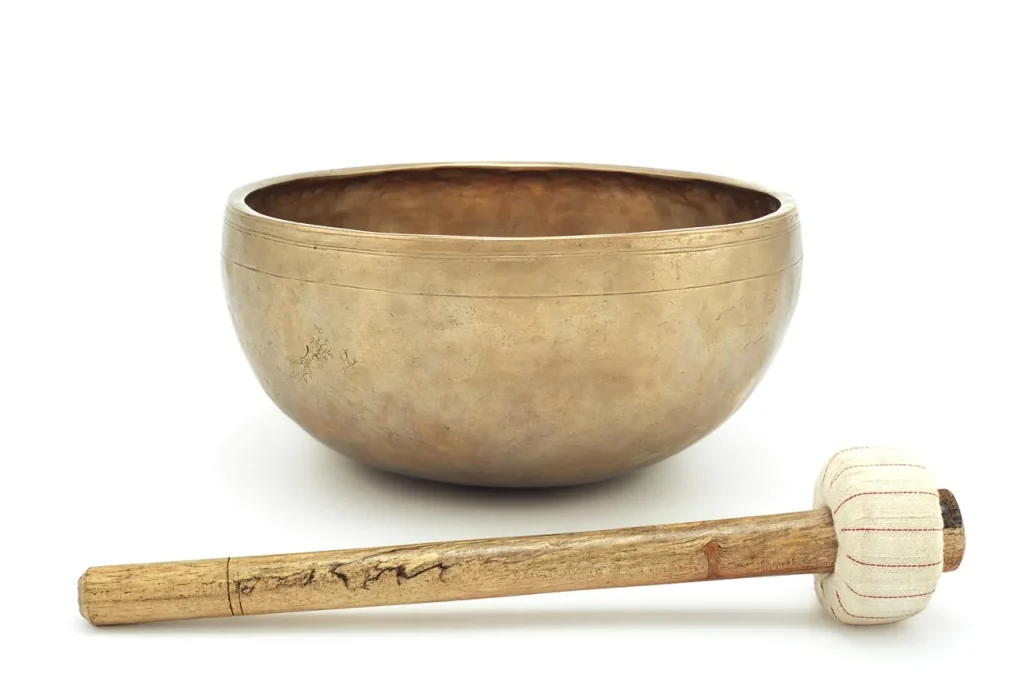
This guide clarifies the myths, history and material reality.
Since the 1960s, the story of the “seven metals” has grown in popularity alongside tourism. Metallurgical studies, however, show that old bowls are mostly made of bell bronze, an alloy of copper and tin.
Our article explains the history, composition and symbolism. It helps distinguish the spiritual significance of the number seven from the instrument’s physical makeup.
We also discuss sound quality and use in meditation, relaxation or music. This approach combines scientific analyses and traditions to help you make an informed choice.
To learn more about the origins of these stories and the tests, read this guide to singing bowls: everything you need to know about singing bowls.
Seven-Metal Tibetan Singing Bowls: Meaning and Benefits — The Ultimate Guide
To understand the subject, let’s first define a singing bowl and clarify the terms used.
Definition, terminology and what this guide covers
Definition: a singing bowl is an inverted metal bell set vibrating by rubbing or striking it. It is used for meditation, relaxation and music.
Terminology: we distinguish “Himalayan singing bowls,” bell bronze (an alloy of copper and tin) and brass. There is also a clear difference between traditional hand forging and modern machining.
- History and origins
- Actual composition and metallurgical tests
- The symbolism of seven and practical uses
Misconception or craft tradition? Setting the context
Many sellers promote the belief that each metal corresponds to a chakra, a note or a celestial body.
Available analyses instead show that most old bowls are bronze: a binary alloy of copper and tin, with at most traces of other elements.
Approach: this article takes neither an aggressively skeptical nor an unquestioning view. It aims to assess the evidence and cultural values clearly.
| Claim | Evidence | What it means when buying |
|---|---|---|
| Seven sacred metals linked to the chakras | Commercial sources; few historical analyses | Prioritize listening and documented composition |
| Old bowls made of pure bronze | Repeated metallurgical analyses | Choose according to the alloy and workmanship |
| Modern mixtures of several metals | Industrial machining and variable test results | Check provenance and test results before buying |
This guide helps you save time, avoid purchases driven by slogans and understand the factors that actually affect sound.
Origins, recent history and the “seven metals” myth
Although the object has existed for centuries, its use as an instrument is largely recent. Tibetan records and accounts by early twentieth-century explorers do not describe singing bowls as musical instruments. They appear more often in culinary or ritual contexts.
From old bowls to the 1960s: changing uses
The first wave of musical popularization dates to the 1960s and is linked to tourism and cultural exchange.
This idea of turning the bowl into an instrument spread quickly in the West. New Age accounts added symbolic interpretations of the metals.
Analyses and regional influences
A 2010 study of more than a hundred pieces from the sixteenth to nineteenth centuries found a composition made almost entirely of bronze, an alloy of copper and tin. Fewer than 2% contained traces of iron; no other metal was confirmed in significant quantities.
Related instruments, such as Japanese and Chinese rin or dobachi, reinforce the “inverted bell” model. Understanding this history helps distinguish the object itself from commercial claims.
What Tibetan singing bowls are actually made of
Metallurgical analyses provide clear figures for the composition of old and modern pieces.
Bell bronze: proportions and acoustic role
Bell bronze is primarily an alloy of copper and tin. The optimal proportions are around 77% copper and 22% tin.
This high tin content is difficult to control during melting. It can, however, improve the timbre and sustain.
Traces of other elements: impurities or deliberate additions?
Analyses sometimes show iron (0.03 to 0.15%) or residues of arsenic and sulfur. These elements are generally impurities with no significant audible effect.
Brass (copper and zinc) appears mainly in modern machined pieces. Its sustain is often shorter and its sound less rich.

Claims about “meteoritic” metal and how to verify them
Claims about meteoritic metal imply the presence of iron, nickel and cobalt. Studies of old bowls have not found significant amounts of nickel or cobalt.
In recent so-called “seven-metal” bowls, copper and tin make up more than 99% of the composition; the other metals occur in very small amounts and are mainly symbolic.
| Alloy | Typical proportions | Effect on sound |
|---|---|---|
| Bell bronze | About 77% copper / 22% tin | Rich timbre, long sustain |
| Modern brass | Copper and zinc (variable proportions) | Shorter sustain, duller sound |
| Trace elements (iron, arsenic, sulfur) | Negligible effect; impurities |
Practical advice: check the alloy and listen to the sound instead of relying on claims about the number of metals. For further reading, see this practical guide to singing bowl metals and their composition.
Seven sacred metals and their symbolism
The number seven holds a place in many symbolic traditions involving celestial bodies, sounds and energy centers.
This framework links seven visible elements to seven planets, seven days and seven notes. It mainly serves as a reference for meditation and ritual music, providing a simple way to set an intention.
Traditional correspondences: chakras, planets, colors and notes
A common symbolic list gives these correspondences:
- Iron — Mars — red — C
- Copper — Venus — green — F
- Tin — Jupiter — blue — A
- Gold — Sun — yellow — E
- Silver — Moon — orange — D
- Mercury — Mercury — light blue — G
- Lead — Saturn — violet — B
Seven days, seven notes, seven celestial bodies: the power of the symbol
These correspondences are often aligned with the chakras, from the root center to the crown center. They can help with visualization and setting an intention during a session.
Putting tradition in perspective: inspiring symbolism, limited metallurgical evidence
Important: historical analyses show that most singing bowls consist mainly of copper and tin. There is no material evidence that all seven metals are systematically present.
| Symbolic use | Benefit | Limitation | Practical advice |
|---|---|---|---|
| Correspondences between planets, notes and metals | Clear framework for meditation | No guarantee about composition | Use them to focus an intention, not as proof of the alloy’s composition |
| Alignment with chakras | Helps concentration | Varies between schools | Adapt it to your experience |
| Musical rituals | Enriches the listening experience | Does not replace careful listening | Prioritize acoustic quality when buying |
Sound, quality and craftsmanship: from alloy to timbre
An instrument’s timbre depends on its alloy as well as its size and construction. Bell bronze (copper and tin) offers rich harmonics, a stable attack and long resonance.
Bell bronze or modern brass
Bronze is valued for the sound quality of musical instruments, particularly bells and gongs. Brass is less expensive and often machined; it produces shorter resonance and a duller timbre.
Size, pitch and harmonic richness
The size of the bowl determines its pitch: a large bowl produces a low sound, while a small bowl produces a high one. Its mass and thickness affect projection and the stability of the fundamental note.
Handcrafting and machining — signs and effects
Handcrafting leaves hammer marks and slight irregularities that give the sound a distinctive character. A machined bowl has perfect symmetry, a central hole and a uniform surface.
“Test the attack, rim rubbing and sustain: a good alloy can be recognized by the absence of buzzing.”
- Listen to the mallet’s attack, the sustain and the beating between tones.
- Choose a mallet (wood, felt or leather) and a support (ring or cushion) to bring out the timbre.

| Characteristic | Bronze | Brass |
|---|---|---|
| Sustain | Long | Short |
| Timbre | Rich | Duller |
| Manufacture | Often handcrafted | Commonly machined |
Choosing and using a singing bowl today
Choosing an instrument starts with listening to it rather than trusting labels. Prioritize sound quality and provenance over unverified promises.
Buying criteria
Listen to several models at a specialist seller. Test the stability of the fundamental note, the richness of the harmonics and the length of the resonance.
Check the alloy and provenance. Favor an alloy of copper and tin when the composition is stated. Be wary of descriptions that cannot be substantiated.
Choose within your budget: size, finish and handwork affect the price. Good sound for the price is worth more than an empty label.
Common uses
For meditation and relaxation, choose low tones with long resonance. For ensemble music, look for a stable note and a complementary timbre.
Products intended for ritual use may be chosen for their symbolism, but test the instrument before buying to see how it feels to you.
Care and good practice
Select mallets of different hardness to vary the attack and warmth of the sound. Use a support that does not muffle the vibration.
Clean the bowl gently, without abrasives. Store it away from knocks, on a cushion or flat surface, to protect its rim. Avoid dropping it, as this can crack the bronze.
“Test the attack, rim rubbing and sustain: let your ear decide.”

Develop a regular practice: control the rim rubbing, adjust the angle and pressure, and synchronize your breathing during meditation. Ultimately, your personal connection with the sound remains decisive when choosing Tibetan singing bowls.
Safety, health and checking the composition
Health is not automatically a cause for alarm, but simple precautions are advisable. In most cases, analyses mainly find copper and tin, the two dominant metals that determine the sound.
Lead and mercury: traces, risks and precautions
If lead or mercury is detected, it is almost always present only in traces. The amounts found are generally too low to cause poisoning during normal use.
However, some people develop a skin reaction to copper or tin. If irritation occurs, consult a healthcare professional and stop direct contact.
Can you verify the presence of all seven metals?
Laboratory analyses and nondestructive spectrometers are available, but they remain expensive. Portable instruments sometimes give ambiguous results for elements present at very low concentrations.
For buyers, researching the seller and listening to the bowl remain practical steps: choose reputable sellers, request audio samples and ask for details about the products’ origins. To learn more, read this practical guide.

In practice, avoid knocks, hold the instrument by its base and use suitable mallets to protect the metal. Simple care extends its life: a well-treated bowl can last for generations.
Conclusion
To recap: sound quality depends first on a well-made alloy and skilled craftsmanship. Old bowls are mostly made of bronze (an alloy of copper and tin), which accounts for their sustain and rich harmonics.
The symbolism of the “seven metals” can enrich your practice, but it does not replace examining the composition or listening carefully. When choosing, rely on note stability, timbre and the maker’s reputation.
Simple care, careful handling and good accessories extend the instrument’s life. If you are sensitive to metal, choose suitable alternatives.
For more information, read the practical guide everything you need to know about Tibetan singing bowls. In the end, the right bowl is one that resonates with you, technically and personally.