
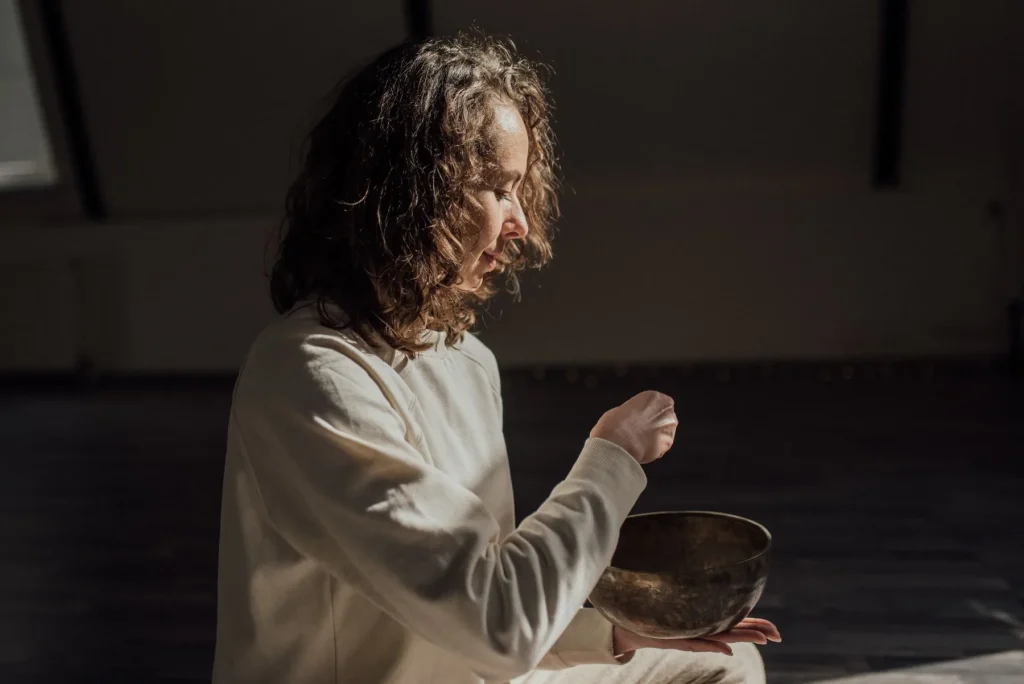
This guide explores the true significance of vibrations and explains how they influence your inner state. Singing bowls come from a Himalayan craft tradition. Their sound encourages relaxation, energetic balance and alignment.
Here, we connect engravings, materials and practice to offer an understanding useful to beginners and practitioners alike. You will discover how engraved symbols can act as catalysts for intention.
A bowl’s vibrational signature arises from a precise alloy and skilled craftsmanship. Each singing bowl has a unique resonance that shapes meditation and healing.
This first section introduces the topics covered: history, alloys, key symbols, connections with chakras and rituals. To learn more, read a detailed article on symbols and their meanings.
Introduction to the ultimate guide: Tibetan singing bowls, sounds, symbols and practice
This guide places Tibetan singing bowls at the intersection of history, practice and inner listening.
These instruments have existed for more than 5,000 years. They passed from shamanic rites into the traditions of Tibet and Nepal. Today, they are used for relaxation, meditation and sound therapy.
Hand hammering gives each bowl a unique sonic character. This individuality produces vibrations that calm the mind and influence emotions.
Here, readers will find the origins and making of bowls, their main symbols, chakra correspondences, rituals and selection criteria. The approach combines theory and application to improve everyday life.
As you read, you will learn to incorporate these bowls into your routine. By the end, you will know how to choose a suitable Tibetan bowl and make the most of your practice.
Origins, craftsmanship and metal alloys: the foundations of sound and quality
An instrument’s sound quality depends as much on its material as on the hands that shape it. The history links early bowls to shamanic practices and then to their adoption by Buddhist traditions, where they became ritual and musical tools.
The seven metal alloy and planetary correspondences
Bowls are often said to contain a traditional alloy: copper (Venus), tin (Jupiter), iron (Mars), mercury (Mercury), silver (Moon), lead (Saturn) and gold (Sun).
Each metal colors the tone: silver brings clarity, copper warmth, gold brightness, while lead stabilizes the sound’s sustain.
Traditional forging, Full Moon bowls and their influence on vibrations
Hand hammering requires precise adjustments. The thickness, rim and diameter determine the fundamental note and partial harmonics.
The Full Moon practice adds a ritual dimension: the bowl is forged at night under a bright moon that, according to artisans, impresses an intention upon it and influences its harmonic richness.
- Signs of authenticity: tiny hammer marks and a natural patina.
- Effect on sound: the alloy and thickness affect sustain, projection and vibrational stability.
Conclusion: quality sound results from the combination of history, metals, the artisan’s hand and the forging method.
Why are there symbols on a Tibetan singing bowl? Energy, Buddhism and ritual purpose
Engravings guide the practitioner’s intention and turn the object into an energetic tool.
Energetic connections and amplification: the motifs are more than decoration. They serve to channel energy and strengthen vibrations when the bowl sounds.
Visually focusing on a symbol amplifies the effect of the sound. Sustained attention acts like a mental resonator. The mind recenters, and concentration deepens.
Ritual transmission and protection
In Buddhism, some signs convey values such as compassion, wisdom and nonattachment. They accompany practice and protect the ritual space.
- Purification: cleanses the space through intention and resonance.
- Harmonization: aligns the energy of the place and body.
- Meditative support: helps steady attention.

| Function | Effect | Choice |
|---|---|---|
| Channel energy | Amplification of vibrations | A motif aligned with the intention |
| Teaching | Transmission of values (compassion) | A familiar Buddhist symbol |
| Protection | Ritual stability | Double dorje or parasol |
The variety of engravings reflects local traditions and the artisan’s sensibility. Choose a symbol that resonates with your intention to encourage calm, focus and a greater sense of presence.
To learn more about symbols and their meanings, follow this link.
Meaning of Tibetan singing bowl sounds: vibrations, states of consciousness and well-being
When a bowl vibrates, it creates a soundscape that encourages deep, steady listening.
From sound to inner state: relaxation, balance and harmony
Vibrations travel through the body and help structure attention. They encourage a meditative state by supporting parasympathetic relaxation.
The effects on well-being are tangible: less stress, a calmer nervous system and better sleep. The heart finds an emotional coherence that makes openness and gentleness easier.
Physical relaxation follows: muscles release, breathing slows and the body relaxes overall. Long harmonics heighten the sense of harmony as frequencies overlap.
- Chakras: resonance supports energy work and balance among the centers.
- Healing: emotional rebalancing and mental clarity.
- Practice: intention + active listening = transformation.
Regular, mindful listening reinforces these benefits. In short, a simple singing bowl practice encourages relaxation, balance and emotional integration.
Main engraved symbols and their spiritual meanings
Each symbol engraved on an instrument has meaning for meditation. These motifs provide a visual vocabulary that supports intentions such as compassion, protection and awakening.

Om Mani Padme Hum
Om Mani Padme Hum associates each syllable with inner work. Linked to Avalokiteshvara, it invites compassion and the purification of karma.
Reciting this mantra steadies the heart and clarifies intention during a singing bowl session.
Double dorje (vajra)
The double dorje symbolizes indestructibility and the union of wisdom and compassion.
Practice: it encourages mental stability and supports meditation focused on inner strength.
Lotus and Shou Lotus
The lotus evokes purity and awakening: it grows in mud and blooms unblemished.
The Shou Lotus adds the idea of longevity and prosperity in spiritual life.
Buddha’s eyes
The eyes represent penetrating vision and an enduring awakened presence.
They encourage sustained attention and kindness in daily practice.
Flower of Life
This sacred geometry evokes creation, interconnectedness and protection.
Combined with sound, it encourages balance and energetic transformation.
Endless knot
A symbol of interdependence and eternity, it recalls continuity and resilience.
It encourages nonattachment and a deep understanding of the relationship between causes and effects.
Eight Auspicious Symbols
Ashtamangala: conch shell, dharma wheel, victory banner, parasol, golden fish, treasure vase, lotus and endless knot.
Each element contributes to a spiritual message of victory, protection, abundance and teaching.
Deities and the five Dhyani Buddhas
Their images provide a focus for transforming emotions into awakened qualities.
They guide emotional transformation through practice and listening to sound.
Tibetan script and healing mantras
Inscriptions of mantras (Tara, Medicine Buddha, Vajrasattva) are intended for protection, healing and purification.
“Sound, symbol and intention form a trio that guides inner transformation.”
Tip: choose an engraving that reflects your intention—compassion, protection, purification or awakening—to strengthen the harmony between image, sound and practice.
| Symbol | Meaning | Practical use |
|---|---|---|
| Om Mani Padme Hum | Compassion, purification | Recitation while the bowl resonates |
| Double dorje | Strength, stability, union | Grounding meditation |
| Lotus / Shou Lotus | Purity, longevity, awakening | An intention of awakening and prosperity |
| Buddha’s eyes | Penetrating vision, presence | Concentration and compassion |
To explore how to choose an instrument and its engravings, read a complete guide to singing bowls.
Sounds, chakras and musical notes: energetic alignment with a bowl
A given frequency resonates in an area of the body and encourages balance in its associated center. Understanding these correspondences helps you choose an instrument for a focused session.
Traditional correspondences and ascending progression
Principle: each chakra corresponds to a note, a color and an area of the body. For example, C is often associated with Muladhara (the root chakra) for grounding.
The progression follows an axis: from the base to the crown, the notes rise and support energetic opening.
Tuned crystal bowls: precision and intention

Quartz crystal bowls can be tuned to a precise note. Sometimes they carry the color and symbol of the targeted chakra.
Advantages: greater precision, consistency with musical and intention-based practice, and clear harmonics.
- Color & body area: Muladhara/C, red/grounding; Svadhisthana/D, orange/creativity; Manipura/E, yellow/willpower; Anahata/F, green/heart; Vishuddha/G, blue/expression; Ajna/A, indigo/intuition; Sahasrara/B, violet/consciousness.
- The note’s vibrations stimulate the targeted center to restore balance and the flow of energy.
- Testing how the sound resonates with your body helps you sense which areas vibrate and which notes aid meditation.
Intentional practice: choose a color and note according to your aim (grounding, opening the heart or clarity). Combine listening, deep breathing and visualization of the corresponding color to strengthen the effect.
Complementary qualities: metal bowls offer harmonic richness and warmth. Crystal bowls bring precision and purity. Used together, they create a sound journey through all the centers.
Meditative practice and sound therapy: combining symbols, mantras and resonance
A simple ritual combines the visual, vibration and intention to begin the practice.

Begin by looking closely at the engraving. Let the motif steady your attention and prepare your mind for meditation.
A guided ritual in four steps
- Observation: look calmly at the symbol to ground your intention.
- Making it vibrate: play the bowl with a mallet; adjust the pressure and speed until you hear a clear, lasting sound.
- Recitation: choose a mantra (for example, Om Mani Padme Hum, Vajrasattva or Medicine Buddha) and chant it in harmony with the sound.
- Integration: remain silent and breathe mindfully to let the effect spread through the body.
Visual focus acts as an energy amplifier. It anchors attention and limits wandering thoughts.
To make a singing bowl sing, rub its rim slowly with the mallet, then increase your speed until the note steadies. Adjust the pressure to control the volume, and listen as the sound fades.
“Holding the instrument, listening to its harmonics and breathing is like a dialogue with your inner world.”
| Step | Action | Purpose |
|---|---|---|
| Observation | Focus on the symbol for 1 to 2 minutes | Ground your intention |
| Making it vibrate | Sound the bowl for 3 to 5 cycles | Enter into resonance |
| Recitation | Choose a mantra suited to your aim | Strengthen the energy |
| Integration | Remain silent for 2 to 10 minutes | Let the experience settle |
Practical tips: hold the bowl in your hand if that feels comfortable so you can sense the vibrations. Adapt the duration to your schedule: a short daily practice or a longer sound therapy session.
To explore a range of instruments and accessories, browse a selection of singing bowls.
Regularity, a clear intention and listening to your heart guide the experience and help you notice its effects over time.
Choosing an engraved Tibetan singing bowl for your intention and lifestyle
A lasting choice comes from the match between your aim and the object’s resonance.
First, define your intention: compassion, protection or transformation. Then look for engravings that support it: mantras for compassion, a dorje for stability or a lotus for awakening.
Authenticity: favor hand craftsmanship, a traditional alloy and careful finishing. Be wary of unusually low prices, which often conceal industrial production.
Sound quality and construction
Test the sound: how long it resonates, the richness of its harmonics and the gentleness of its initial tone. Thickness and diameter affect the note, projection and intended use (meditation or therapeutic work).
Check for rough welds and examine the engraved lines: slight irregularities can indicate an artisan’s work.
Essential accessories
Choose a suitable mallet (wood, leather or felt). A stable cushion supports the bowl and preserves the quality of its vibrations. A suction cup may make circular playing easier.
“Test it, feel it and record your impressions to make an informed choice.”
| Criterion | What to check | Impact |
|---|---|---|
| Intention | A fitting symbol (mantra, lotus, dorje) | Strengthens meditative practice |
| Authenticity | Hand craftsmanship, traditional alloy | Durability and energetic value |
| Sound | Long resonance, rich harmonics, gentle initial tone | Greater effectiveness for therapeutic work and meditation |
| Construction | Suitable thickness and diameter | Fundamental note and projection |
| Accessories | Mallet, cushion, optional suction cup | Stability and ease of use |
Practical tip: before buying, test how the sound resonates in your body and note how you feel. For a detailed buying guide, read a page about choosing a bowl.
Care, purification and everyday energetic transformation
A short, respectful ritual preserves the instrument’s sound quality and energetic clarity.
Physical cleaning and purification
Wipe the bowl regularly with a soft, dry cloth to remove dust. Dry it after any contact with moisture to preserve its patina and surface.
To purify the space and the object, make the bowl sing slowly: a few gentle cycles are enough to clarify the atmosphere and your intention.
- Complement this ritual with white sage or palo santo for combined purification.
- Renew your intention before use: gratitude and respect deepen the purification.
To recharge stones or jewelry, place them in the bowl, then sound it gently and gradually. Notice bodily sensations as a sign of renewed clarity.
| Action | Frequency | Effect |
|---|---|---|
| Dusting with a cloth | Weekly | Preserves the surface and sound |
| Sound purification | Before or after a session | Clarifies the space and object |
| Sage / palo santo | As needed or according to the lunar cycle | Strengthens purification |
| Recharging minerals | After intensive use | Restores the stones’ energy |
Recommended short ritual: clean the bowl, sound it for 3 cycles and take a moment to express gratitude. Adapt the frequency to your lifestyle and the phases of the moon to encourage transformation and well-being.
Conclusion
At the end of this journey, consider each instrument a companion along the way.
In summary: Buddhist symbolism, craftsmanship, the seven metal alloy, meditative practices and sound therapy form a useful whole for everyday life.
Choosing a quality handmade Tibetan singing bowl gives you a reliable vibrational signature and supports lasting practice. Aligning intention, symbol and practice encourages harmony among the chakras, body and mind.
The benefits are tangible: relaxation, renewed focus and a stronger sense of presence over time. Experiment, listen to how you feel, and maintain and purify the instrument regularly.
In conclusion: follow this simple, patient path; each singing bowl can become a sound guide that encourages balance, transformation and a love of practice.