

Introduction — This guide offers a clear overview of Tibetan singing bowls, from their distant origins to manufacturing techniques and the metals used. It aims to help readers understand the instrument and make informed choices.
The first singing bowls appeared more than 5,000 years ago on the Mongolian steppes. They developed from hammered copper household bowls whose vibrations soon caught the attention of shamans.
Gradually, domestic use gave way to ritual use in the Himalayas, followed by worldwide use in meditation, yoga and sound healing. We also explain the two main production methods: hand hammering and casting.
This article examines metal composition, the effect of finishes on sound, and the quality criteria that matter to enthusiasts and practitioners. It draws on information from workshops in Kathmandu and Patan to illuminate the craft tradition.
For more technical and historical background, see the entry on singing bowls. This article can be read from start to finish or consulted as needed.
The ultimate guide to Tibetan singing bowls: overview, aims and what this guide offers
Understanding the Tibetan singing bowl calls for knowledge of its history and construction, as well as attentive listening: this guide brings those elements together to turn curiosity into practical knowledge.
Our aim is to offer a clear, complete account, from history to practical use, to help readers choose an instrument and make it sing.
- historical and spiritual origins
- alloys, shapes and finishes
- handworking techniques and casting
- quality criteria, artisans and ethics
- use, care and listening cues
This article is for meditation practitioners, music and percussion enthusiasts, sound therapists, and teachers who want to introduce the instrument into their teaching.
“We offer technical and sensory cues for assessing sound quality beyond appearance.”
The approach is educational: turning technical vocabulary into practical steps for everyday use. Examples show when hand hammering or casting may better suit the intended use.
Finally, this article includes field information gathered from Himalayan workshops to connect the traditional spirit of the craft with present-day realities.
Guiding thread: a logical, practical progression that makes it easier to choose and use a bowl while dispelling misconceptions about the seven-metal myth.
Tibetan singing bowls: origins, manufacture and materials
This object fascinates because it brings together ritual tradition, handcraft and deep harmonics.
Sound qualities: a clear fundamental note, harmonics that surround the ear and a resonance sometimes felt in the body. These qualities encourage calm and concentration.
Topics covered: the history of the steppes and shamanic practices, alloy and composition, hammering and casting techniques, and audible and visual quality criteria.
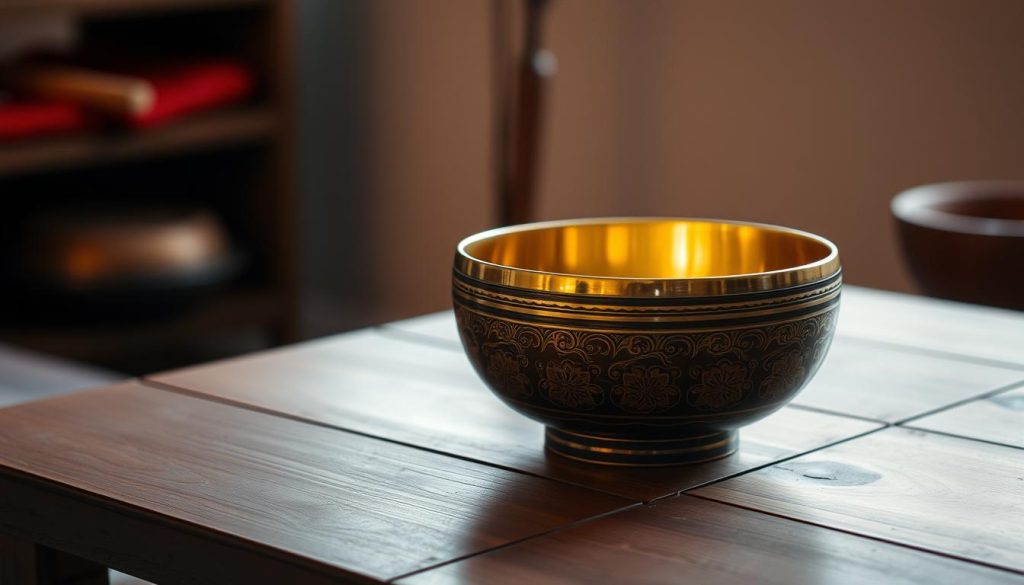
Key terms: hammering (cycles of heating and coordinated blows), casting (pouring into a mold), alloy (mostly copper and tin). Modern analyses show about 77% copper and 22% tin, with other metals present only in trace amounts.
- Practical distinction: hammering adds harmonic richness, while casting allows faster production.
- Uses: meditation, rituals, sound healing and music-making.
- Listening: notice the length of the resonance, the pitch of the fundamental note and the balance of the harmonics.
Initial conclusion: final quality comes from a subtle balance of alloy, thickness, shape and finish. The following sections offer practical guidance for making an informed choice.
The origins of singing bowls: between the steppes, Bön and Tantric Buddhism
On the high plateaus, copper vessels gradually revealed an unexpected quality: musical resonance.
Household bowls used for cooking took on a new role when shamans noticed their vibrations. These nomadic practitioners explored their sounds for rituals and healing.
Transmission: knowledge passed from shamanism to the Bön religion and then to Tantric Buddhist monks. The bowl became an aid to meditation and a ritual object.
The meeting of Nepal and Tibet was decisive. Tibetan miners supplied the metals. Nepalese hammerers, particularly around Kathmandu and Patan, refined the alloy and the technique.
- Original use: a utensil that became an instrument.
- Economy: trade and barter along Himalayan routes.
- Community life: seasons, migration and shared knowledge.
| People | Role | Impact |
|---|---|---|
| Shamans | Discovery of the vibrations | Ritual and sensory use |
| Bön communities | Ritual transmission | Integration into religious practice |
| Nepalese artisans | Hammering and finishing | Improved sound quality |
| Tibetan miners | Metal supply | Availability of alloys |
Over the centuries, these exchanges rooted singing bowls in the lives of Himalayan peoples. The collaboration between Nepal and Tibet continues to shape the sound of these instruments today.
Materials and composition: from the seven-metal myth to metallurgical reality
Between myth and laboratory analysis, the actual composition of bowls holds some surprises.
Symbolic tradition associates seven metals with the planets: gold (the Sun), silver (the Moon), mercury, lead (Saturn), tin (Jupiter), iron (Mars) and copper (Venus).
Modern analyses, however, show a very different composition: about 77% copper and 22% tin. Other metals generally account for less than 1%, and gold and mercury are often absent.

The role of the main elements
Copper lends warmth and helps conduct sound. It contributes to the mellow quality of the harmonics.
Tin increases hardness and harmonic clarity. A higher proportion makes the timbre more direct.
Preparing the alloy disc
Melting takes place in a limestone or metal crucible at a temperature close to 1,800°C before the metal is poured into a disc. The metals are added according to their melting points: lead and tin first, then copper, and finally iron if it is used.
| Metal | Planetary symbol | Effect on sound |
|---|---|---|
| Copper | Venus | Warmth and length of resonance |
| Tin | Jupiter | Clarity and brightness of the harmonics |
| Others (lead, silver, gold, mercury, iron) | — | Minor role; small workshop adjustments |
The alloy disc determines how the finished bowl will behave acoustically. Master craftspeople often keep the exact proportions secret.
To learn more about the seven-metal legend and its critical examination, read this detailed article on seven-metal singing bowls.
Hand-hammered production: the aristocracy of Tibetan bowls
Traditional hammering transforms a heated disc into a living piece. Cycles of heating, hammering and quenching are repeated to alter the metal’s internal structure.
A team of four works in rhythm: three hammerers take turns striking while a leader holds the disc with tongs. Frequent returns to the fire keep the piece workable and its shape even.

Finishing and polishing
Once the bowl has been shaped, its edges are trimmed on a lathe and it is polished. These steps smooth the edges without compromising its distinctive sound.
Surface variations
- Acid patina for an antique appearance.
- Etching for raised patterns.
- Shiny finish for a bright surface without patina.
| Step | Purpose | Effect on sound |
|---|---|---|
| Heating the disc | Soften the metal | Allows deep hammering |
| Coordinated hammering | Shape the bowl | Greater harmonic complexity |
| Quenching | Stabilize the structure | Improved resonance length and tuning |
| Polishing and trimming | Finish the piece | Clearer partials |
Note: in winter, temperature control and reduced artisan fatigue often produce better bowls. The hammerers’ hands, movements and rhythm leave an audible signature long before finishing.
Cast production: speed, decoration and sonic limits
To meet demand, workshops adopted casting in single-use molds to save time. Direct casting forms the piece in one step; the mold is then removed and the bowl trimmed and polished. This process greatly reduces working time compared with hammering.
Limestone molds: the alloy was poured into stone molds that were broken after use. Removing the casting destroyed the mold, producing pieces that were similar but never identical.
Broken limestone molds, enriched brass and acid etching
Cast alloys are often based on brass, sometimes enriched with one or two metals to adjust the timbre. After trimming, decorations were added by acid etching or a patina was applied.
Sound signature: a dominant note, shorter resonance and the “five-metal” exception
The sound often has one dominant note, few harmonics and a shorter resonance. “Five-metal” castings are an exception and can surpass plain brass in quality.
- Advantages: speed, lower cost and varied decoration.
- Limitations: less harmonic complexity and shorter resonance.
“Casting met an economic need, but it does not erase the acoustic superiority of hammered bowls.”
In short, the choice of process depends on the intended use. For occasional ritual use or a tight budget, these pieces offer real value. For attentive listening, favor the artisan-made sound.
Finishes, shapes and quality: what the eye sees and the ear hears
A piece’s finish subtly influences its tone, especially in the midrange.

Acid baths and etching: appearance and effects on the midrange
An acid bath creates an antique patina that slightly softens high frequencies. The visual result invites meditation and simplicity.
Etching combines the application of black wax with immersion in acid to create patterns. This process can reduce the wall thickness where the designs are etched.
Acoustically, this slight reduction in thickness opens up the midrange. The middle tones gain fullness and air.
Shiny, Patan and engraved finishes: reading a finish for clues to its sound
A Shiny finish gives the bowl a bright sheen and smooth surface. This promotes projection and clarity in the higher partials.
Patan refers to a traditional, often dark patina that tempers the harmonics and softens the sound.
Engraved pieces carry Buddhist symbols. Their walls may be slightly thinner in places, changing the projection of the midrange.
Thickness, diameter and curvature: effects on power, resonance and harmonics
The thicker the wall, the greater the mechanical energy. This increases power but tends to reduce harmonic richness.
A larger diameter lowers the fundamental note and lengthens the resonance. Curvature affects pitch stability and the balance of partials.
Practical tip: always test the bowl with the leather side of the striker, then the wooden side. Leather reveals the fundamental note; wood brings out the higher tones.
- Match size and shape to the use: meditation (sustained notes), sound massage (strong vibrations) or punctuation (a clear attack).
- Do not judge by sight alone: a beautiful finish does not guarantee sound quality.
- Compare several pieces that look alike but differ in thickness and curvature.
| Finish | Visual effect | Acoustic effect | Suggested use |
|---|---|---|---|
| Acid bath | Dark, antique patina | Softens high tones and the midrange | Meditation, ritual |
| Etching (engraving) | Distinct patterns and relief | Local thinning; airy midrange | Guided meditation, sound massage |
| Shiny | Bright, smooth surface | Clear projection and lively harmonics | Concerts, music-making |
| Patan / traditional patina | Warm, aged appearance | Soft sound and balanced resonance | Ritual and personal use |
In summary: perceived quality arises from the match between the alloy, local wall thickness, consistency of shape and quality of finish. Listen before you buy.
Artisans, places and ethics: the hands and knowledge behind every bowl
Behind every resonant piece are hands trained in an old craft.
Kathmandu and Patan are centers of excellence.
Master hammerers, some from Calcutta and the Bay of Bengal, helped raise technical standards there.
Workshops follow a clear hierarchy: leader, assistants and polishers.
Knowledge is passed on within the workshop and is often closely guarded.
Conditions, pay and seasonality
A lead hammerer could earn about €1,500 per month in March 2018.
This was a high income locally and reflected the value of the craft.
The work is seasonal: activity peaks in winter and summer, while the periods between seasons allow workers to return to their families in India.
This rhythm affects production quality and pace.
| Factor | Observation | Impact |
|---|---|---|
| Centers | Kathmandu, Patan and Bengal’s influence | High technical standards |
| Pay | Leader: about €1,500 per month (2018) | Appeal of the profession |
| Seasons | Winter and summer; family time between seasons | Changes in quality and production pace |
Ethics: safety around furnaces, adequate breaks and fair pay are essential to preserving the craft.
A bowl’s authenticity depends directly on the artisans’ commitment and experience.
“Learn about the working conditions behind the object to make a responsible choice.”
To support sustainable practices and ethical trade, make a responsible choice when buying.
Sound quality and selection: practical criteria for every use
A good choice rests on three simple factors: accurate pitch, length of resonance and physical sensation. These determine whether an instrument suits meditation, relaxation or care sessions.
Meditation, yoga and ritual punctuation
For meditation and yoga, favor fairly thin hammered bowls weighing roughly 700 g to 2 kg. They offer rich harmonics and an airy sound suited to relaxation.
Test the pitch of the fundamental note, the balance of the harmonics and the fullness of the resonance. Together, these reveal the sound quality that matters in a session.
Sound massage and sound therapy
For massage and sound therapy, look for thicker, heavier pieces. Jumkha and Patan models are often valued for their strong vibrations.
A dense instrument transmits substantial mechanical energy that can be felt in the body. This encourages a sense of grounding and a therapeutic effect.
Practical tip: try several sizes. Diameter affects the fundamental note; weight affects sustain and projection.
“Recording or comparing several examples helps reveal subtle differences.”
- Listening criteria: pitch, balance of partials, fullness and length of resonance.
- Meditation and ritual: a thin bowl rich in harmonics.
- Massage and care: a thick bowl with strong vibrations.
Do not judge appearance alone: a beautiful object does not guarantee good performance. Good Tibetan singing bowls offer much greater versatility and consistency over time.
Use, care and safety: getting the best from your bowl
Good playing begins with a stable posture and a measured movement. This short practical guide gathers the essentials for everyday use, safe care and contact with the body.
Making the bowl sing: striker, pressure and speed
Hold the bowl steady in your hand with your elbow level. Begin slowly with steady pressure, then slow down as soon as the vibration develops.
Use the leather or suede side of the striker to bring out the low fundamental note. The wooden side emphasizes the midrange and high tones.
Match the striker’s size to the bowl’s diameter for better control of its timbre. Also try gentle strikes with a mallet to compare the attack and length of resonance.
Careful cleaning: cloth, whiting and Mirror
Finishes have often been treated in an acid bath; occasional cleaning with a product such as “Mirror” is still possible.
To preserve the patina, choose whiting or a damp cloth. Avoid harsh abrasives and always dry the bowl after cleaning.
Good practice: body contact, precautions and durability
For sound massage, place the bowl on a stable cushion, proceed gently and respect the body’s sensitivities.
Avoid vulnerable areas and watch the sound level. Check the edges, cleanliness and condition of the finish regularly.
- Basic movement: steady the bowl in your hand, maintain even pressure and slow down as soon as it begins to vibrate.
- Support: a cushion limits unwanted vibrations and improves projection.
- Routine: regular playing, gentle cleaning and inspection help extend the instrument’s life.
Learning these techniques gradually promotes a consistent sound and a longer-lasting instrument.
Conclusion
This overview brings together history, craft and science to guide the choice of a sound-making instrument. It shows the meeting of a Himalayan tradition, an alloy made chiefly of copper and tin, and two production methods: hammering and casting.
The key point: Tibetan bowls offer much more than a single note. Hammering produces complex timbres and long resonance; casting meets other practical needs.
Finishes, thickness and shape alter the vibrations. For meditation, music, percussion or therapy, listening remains the final judge: each bowl reveals its character over time.
Give credit to the workshops of Kathmandu and Patan and take time to try the bowls. With regular practice, a singing bowl becomes a companion whose resonances linger long after playing ends.