
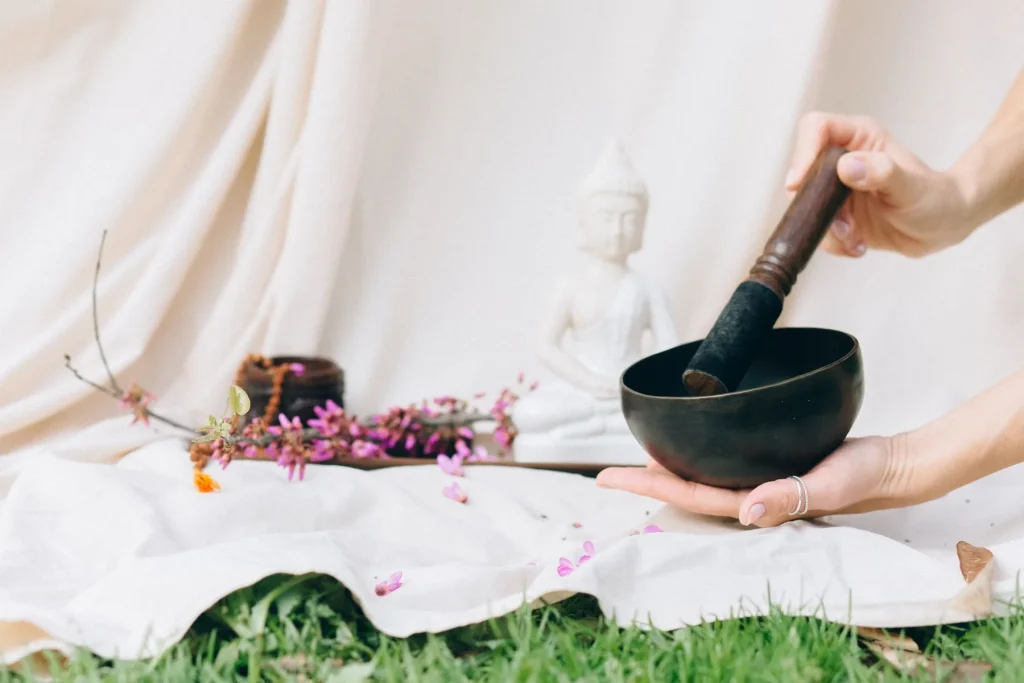
Purpose: This article clearly compares the strengths and limitations of a traditional metal bowl and a crystal bowl. It aims to help you choose based on the sound, intended use and energy you seek.
The differences begin with how they are made. A bowl hand-hammered in the Himalayas produces rich harmonics thanks to its traditional alloy. A crystal bowl is made from quartz melted at a very high temperature; it offers tonal purity and precise frequencies.
Practical uses include meditation, sound baths and focused sessions. Manufacturing quality strongly affects these instruments’ resonance, sustain and longevity. Beyond technical specifications, your ears remain the best judge.
For a complete guide and measurable criteria (sustain, weight, size and harmonic richness), see our metal versus crystal Tibetan singing bowl comparison.
Why compare metal Tibetan singing bowls and quartz crystal bowls today?
With so many options now available, it helps to consider singing bowls in the context of how they will be used. Practices range from individual sound therapy sessions to group sound baths, making the choice difficult for practitioners and enthusiasts alike.
Two approaches stand apart: Himalayan craftsmanship, which emphasizes harmonic richness, and modern fused quartz, which emphasizes tonal precision. The difference affects both sound and ease of use, whether in a small apartment or a large hall.
Growing interest in slowing down and finding focus has increased the appeal of singing bowls. Some people seek a grounding sound; others want a specific frequency for a repeatable practice. Expectations are rising: reliability, reproducibility and the ability to trace a sound’s source have become important criteria.
Comparing the bowls also helps dispel myths about chakra scales and miraculous frequencies. Rather than fixating on a material, try an instrument in person to see how it feels to you. The following sections examine materials and production methods to explain each type’s distinctive sound.
Materials and construction: metal alloy or pure quartz
Both the material and the maker’s technique shape an instrument’s voice.
Traditional alloy: metal bowls are made from an alloy of 3 to 7 metals (copper and tin, sometimes silver or gold). Hand-hammering in Nepal gives them a distinctive vibrational character. Hammer blows, repeated heating and uneven thickness create small acoustic variations. Each piece is therefore unique.
Fused quartz: crystal bowls are made from silica sand heated to approximately 4,000 °C to form quartz glass. This industrial process allows considerable tonal precision. Since the 1980s, crucibles associated with the silicon industry have served as a source for these instruments.
Most are produced in China; the origin of the silica has little effect on sound when the bowl’s geometry is identical. Molding allows tight tolerances and stable frequencies. Hammered metal, by contrast, retains a distinctive texture, complex harmonics and organic variation.
Effect on sound: wall thickness, hardness and internal stresses change sustain and harmonics. Standardization helps create consistent sets for precise practices, but material purity does not automatically produce a more musical sound.
Traditional alloy: 3 to 7 metals and a distinctive vibrational character
Different metals affect the tone. Hammering gives the sound a perceptible vibrational “history.”
Quartz fused at 4,000 °C: purity, precision and standardization
Quartz glass molded into a bowl emphasizes a central note and repeatability.
Handcrafted or industrially molded: the uniqueness of hammered pieces
Choosing between them means weighing organic character against reproducibility. Understanding how each is made helps you choose for your intended use.
Sound, frequencies and harmonics: organic depth or exact tonal purity
An instrument’s sound quickly reveals whether it favors harmonic richness or precise pitch. Your choice depends on whether you want group immersion, a targeted practice or individual use.

Complex harmonics and multiple notes
Hammered alloys produce layers of harmonics that create beats and interactions. Their enveloping sound can encourage a sense of grounding and depth during sound baths.
Dominant frequency and precise pitch
Quartz instruments produce a distinct frequency with a pronounced spectral peak. They are often chosen for a target pitch, such as 440 Hz or 528 Hz, in focused work.
Scales, chakras and marketing
Sets presented in C major simplify a complex reality. A strict correspondence between equal-tempered notes and energy centers has no solid historical basis; the practitioner’s intention remains central.
| Sound signature | Metal | Quartz |
|---|---|---|
| Harmonics | Rich, multiple notes | Stable, dominant peak |
| Suggested use | Sound baths, immersive meditation | Focused work, precise pitch selection |
| Practical advantage | Organic depth | Tonal precision |
Beyond frequency, assess sound quality, projection and resonance in your space. Always listen for yourself: how a bowl feels to you is a better guide than marketing claims.
Benefits, energy and current uses
A few vibrations can sometimes calm the mind and help bring attention back to the body.
Meditation, relaxation and sound baths: effects on body and mind
Often-cited benefits include a calmer mind, reduced tension and better sleep. Short, regular sessions can help make the experience more consistent.
Vibrations can be felt through the body, and breathing may naturally deepen. These effects can support relaxation and ease stress.
In practice, singing bowls can support meditation through the grounding quality of metal or the focused tone of quartz, depending on the practitioner’s intention. Combining breath and sound can deepen the experience.
Vibrational fields, Schumann resonance and energy practices
The Earth’s natural resonance provides a wider context for some energy practices. Within that context, a desire for energetic coherence leads some people to use these instruments to harmonize their personal energy.
| Recommendation | Practice | Expected result |
|---|---|---|
| Duration | 10 to 20 minutes, regularly | More consistent benefits |
| Preparation | Quiet surroundings, soft light, comfortable posture | Easier relaxation |
| Active listening | Notice sensations and adjust your distance | Sessions suited to your body |
Note: these methods can complement healthcare; they do not replace medical care. To learn more about the role of crystal bowls, read our article on whether crystal bowls are more powerful.
Crystal Tibetan singing bowls: strengths and limitations
Intended use often matters more than appearance when choosing an instrument.
Strengths of metal bowls: rich sound textures and the ability to hold a space while helping individuals or groups feel grounded. Their range of harmonics suits sound baths and rituals.
They are also versatile, working in both intimate and group settings.
Limitations of metal bowls
They require practice: without the right technique, they may rumble or produce shrill tones.
Their weight can make transport difficult. Differences between individual bowls also make results harder to reproduce in clinical settings.

Strengths of quartz bowls
Quartz instruments offer tonal purity and precise frequency selection (for example, 528 Hz). Their clear projection appeals to practitioners seeking consistency.
Their modern design also fits well in contemporary spaces.
Limitations of quartz bowls
The fragility of silica glass calls for careful handling and suitable transport. Their consistent sound may seem monotonous to someone seeking more “lively” harmonics.
Manufacturing quality strongly affects the result: how a bowl is made matters more than its size alone.
- Suggested uses: recreation, professional practice or clinical protocols, depending on the consistency required.
- Practical tip: combine both types—metal for a harmonic foundation and quartz for a focused pitch.
Tip: listen for yourself and favor firsthand experience over absolute claims. For a detailed comparison, see our metal versus crystal comparison.
A practical selection guide: use, space, budget and sound quality
A good choice balances intended use, space and budget. Defining your goal helps prevent impulse purchases and points you toward the right setup.
Define your goal
Common goals: individual meditation, group sound baths or precise work focused on an energy center.
For individual meditation, choose an instrument that is easy to handle. For sound baths, look for bowls with generous sustain.
Size, weight, resonance and sustain
Small diameter (10 to 15 cm): higher pitches, quick attack and easier transport.
Large diameter (> 25 cm): lower frequencies, an immersive sound and long sustain.
Listen to the resonance: clear harmonics, a stable note and no unwanted buzzing are signs of sound quality.
Check authenticity
Hand-hammered pieces often cost more but have a unique sound signature. Molded pieces offer more consistent results at lower prices.
Ask about certificates and evidence of craftsmanship, then test the sound by striking and rubbing the bowl. Give priority to traceable origins.

- Budget: frosted crystal is more affordable than clear crystal; handcrafted metal > molded metal.
- Fit for your space: avoid very large bowls in small, reverberant rooms.
- Portability: consider weight, a carrying case and protection if you move the instrument regularly.
- A balanced set: combine a low metal foundation with a clear crystal accent to suit your aims.
- Comfort: choose suitable mallets and an ergonomic playing position.
Origins, types of crystal bowls and what to check before buying
Knowing where materials come from helps you assess claims about sound and manufacturing quality.
Quartz instruments are made from melted silica sand. Much of the raw material and manufacturing is located in China, not necessarily in the United States. Check “Made in USA” labels: ask for evidence of the factory or manufacturing process.

Available types
Frosted: thick, powerful, long sustain and moderately priced.
Clear: thinner, with transparent tones, and often more expensive.
Alchemy: quartz infused with metals or stones, with a distinctive appearance, higher prices and variations in tone.
“Chakra” sets and frequencies
C-major sets are largely a marketing convention. A strict correspondence between notes and energy centers lacks a historical basis. Be critical of claims about special frequencies.
| Type | Characteristics | Indicative price range |
|---|---|---|
| Frosted | Power, sustain | Sets: $800 to $2,500 |
| Clear | Delicate sound, clear projection | Individual bowls: $300 to $4,000; diatonic sets: > $5,000 |
| Alchemy | Distinctive appearance, variable tone | Premium, high prices |
Advice: favor sellers who are open about their products, offer return policies and provide quality recordings. Try a bowl in person: an audio file cannot convey how its vibrations feel.
For more help choosing an instrument, read our singing bowl guide.
Care, resonance and instrument longevity
Regular care can help a bowl retain its sound for longer. Simple habits preserve its resonance and vibrational character.
Cleaning and storage by material
For metal: clean with a soft cloth, lukewarm water and a few drops of lemon juice. Dry immediately to prevent oxidation. Store away from moisture and sunlight, separating bowls with cloth if you own several.
For quartz glass: handle carefully and use padded cases and stable supports. Avoid hard impacts and temperature changes that could affect the material.
Maintaining resonance and preventing wear
Play the instrument regularly to keep familiar with its response. If you wish, you can include a little sage or incense smoke in your practice. Do not play excessively loudly: listen for signs of distortion.
| Action | Frequency | Purpose |
|---|---|---|
| Visual inspection | Monthly | Spot cracks or wear |
| Gentle cleaning | Monthly | Prevent corrosion and dirt buildup |
| Playing | Weekly | Maintain familiarity with its resonance and sustain |
| Suitable storage | At all times | Protect the material |
Accessories: choose appropriate mallets and rings or stands that do not dampen resonance. Careful handling helps preserve the sound over time.
Conclusion
Ultimately, listening remains the best guide to choosing your instrument. This article shows that each type has its own sound: metal offers organic depth, while quartz provides precise pitch.
To choose well, consider your goal, space, budget and standards. Try several singing bowls and notice how your body responds: each note feels different in the body.
Remain alert to myths about scales and overly simple claims. Combining metal and crystal bowls can give you a broad range of sounds. Favor quality, traceable origins and a lasting practice: care, training and active listening make the experience more rewarding.