
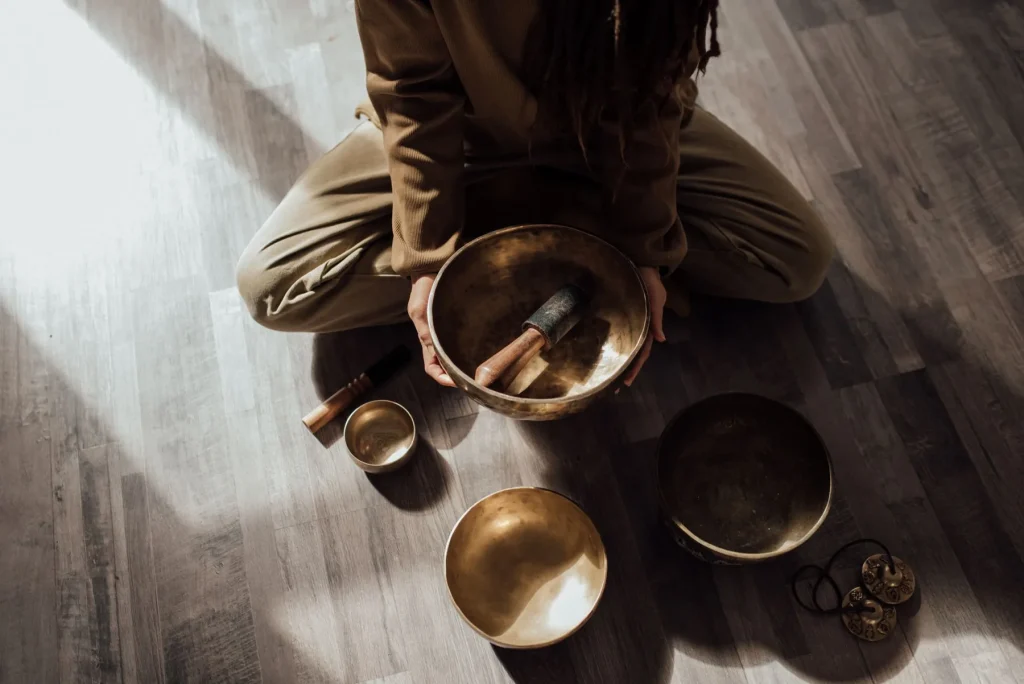
Practical guide to understanding the pitch, fundamental frequency and harmonics of a singing bowl. This article helps you identify the frequency that matters and choose a purpose: meditation, healing or musical performance.
A singing bowl is an idiophone. Its tone combines a fundamental frequency with several harmonics. The length of its resonance and the relative strength of its tones change with the mallet: a soft mallet brings out lower tones, while a firmer one emphasizes higher tones.
Relevant frequencies range from about 100 to 900 Hz. A smartphone with a spectrum analyzer can help identify a note, though its accuracy to the nearest hertz is limited. For reliable measurements, a calibrated external microphone is preferable.
Sound signature = fundamental frequency + harmonics + resonance time + timbre. Two bowls of the same size can sound different because of their alloy, thickness and shape. Their tuning is difficult to change, so it is best to choose the right bowl when buying it.
For more on note correspondences and frequencies, read this detailed guide to frequencies and chakras.
Understanding a singing bowl’s “note”: fundamental frequency, harmonics and sound signature
Our perception of a note comes from several frequency peaks that form a unique sound signature.
The fundamental note and harmonics: what your ear actually hears
The fundamental note corresponds to the lowest peak in the spectrum and gives the singing bowl its low-pitched foundation. Harmonics are higher frequency peaks that shape its timbre.
Measurements of actual bowls show average ratios of about 1.98, 2.89, 3.94 and 5.48. These values help explain why an instrument can sound rich and complex.
Relative strength of the notes and resonance time: what makes a bowl sound rich
How you play the bowl changes the strength of its tones: a soft mallet brings out lower tones, while a firm mallet emphasizes higher ones.
Resonance time = the length of time the sound remains audible. Some singing bowls, such as Full Moon or Om Sajan models, sustain their sound longer and create a sense of grounding.
Why a bowl can seem to fall “between two notes”
Handcrafting and the alloy affect the bowl’s mix of frequencies. Its frequencies often fall between two reference notes; a tolerance of about 1 to 2% may be acceptable in a set.
Looking at the spectrum remains essential: each peak reveals part of what the ear actually hears. Listen and measure several times to confirm the dominant tone.
| Element | Role | Practical effect |
|---|---|---|
| Fundamental note | Low-pitched foundation | Grounding; reference for tuning |
| Harmonics | Tonal color | Richness and clarity; ratios of about 1.98 to 5.48 |
| Resonance time and beating | Duration and modulation | Perceived effect: energizing, floating or calming |
| Alloy and handcrafting | Distribution of energy | Differences among Tibetan bowls and models |
Which physical factors affect the note: size, thickness, shape and alloy
A bowl’s pitch depends primarily on its geometry and the mass of its walls.
Size and diameter. A wide singing bowl produces a lower perceived frequency. These lower-pitched bowls suit grounding and deep relaxation. Just a few extra millimeters can shift the fundamental frequency.

Thickness and stiffness. At the same diameter, thicker walls raise the frequency, producing a brighter, sharper tone. Thinner hammered walls produce a lower, fuller sound.
Shape and composition. An open profile favors lower modes and a long resonance time. A closed profile concentrates energy in higher harmonics. The alloy and its metals alter the distribution of peaks; a high proportion of silver, for example, can color the frequency and timbre.
Handcrafting and a practical example. Hand hammering affects how even the walls are. Two 20 cm bowls—one rounded and thick, the other open and thin—will have neither the same fundamental frequency nor the same dominant harmonics. To assess the fundamental frequency, always consider diameter, thickness and shape together.
How to choose the note of your Tibetan singing bowl
Your intended purpose—grounding, healing or energizing—guides your choice of frequency.
Clarifying your goal helps you decide whether you prefer a low fundamental note or a dominant harmonic.
Goals and practical choices
For calming meditation, look for a low fundamental note and a long resonance time. For an energizing effect, choose a bowl with more prominent high harmonics.
Fundamental note or dominant harmonic
Choose the fundamental note if you want depth and grounding. If your ear mainly picks up a harmonic, let that tone guide how you use the bowl.
Building a harmonious set
For a set, use the same tuning reference (440 or 432 Hz) and keep within a tolerance of ±1 to 2%, or ±3 Hz in octave 3. Avoid pairing notes that are too close together, especially E and F, which can sound uncomfortably out of tune.
Examples of useful pairings
- Low C + G (a fifth) for grounding and stability.
- F + A for a sense of harmony between the heart and intuition.
- D + B for fluidity and uplift.
Final tip: try several singing bowls and record the frequency, octave and dominant tone you hear. A crystal bowl may be preferable for focusing on a particular chakra; metal offers a richer range of harmonics.
Measuring and identifying the note with a spectrum analyzer
Preparing carefully makes your measurements much more reliable.
Prepare to measure: choose a quiet space, place the bowl on a neutral support and keep the smartphone at a constant distance. Use Spectroid (Android), or Audio Spectrum Analyzer dB RTA or Tuner Pro (iOS). A calibrated external microphone improves accuracy.
Reading the spectrum
Strike the bowl, then rub its rim and watch the screen: the first peak on the left is the fundamental frequency. The following peaks are harmonics. Note their relative amplitudes to see which frequency your ear hears most strongly.
Striking or rubbing
How you play changes the dominant tone: a soft strike highlights the lower tones, while rubbing can reveal a high harmonic. Repeat the measurement several times and average the readings.
Tolerances and practical reference points
Typical frequencies are about 110 to 660 Hz, sometimes reaching 800 to 900 Hz. Aim for a difference of 1 to 2%, or ±3 Hz in octave 3. Pay attention to bowls that fall between two notes, especially E and F.
| Element | Action | Expected result | Example |
|---|---|---|---|
| Preparation | Quiet room, consistent position | Fewer artifacts | Smartphone 30 cm away |
| Setup | Open Spectroid or Tuner Pro | Display from 100 to 900 Hz | Centered scale |
| Readings | Take 3 to 5 readings and calculate the average | Reliable reading | Fundamental frequency of about 114 Hz |
| Verification | Convert the frequency to a note (440 or 432 Hz reference) | Identify the note for your purpose | Dominant harmonic of about 346 Hz |
To keep a record of your measurements and explore the subject further, read this useful guide to determining the frequency.
Recommended tools and apps for analyzing frequencies
A good mobile tool displays the fundamental frequency and harmonics at the same time, making analysis easier.
Spectroid (Android) is a reliable real-time analyzer. It displays frequency and amplitude in dB, letting you spot a singing bowl’s fundamental frequency and harmonics at a glance.

iOS options: Audio Spectrum Analyzer dB RTA is suitable for professional use while remaining approachable. Tuner Pro and SpectrumView are good alternatives; SpectrumView also offers spectrum recording and playback.
For Android, Sound Spectrum Analyzer is a simple, quick option for occasional use. A calibrated external microphone improves accuracy considerably, especially when you are putting together a set.
Tuners and spectrum analyzers
A musical tuner identifies a single note but can be misled by competing harmonics.
A spectrum analyzer displays all the peaks at once and helps you understand which sound your ear actually perceives.
| Tool | Platform | Practical use |
|---|---|---|
| Spectroid | Android | Real-time display; identifying the fundamental frequency and harmonics |
| Audio Spectrum Analyzer dB RTA | iOS | Professional analysis; saving readings and measuring in dB |
| Tuner Pro or SpectrumView | iOS | Other options for measuring and recording the spectrum |
| Sound Spectrum Analyzer | Android | Simple option for quick detection |
Typical procedure: launch the app, rub the rim steadily, wait for the curve to stabilize, then record the fundamental frequency and the main peaks. Compare several apps if needed, and keep the phone in the same position for repeatable measurements.
Connecting notes, frequencies and chakras: how to guide your choice
The C major scale often provides a framework for pairing notes with chakras. These correspondences can help you select a bowl that suits your intention.
The C major scale and its correspondences
C – Muladhara / D – Svadhisthana / E – Manipura.
F – Anahata / G – Vishuddha / A – Ajna / B – Sahasrara.

Focusing on one chakra or seeking overall balance
To focus on a particular chakra, choose a bowl whose fundamental note corresponds to that energy center. Crystal produces a purer note that makes precise targeting easier.
For overall balance, choose metal bowls: their harmonics can surround several chakras with sound, even when one fundamental note dominates.
“Measure, listen and let your own experience confirm the correspondence.”
| Goal | Type of bowl | Expected effect |
|---|---|---|
| Focused work | Crystal | Stable note, precise focus |
| Overall balance | Metal singing bowl | Wide range of harmonics; engagement with several chakras |
| Grounding | Lower-pitched bowls | Deep relaxation, stability |
Practical tip: pair two bowls (for example, C + G) for grounding and expression. Check their frequencies with a spectrum analyzer and choose the octave to suit your purpose. Your ear and body remain your best guides.
Metal and crystal bowls: note accuracy, timbre and use
The material often shapes how a bowl is used in music and therapeutic practice. The alloy affects its timbre and the balance between the fundamental frequency and harmonics.

Metal alloys: rich harmonics and an evolving sound signature
Metal bowls produce a fundamental frequency accompanied by many partial tones. Their resonance and beats change over time.
Practical advantage: they are well suited to sound baths and improvisation because their evolving sound fills the space and engages several energy centers.
Quartz and crystal: a purer note for precise focus
Quartz crystal bowls produce a more stable frequency and subtler harmonics.
A frosted bowl with thick walls often sounds higher than a clear bowl of the same diameter. Crystal makes it easier to play in tune with diatonic instruments and drones.
| Type | Characteristic | Recommended use |
|---|---|---|
| Metal | Rich harmonics, lively resonance | Sound baths, overall balance |
| Crystal (quartz) | Pure note, subtle partial tones | Focused work, melodic accompaniment |
| Both together | Complementary depth and precision | Test how they interact; measure their frequencies |
Tip: combine a metal Tibetan singing bowl for depth with a crystal bowl for clarity. Measure their frequencies before pairing them to make sure they sound good together.
Common pitfalls and good buying practices
Buying a singing bowl calls for a considered approach and careful listening. Many people choose instruments that fall “between two notes,” making them harder to use in a set.
The intermediate-note trap: many bowls have frequencies between established notes. Assign the note whose frequency in hertz is closest, then test the bowl in the set to avoid unpleasant beats.
Between two notes: tolerances to observe
Aim for a difference of no more than 1 to 2%. In practice, for a set intended to cover the seven chakras in octave 3, it is better to stay around ±3 Hz. A wider margin, such as ±5 Hz, may be acceptable for a bowl played alone but problematic in combination.
Pay particular attention to E and F: the semitone between them is narrow. An E that is too high and an F that is too low draw closer and can sound uncomfortably out of tune. If that happens, change octave or replace one of the instruments.
440 Hz or 432 Hz: use a consistent reference
Choose a reference pitch (440 Hz or 432 Hz) and use it consistently. Their note-frequency charts differ; mixing the two can introduce subtle but audible differences between pitches.
Recommended checking procedure: take several measurements with a spectrum analyzer, calculate their average, and record the frequency, octave and conditions (room, distance and tool). Try both striking the bowl and rubbing its rim: the dominant tone may change with how you play it.
| Point | Action | Recommended threshold |
|---|---|---|
| Measurement | Take 3 to 5 readings and calculate the average | ±3 Hz (octave 3) |
| Reference | Choose 440 or 432 Hz | Consistency across the set |
| Checking | Listen to two or three bowls together | No perceptible unwanted beats |
One last tip: the alloy and manufacturing process can shift the peaks slightly. Be wary of unrealistic promises about retuning; choose an instrument that meets your needs when you buy it.
Conclusion
Ultimately, careful listening backed by reliable spectrum analysis will help you decide. To identify the note and frequency, combine measurements (using Spectroid, Audio Spectrum Analyzer dB RTA or Tuner Pro) with tests in which you strike and rub the bowl. Use a consistent 440 or 432 Hz reference to keep the set musically coherent.
Remember: size, thickness, shape, alloy and handcrafting all affect pitch and timbre. Metal singing bowls offer rich harmonics; a crystal bowl gives a purer, more focused frequency.
Follow a repeatable procedure (same tool, distance and duration) to identify the note and octave. You cannot reliably retune a bowl: if the difference is bothersome, choose another bowl instead of hoping for an unlikely correction.
Always test your bowls together in the space where you will use them. Return to this article whenever you need its checklists and reference points, then let your ear and experience confirm your final choice.