

Learning to play the accordion can be exciting and rewarding for beginners. Choosing the right type of accordion, such as a diatonic accordion, is important when starting out. It is also essential to become familiar with the instrument’s different parts, such as the right-hand keyboard keys and left-hand buttons. There are many resources for learning the accordion, including private lessons, online lessons, and learning methods. Regular practice with technical, coordination, and bellows exercises is also necessary to improve. Finding inspiration by listening to accordion music, attending musical events, and joining groups or associations can also help you stay motivated.
Choosing the right type of accordion, such as a diatonic accordion, is important when beginning your musical journey. The diatonic accordion is well suited to beginners because it is simpler to play and understand. Its right-hand keyboard has buttons that produce different notes depending on the movement of the bellows. It also has left-hand buttons for adding chords and bass notes.
The simplicity of the diatonic accordion makes it easier to learn the basics. The layout of its keys and buttons is more intuitive for beginners, helping them progress more quickly. The diatonic accordion is also often used in traditional and folk music, providing an authentic introduction to different musical genres.
Choosing the right type of accordion when starting out is essential, as it will help you build a solid foundation. Before you begin learning, ask accordion professionals or teachers for advice on choosing an instrument suited to your level and musical preferences.

| Type of accordion | Advantages | Disadvantages |
|---|---|---|
| Diatonic accordion | Easy for beginners to play Used in various traditional music genres |
Limited range of available notes Not suitable for every style of music |
| Chromatic accordion | Can play every note of the chromatic scale Suitable for different styles of music |
More complex to play and understand More expensive |
In conclusion, choosing the right type of accordion, such as a diatonic accordion, is essential for beginners who want to learn to play. The diatonic accordion offers a simpler, more intuitive introduction to the instrument, helping you progress more quickly. Ask professionals for advice to help you make the right choice. Get ready for an exciting musical journey with the accordion!
Getting to know the instrument
To play the accordion well, it is essential to become familiar with its different parts, such as the right-hand keyboard keys and left-hand buttons. Understanding how the accordion works and getting to know its components will help you progress quickly.
The accordion has two main playing areas: the right-hand keyboard and the left-hand buttons. The right-hand keyboard has keys that produce notes when pressed. They are arranged in a specific pattern called the “chromatic scale.” Learning the different notes and their positions on the keyboard will allow you to play melodies and chords.
The left-hand buttons are used to play bass notes and chords. Each button produces a different sound, and combinations of buttons create chords. Practise placing your fingers correctly on the buttons to produce clear, well-articulated sounds.
To help you picture the accordion and better understand how it works, here is a diagram of the instrument:

| Right-hand keyboard | Left-hand buttons |
|---|---|
| Keys for playing notes | Buttons for playing bass notes and chords |
| Chromatic scale layout | Button combinations for creating chords |
By understanding the different parts of the accordion and how they work together, you can make progress and play beautiful melodies. Take time to get to know your instrument, and practise regularly to develop your skill and expressiveness.
Resources for learning the accordion
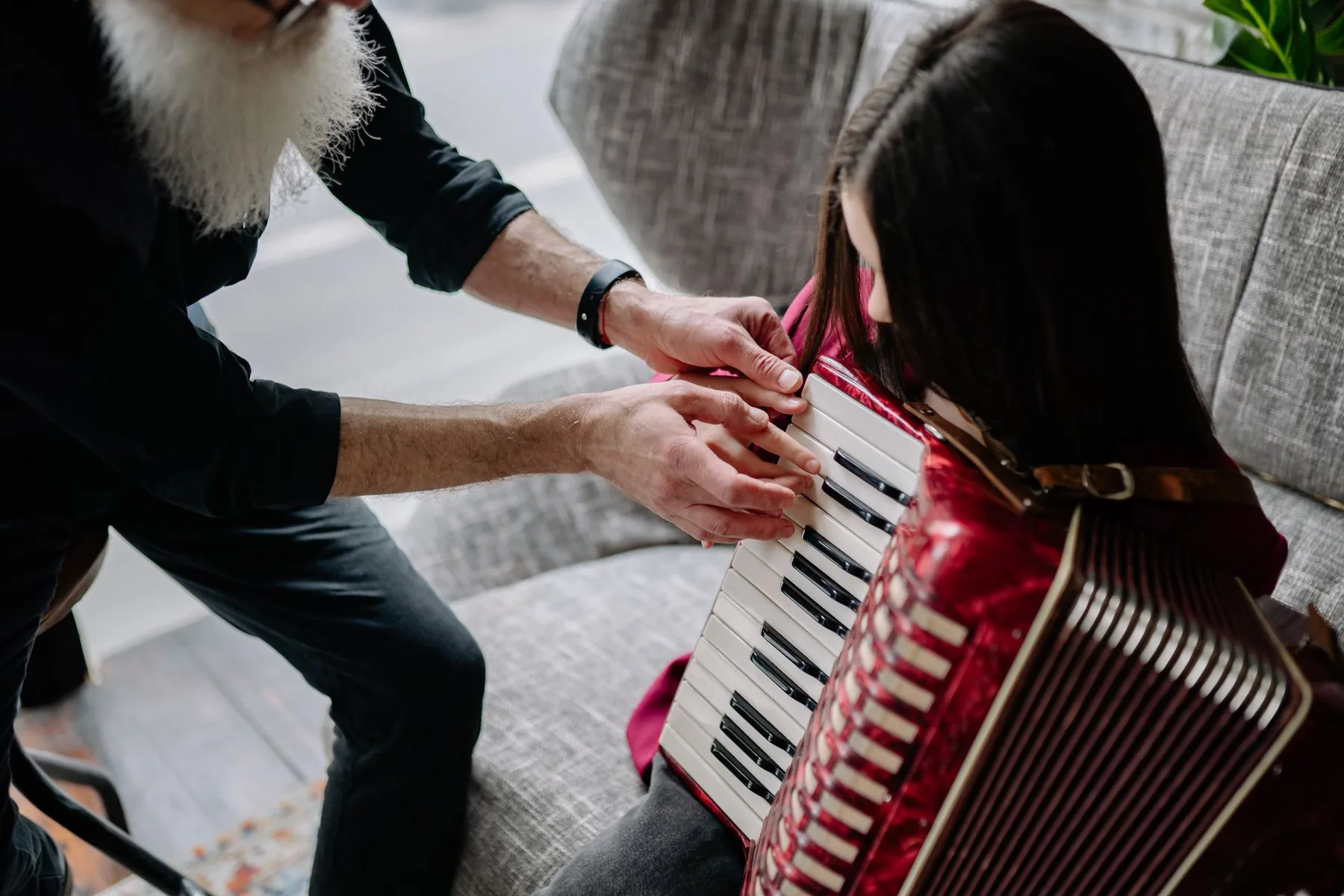
There are many resources for learning the accordion, including private lessons, online lessons, and learning methods. If you are just starting, a private teacher can guide your learning. Private lessons offer a personalised approach and let you progress at your own pace.
Online lessons are another popular option. Many websites offer instructional videos, sheet music, and interactive exercises to help you master accordion techniques. This approach lets you study when it suits you and revisit lessons as needed.
Alongside private and online lessons, there are various accordion learning methods. These include books, DVDs, and software with exercises and sample pieces to help you develop your skills. Exploring different methods can help you find the one that best suits the way you learn.
Overview of resources for learning the accordion
| Resources | Description |
|---|---|
| Private lessons | Experienced teachers who provide personalised instruction and individual guidance. |
| Online lessons | Videos, sheet music, and interactive exercises available online to learn to play the accordion. |
| Learning methods | Books, DVDs, and software offering exercises and sample pieces to develop your skills. |
Among these many resources, you can choose the one that best meets your needs and learning style. Whether you prefer the individual attention of private lessons, the flexibility of online lessons, or traditional learning methods, you can find a resource suited to your accordion studies.

Regular practice with technical, coordination, and bellows exercises is also necessary to improve your accordion playing. These exercises strengthen fundamental skills and improve your command of the instrument. Here are some techniques and exercises that can help you progress:
- Fingering exercises: Working on fingering is essential for developing speed and precision in your finger movements on the keyboard. Practise playing ascending and descending scales, changing fingers for each note.
- Coordination exercises: Coordination between both hands is crucial for playing smoothly and harmoniously. Practise synchronising your right and left hands by playing chords and melodies at the same time.
- Bellows control: The bellows are an essential part of the accordion. Practise controlling the speed and force of their movement by playing long and short notes and adding dynamic accents.
Set aside time for these exercises regularly as part of your learning routine. Start with short sessions and gradually increase their length as your ease and stamina improve.
Additional tips:
- Vary your exercises: Try different types of exercises to work on different aspects of your playing. For example, alternate between fingering, coordination, and bellows exercises to develop your skills evenly.
- Use a metronome: A metronome is a valuable tool for improving your rhythm and timing. Use one during practice to maintain a steady tempo and become more precise.
- Record yourself: Record yourself playing regularly to assess your progress and identify areas for improvement. This will also help you track how your playing develops over time.
Remember that regular practice and perseverance are essential to improving at the accordion. Be patient with yourself and appreciate your progress. In time, you will develop your own style and be able to play with ease and passion.
| Exercise | Description | Difficulty level |
|---|---|---|
| Fingering exercise | Play ascending and descending scales, changing fingers for each note | Easy |
| Coordination exercise | Play chords and melodies simultaneously to improve coordination between both hands | Moderate |
| Bellows control exercise | Control the speed and force of the bellows while playing long and short notes | Difficult |
Finding inspiration
Finding inspiration by listening to accordion music, attending musical events, and joining groups or associations can help you stay motivated as you learn the accordion. The accordion is a versatile instrument with a rich sound. Listening to different accordion pieces can give you new ideas, introduce you to musical styles, and motivate you to improve.
Music can stimulate creativity and put us in a frame of mind that supports learning. By listening to accordion music, you can develop your musical sensitivity and improve your playing by absorbing different techniques and interpretations.
Attending local musical events is another excellent way to find inspiration. At concerts by talented accordionists, you can see and hear what the instrument can do up close. You can also talk with other enthusiasts, meet new people, and discover fresh perspectives on the accordion.

Joining accordion groups or associations can be a valuable source of inspiration and motivation. These communities often offer opportunities to play together, exchange advice and tips, and take part in special events. Talking with other accordionists, whether beginners or more experienced players, can help you improve and sustain your enthusiasm throughout your learning journey.
| Benefits of finding inspiration | Examples of musical events | Accordion groups and associations |
|---|---|---|
|
|
|
Finding inspiration is essential for staying motivated and continuing to improve as you learn the accordion. Explore different pieces, attend musical events, and take part in accordion groups or associations to nurture your passion and develop your playing.
Accordion sheet music
Accordion sheet music is an essential tool for learning new pieces and improving your playing. It helps beginners learn to play specific melodies and chords by following musical directions and notation. Using sheet music can gradually expand your repertoire and help you gain better command of the instrument.
There is a wide variety of accordion sheet music for different skill levels. It may be available in books, downloadable PDF files, or even mobile apps. Choose music that matches your level and musical tastes.
As well as providing the necessary notes and chords, accordion sheet music may include fingering directions and performance tips. It can help you understand the structure of a piece and improve your technique. You can also find accordion sheet music for styles such as folk, jazz, and classical music.
Tips for using accordion sheet music:
- Start with music suited to your level, then gradually move on to more complex pieces.
- Take time to read the directions and notation carefully so you understand the piece’s structure and rhythm.
- Practise slowly and regularly, focusing on the accuracy of the notes and chords.
- Use the fingering directions to improve your technique and the fluidity of your playing.
- Feel free to develop your own musical interpretation using the guidance provided in the score.
- Explore different musical styles and try scores outside your comfort zone to broaden your skills and repertoire.
Using accordion sheet music regularly can help you progress quickly. Remember to enjoy playing and let the music carry you along as you develop your skills.
| Advantages of accordion sheet music | Disadvantages of accordion sheet music |
|---|---|
| Makes it easier to learn new pieces | Can be expensive to buy |
| Helps improve technique and accuracy | May require the ability to read music |
| Provides a clear structure for playing melodies and chords | Does not always provide detailed performance guidance |
In conclusion, accordion sheet music is an essential tool for beginners who want to learn new pieces and improve their musical skills. By using it and following the guidance provided, you can develop your accordion playing and explore different musical styles. So get some sheet music, let the music guide you, and enjoy learning the accordion!

In conclusion, learning to play the accordion is an exciting journey for beginners, but it takes time, practice, and suitable resources. Choosing the right type of accordion is essential. The diatonic accordion, for example, is well suited to beginners because of its simplicity. By becoming familiar with the instrument’s different parts, such as the right-hand keyboard keys and left-hand buttons, beginners can better understand how the accordion works.
Many resources can help you improve as you learn the accordion. Private lessons offer personalised teaching and individual guidance, while online lessons provide a flexible and convenient way to learn. Learning methods such as books and structured programmes can also help you gain new knowledge and skills.
Regular technical, coordination, and bellows practice is crucial to improving your playing. By working on different techniques and coordination between both hands, beginners can refine their playing and become more comfortable. Finding inspiration is also important for staying motivated throughout your musical journey. Listening to accordion music, attending musical events, and joining accordion groups or associations can nurture creativity and deepen your passion for the instrument.
FAQ
What type of accordion is best for beginners?
The diatonic accordion is often recommended for beginners.
What are the main parts of the accordion?
The accordion has keys on the right-hand keyboard and buttons for the left hand.
Where can I find resources for learning the accordion?
You can find resources such as private lessons, online lessons, and learning methods.
What kinds of exercises are important for improving at the accordion?
Regular technical, coordination, and bellows exercises are essential for improving at the accordion.
How can I find inspiration for playing the accordion?
You can find inspiration by listening to accordion music, attending musical events, and joining accordion groups or associations.