
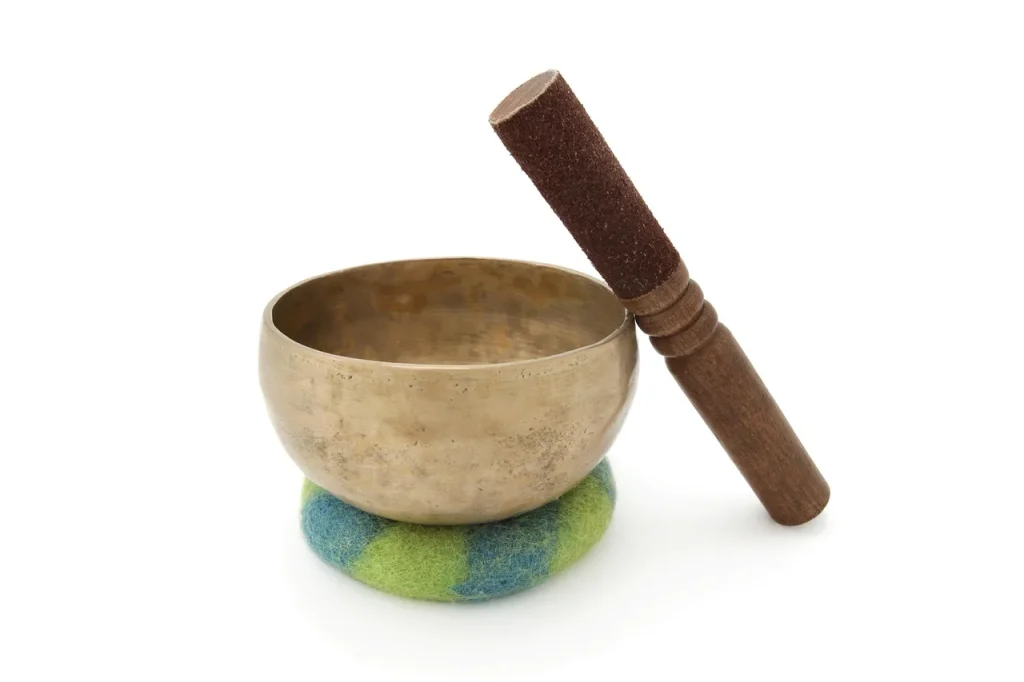
Purpose: this article provides an overview of practices and firsthand reports on using a Tibetan singing bowl for headaches. It draws on health and music therapy research to explain how bowls are used, their limitations, and the precautions to take.
Context: a singing bowl is a musical instrument that many people find relaxing. It is used to ease stress, encourage relaxation, and help manage pain—effects that may be useful for people prone to attacks.
Caution: there is no evidence that a singing bowl cures a serious illness. Clinical reports describe relaxation and reduced stress in palliative care or music therapy. This tool complements medical care; it does not replace it.
We will explore possible mechanisms (sound and vibration), practitioners’ accounts, hospital use, safety, and tips for gentle use tailored to the individual.
Why consider Tibetan singing bowls when you have migraines?
Trying the sounds of a singing bowl appeals to some people because it offers a simple way to reduce stress and encourage muscle relaxation that may help with pain.
In clinical settings (Saint-Étienne University Hospital, Amiens University Hospital, the Montpellier Cancer Institute, and practices in Belgium), the use of singing bowls and sound therapy often receives positive feedback. Teams report lower blood pressure, a slower heart rate, and reduced muscle tension, without promising a cure.
On a neurological and emotional level, sounds and music affect the mind, attention, and anxiety. For some people, a regular ritual with a bowl creates a calming setting and helps reduce the heightened alertness that can worsen attacks.
- Stress management and relaxation.
- Muscle relaxation and emotional support before care.
- Potential use at home as part of a self-care routine.
“Sounds encourage grounding and slow breathing, two key elements in reducing the physical strain associated with headaches.”
| Observed effect | Setting | Precaution |
|---|---|---|
| Relaxation | University hospitals, sound therapy practices | Moderate volume, soft lighting |
| Reduced muscle tension | Guided sessions | Proceed gently according to the individual |
| Emotional support | Palliative care, preparation for care | A complement to medical care |
How vibration and sound affect the body and mind
The vibrations produced by a singing instrument may affect several bodily systems and change how pain is perceived.

Cellular vibrations, the brain, and the body’s response
The emitted waves travel through tissue and reach muscles, skin, and organs. Clinical observations have reported lower blood pressure, a slower heart rate, and muscle relaxation.
A cautious hypothesis: vibrations at different levels might affect cell communication, but the evidence remains preliminary.
From stress to pain: plausible mechanisms
Stress increases physical strain and sensitivity. By encouraging relaxation, sounds may help break this cycle and reduce the perception of pain.
The role of music and sound therapy in emotional regulation
Music influences attention and emotional networks. During a session, a singing bowl can encourage slow breathing and help the mind settle.
“A gradual approach that responds to how the person feels can enhance relaxation while limiting overstimulation.”
| Aspect | Observation | Precaution |
|---|---|---|
| Physical | Lower blood pressure, relaxed muscles | Moderate volume, individual adjustment |
| Emotional | Calm, improved attentional grounding | Structured approach, guidance |
| Practical application | Combined with guided breathing | Limit high pitches for sensitive people |
Tibetan singing bowls and migraines: what practitioners say
Music therapists and sound therapists share their observations on incorporating singing bowls into sessions.
What music therapists and sound therapists report during sessions
Observation: at centers such as the Montpellier Cancer Institute and the Saint-Étienne and Amiens university hospitals, as well as in Belgian residential care homes, teams note marked relaxation after short practices.
Aude Menteaux emphasizes that sound therapy is a support, not a remedy. Reports describe less anxiety, relaxed muscles, and easier breathing.
Experiences in clinical and private practice settings
In her practice, physiotherapist Maria Elena Martinez Ramos uses a singing bowl for 3 to 5 minutes at the start of a session. Patients often report a sense of well-being and some relief from pain.
| Setting | Observation | Precaution |
|---|---|---|
| Hospital (cancer institute, university hospital) | Relaxation, better tolerance of care | Integrated with medical care |
| Physiotherapy practice | Physical preparation, relaxation | Short duration, individual adjustment |
| Sound therapy | Emotional support, grounding | Listen to the patient’s feedback |
“Sounds provide support; they do not replace medical treatment.”
These reports point in the same direction: the instrument can promote well-being and change the perception of pain, without guaranteeing a curative effect. It remains essential to adjust the duration and intensity and ask patients how they feel.
To learn more about its use in stress management, see this resource on sound therapy and stress management.
What its use in hospitals and care settings shows
In hospitals, singing bowls are introduced with one priority: creating a calmer atmosphere for people receiving care.

Relaxation, stress management, and pain in palliative care
Clinical observation: in palliative care units, regular use of a singing bowl at Saint-Étienne University Hospital since 2016 has been associated with reduced stress and muscle relaxation.
Reported effects: emotional relaxation, easier breathing, and sometimes less perceived pain.
Examples from France and Belgium: hospitals, a cancer institute, and residential care homes
Amiens University Hospital, the Montpellier Cancer Institute, and several residential care homes in Belgium (where sound therapy has been used since 2022) document similar cases.
Physiotherapists sometimes place a singing bowl on the area being treated to encourage relaxation and improve mobility.
- Settings: palliative care, hospital units, residential care homes.
- Observed effects: reduced stress, less bodily tension, better tolerance of care.
- Precaution: supervised practice; medical advice recommended.
“Sound therapy supports the care journey; it offers help without promising a cure.”
Overall, these experiences support its complementary use as part of multidisciplinary care, sometimes combined with guided meditation or sensory practices (such as a bowl containing water) to enhance well-being.
Potential benefits for migraines: realistic expectations
This section presents benefits reported by people who have added a sound-producing instrument to their routine, while setting clear limits.

Reduced stress and deep relaxation
Observation: people often mention less stress, relaxed muscles, and a calmer mind after listening for a few minutes.
Changes in pain perception and improved sleep
For some people, regular use improves sleep and reduces perceived pain. These effects may result from a combination of mechanisms: slower breathing, focused attention, and activation of emotional regulation pathways.
What science does not yet tell us, and the possible placebo effect
Sources report perceived benefits, but no proof of a cure. A placebo effect may play a part; it can be useful if it improves how someone feels without interfering with medical care.
- Keep a journal of how you feel before and after each session.
- Combine listening with good sleep habits, hydration, and stress management.
- Use the instrument as a complement, not as a treatment for the cause of migraines.
“Sounds can support well-being; they do not replace medical care.”
For more information, see this practical guide to everything you need to know about singing bowls.
Safety, contraindications, and possible adverse effects
A few simple rules help keep this sound practice safe and reduce the risk of discomfort or worsening symptoms.
Volume, frequency, and sensitivity
Control the volume: large instruments can exceed 80 dB. Avoid prolonged exposure to high pitches close to the ears.
Tip: start quietly and increase the intensity gradually according to your tolerance.
Vibrations applied to the body
Keep vibrations gentle. Do not place the instrument on wounds, inflamed areas, or fragile tissue.
If you have back pain or an implanted device, seek medical advice.
Metals, allergies, and alternatives
Alloys often contain copper and tin; skin reactions are possible. Stop using the bowl if redness or irritation occurs.
To address concerns about metals, choose bronze documented as free of lead and mercury, or a quartz crystal bowl.
Special circumstances and medical precautions
Seek medical advice if you are pregnant, take anticoagulants, have heart disease or advanced diabetes, or have a history of epilepsy.
Some neurological conditions are not formally contraindicated (Parkinson’s disease, for example), but your doctor’s advice takes priority.
“Begin with short sessions at a low volume, notice how you respond, and adjust the practice.”
To learn more about adverse effects, read this article on a bowl’s possible side effects.
How to use a singing bowl when you have a headache
This guide offers simple steps for using a bowl gently when you have head pain.

Choosing a bowl, intensity, and duration
Choose an instrument with a gentle tone. Start at a very low volume.
During an attack, limit the session to 3 to 8 minutes. Between attacks, 5 to 10 minutes a day can help establish a routine.
Simple methods
Listening practice: sit somewhere quiet, dim the lights, and breathe in time with the sounds. Play softly for 5 to 10 minutes.
Sound sweep: play the instrument at a distance from the body. Move it slowly around the head and shoulders. Keep it away from the ears.
Water option: fill the bowl halfway. Play it very gently. Use the ripples as a focus for meditation.
| Activity | Duration | Precaution |
|---|---|---|
| Guided listening | 5 to 10 min | Low volume, calming setting |
| Sound sweep | 3 to 8 min | Comfortable distance; avoid the ears |
| Bowl with water | 3 to 6 min | Gentle ripples; monitor your tolerance |
“Start gently, notice the sensation, and stop if discomfort increases.”
If you wear a hearing aid or are highly sensitive to sound, avoid this practice during an attack. Keep a journal to track its effects and adjust accordingly.
For a complete guide to using a singing bowl, see this resource.
Choosing an instrument: Tibetan, bronze, or quartz bowls
The material and manufacturing method affect the sound and physical tolerance of the instrument.
Manufacture, the “seven metals,” and composition
Tradition often refers to “seven metals,” but in practice most bowls are made of bronze (copper and tin).
Traces of lead or mercury may be present, usually in small amounts. For peace of mind, choose a bronze bowl with a documented composition or a quartz crystal singing bowl.
Hand-hammered or machine-made
Hand-hammered bowls have visual irregularities and a distinctive sound.
Machine-made versions have consistent dimensions and predictable resonance. The choice depends on your preference: warmth and rich harmonics from a handmade bowl, or consistency from a machine-made one.
- Effect of material: it influences tone, harmonic richness, and ease of vibration.
- Practical considerations: diameter, thickness, weight, ease of holding, and compatible mallets.
- Use: listening, moving the sound around the head, or light contact with the body; adjust to individual sensitivity.
For people who work with chakras, choosing a note associated with the intended area may help, provided the volume remains moderate.
“Try several bowls: listening to them yourself is still the best way to find one you find calming.”
Care: clean gently, avoid harsh products and standing water on sensitive metals. Quartz bowls are vulnerable to impacts.
Conclusion
Conclusion
Singing bowls may support people with headaches by encouraging relaxation and emotional regulation and changing how pain is perceived, without claiming to cure an illness.
Reported effects include improved physical and mental well-being, which may be useful between attacks or when early symptoms appear. In care settings, reports suggest this practice may help ease stress as a complement to treatment.
Keep the volume moderate, limit direct vibration on fragile areas, and choose a suitable instrument (bronze or quartz). Seek medical advice if you have a medical condition or receive specific treatment.
Start gradually, record your experience, and adjust the duration, intensity, or method (water or chakra practice) according to your tolerance. For practical guidance, see this complete guide to using a singing bowl.