
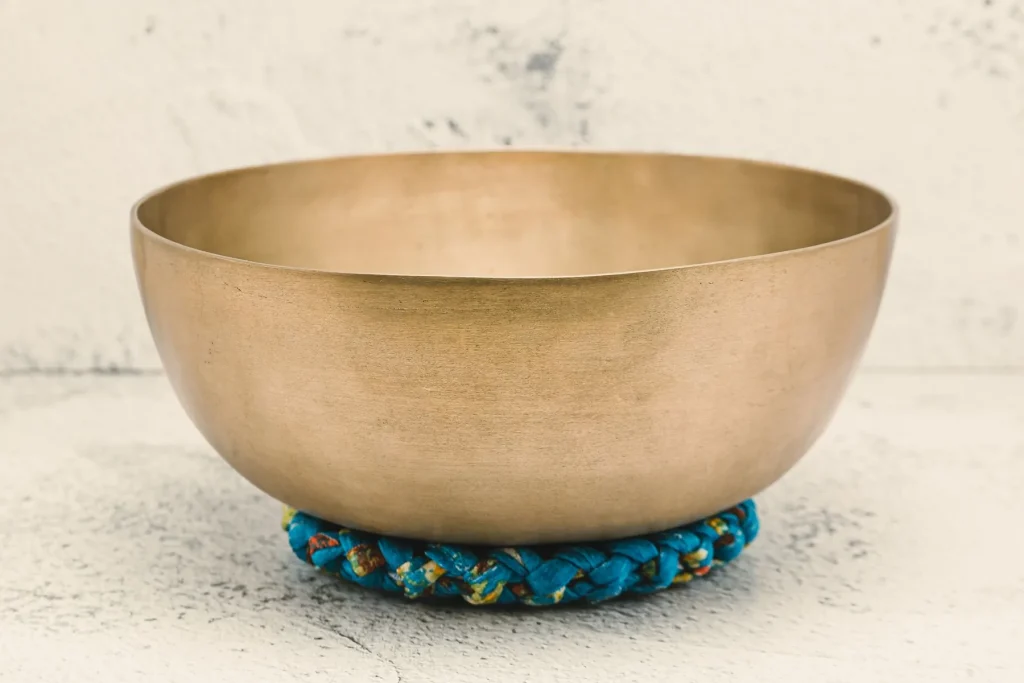
Welcome to this practical guide to producing beautiful vibrations with your bowl.
This article explains the movements, mallet, and attentive listening needed for a practice that respects the spirit of sound therapy.
There is a clear distinction between making the bowl sing by rubbing it and making it ring by striking it. The stick-slip effect, comparable to what happens with a violin, creates vibration when your hand stays relaxed.
A room temperature of 20 to 25 °C and a bowl warmed slightly in your hands encourage a more harmonious resonance. The result depends on the bowl, the mallet, your posture, and the consistency of your movement.
This section begins a step-by-step progression: understand the principles, learn the methods, refine your technique, and choose accessories. The aim is to make the practice accessible, enjoyable, and respectful.
Understanding the Tibetan singing bowl today: vibration principles and intention
To understand a bowl’s song, first understand the mechanism that makes it vibrate. The stick-slip effect occurs when the mallet rubs against the rim: the metal slips and then catches, setting the whole bowl resonating. Nearly 80% of the vibrations are concentrated at the rim, which makes the point of contact important.
There are two complementary movements. Making the bowl ring means striking it gently with a suede-covered mallet, then listening as the sound fades over 15 seconds to a minute. Making the bowl sing involves rubbing the outside of the rim in a circle, clockwise or counterclockwise according to your intention.
A steady movement and controlled pressure keep the vibrations stable and enveloping. A room at a comfortable temperature and a bowl warmed between your hands improve the harmony of the sound.
Listen, breathe, and adjust your position: let your intention guide your energy. Paying attention to how your body feels helps you correct the movement without forcing it. This foundation prepares you for the practical methods that follow.
How to make a Tibetan singing bowl vibrate without mistakes: essential methods
For a pure sound, use simple, steady movements. Here are two complementary methods and tips for recognizing the point of saturation.

The rubbing method — three stages
A light initial impulse: start the vibration with gentle contact.
Rub around the outside: maintain a slow, steady movement. Hold the mallet vertically with a relaxed grip, and guide it with your arm rather than your wrist to keep a consistent speed.
Choose a direction: adjust the rotation to your intention to make the bowl sing.
The striking method and variations
Give the bowl a crisp strike with a suede-covered mallet, in line with its outer wall, then listen to the sound for 15 seconds to a minute.
Rhythmic variation: regular strikes can release energy; four strikes in the cardinal directions disperse the vibrations.
Recognizing and avoiding saturation
If the tone turns metallic or the mallet starts to bounce, slow down, lighten your touch, and return to a fluid movement.
Clean the surface regularly and reduce the contact area for a purer sound.
Suggested practice: a few minutes each day, with notes and adjustments, will help you refine your hand and arm movements. To explore this guide further and master the art of making the bowl sing, patience and attentive listening remain essential.
Holding and positioning the bowl and mallet for fluid practice
How you hold the bowl affects sound projection, tone, and stamina. Depending on the effect you want, you can rest it on your fingertips or in the palm of your hand.
Fingertips or palm
Resting the bowl on your fingertips lets the sound spread in all directions. It projects more widely, and the vibrations travel through the body.
This grip is more tiring, however. Alternate it with holding the bowl in your palm.
Holding the bowl in your palm produces a more contained and often more “vibratory” effect. It reduces the volume but encourages close listening.
Dominant hand, heart height, and arm movement
Position the bowl at heart height, 20 to 30 cm from your body. Hold it with your non-dominant hand and hold the mallet with your dominant hand.
Keep your hand flat and your fingers spread so you do not dampen the wall, especially with an engraved Tibetan singing bowl, whose raised details affect its response.
Let your arm guide the rubbing movement and limit sudden wrist movements. This method stabilizes the tone and helps preserve your stamina.
- Alternate grips to rest your hand.
- Adapt your grip to the bowl’s diameter and weight: for a heavy bowl, use your palm or a stand.
- Try holding the mallet like a pen, with moderate pressure, to make small adjustments.
Refining the sound: speed, pressure, rubbing areas, and surroundings
Finding the right balance between speed and pressure produces a stable, rich note.

Slow speed and controlled pressure
A slow, steady speed stabilizes the harmonics. If you move too quickly, the point of saturation creates dissonance. If you move too slowly, the sound becomes weak.
Ease the pressure of the mallet slightly to restore vibration when the tone becomes harsh. Slow down a little and adjust its path.
Upper or lower rim
Rubbing near the top of the rim produces a clearer, higher sound. Rubbing the lower third brings out fuller low tones.
An engraved Tibetan singing bowl responds differently depending on its raised details: engravings emphasize certain partials. On smooth surfaces, choose a suede-covered mallet to limit squeaking.
Temperature and warming the bowl by hand
Practice in a room at a comfortable temperature, between 20 and 25 °C. Warming the bowl with your hands or in the sun for a few minutes extends its resonance.
Slight warming improves the harmony, helps make the bowl sing, and prolongs its song.
Care and a simple routine
Wipe the bowl gently after each session. Avoid abrasive products, which damage the rim and alter its sound.
Listen to the sound fade between attempts: its duration, from 15 seconds to a minute, tells you about the partials and guides your adjustments.
| Element | Recommended action | Expected effect |
|---|---|---|
| Speed | Slow and steady | Stable harmonics |
| Pressure | Controlled, with a relaxed grip on the mallet | Less saturation |
| Rubbing area | Higher for treble, lower for bass | Control over tone |
| Temperature | 20 to 25 °C, warmed by hand | Longer resonance |
| Care | Gentle wiping, without abrasive products | Purer sound |
Practical tip: note the speed, rubbing area, and pressure that work for each bowl. This complete adjustment guide will help you refine your practice and feel the vibrations through your body during sessions.
Accessories and stands: mallets, sticks, cushions, and suction cups
Sometimes a simple change of mallet or cushion is enough to reveal hidden partials.

Choosing the right mallet for the bowl’s diameter
Match the mallet’s diameter and density to your Tibetan singing bowl. A mallet that is too large produces a muddy, overly low sound. If it is too small, the sound becomes high-pitched or incomplete.
Try several models and record the results. These trials help you find the balance of harmonics that makes the bowl sing with subtlety.
Suitable rings, cushions, and stands
Fabric or silicone rings, wicker bases, or cushions: choose a support whose diameter does not constrict the bowl’s wall.
Avoid direct contact between skin and metal during a sound massage. Use a thin cloth or towel to limit unwanted transfer.
Suction cups in sound massage: benefits and limits
A suction cup makes it easier to move the bowl along the body. However, it reduces the sensations felt by the person playing it.
“A bowl held in the hand remains the standard for attentive listening; a stand is useful for heavy bowls or long sessions.”
- Keep the mallet and bowl aligned when striking or rubbing.
- You can hold the bowl in your hand to control your movement better through touch.
- Record your trials and consult the supplier’s guide to use any available discount code.
Good session practices and safety: playing well without overdoing it
The golden rule in sound therapy is moderation: after a precise strike on the outside of the bowl, take time to listen as the sound fades.
After each strike, let the sound fade for 15 to 60 seconds so the wave can unfold. This pause helps the body and mind absorb the vibration.

Strikes, exceptions, and progression
In ordinary practice, strike the outer wall with moderate force. Avoid striking too hard, which makes the wall tense.
To release energy, use rhythmic strikes or patterns, such as four strikes in the cardinal directions.
If the bowl is resting on a person, some practitioners strike its inner wall lightly for gentler contact.
Precautions and hygiene
Never place a Tibetan singing bowl on the body of someone under 21. You can, however, make it ring from about 20 cm away.
Breathing, hydration, and pace
Encourage slow breathing before and during the session. Drink water before and afterward.
Spacing sessions 24 to 48 hours apart supports body and emotional integration.
| Practice | Recommendation | Effect |
|---|---|---|
| Strike | On the outer wall, with moderate force | Clarity without saturation |
| Silence | 15 to 60 seconds after the strike | Time to absorb the sound |
| Safety | Keep a distance of 20 cm from people under 21 | Protection of the body |
| Frequency | 24 to 48 hours between sessions | Better absorption |
Record how you feel to build your complete guide and adapt the methods and movements to each person.
Conclusion
Remember the essential movements to make this practice a calming experience.
Two approaches produce relaxing vibrations: continuous rubbing in the rubbing method and individual strikes. Your posture, how you hold the mallet, and how you listen to the fading sound guide your hand toward a safe movement.
A few adjustments are often enough to improve the sound. Choose short, regular sessions of 1 to 3 cycles a day to enrich the experience and steady your movement.
Build your complete guide to adjustments based on the bowl’s diameter and support, whether you hold the bowl in your hand or use an engraved Tibetan singing bowl. Gentle care and a suitable support preserve the purity of its song and encourage relaxation.
Finally, explore sound massage with respect, space out your sessions, and stay hydrated to get the most from it.