
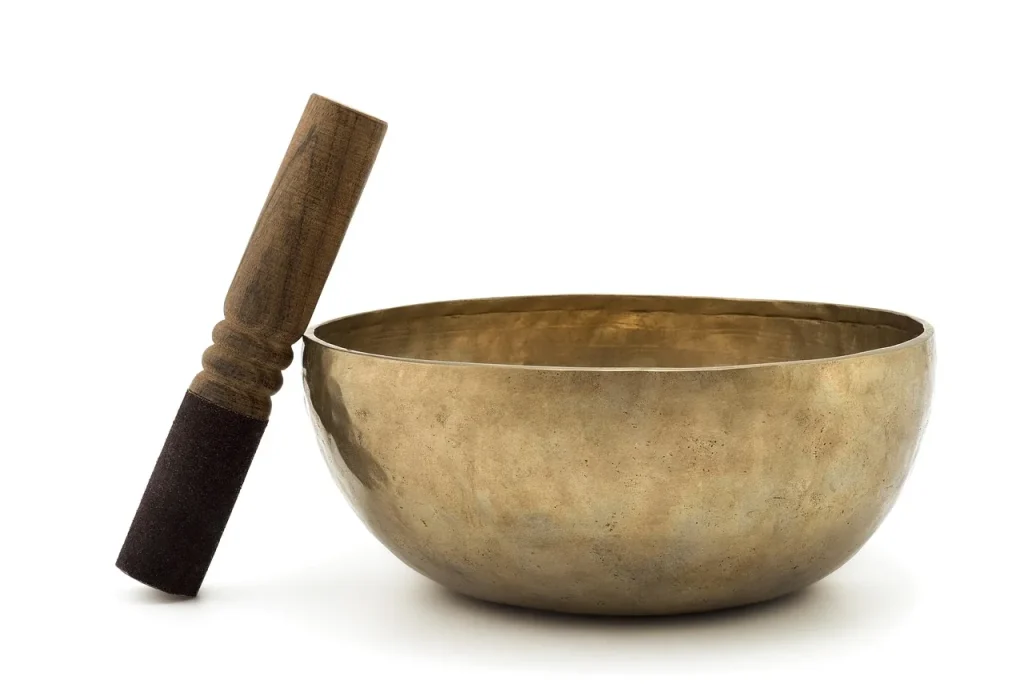
This page brings together clear answers to the main questions about the meaning and use of these instruments. You will find practical guidance on sound quality, traditional craftsmanship and care.
Artisans have imported and selected these pieces since 2002. Many come from India and Nepal and are hammered using an old alloy formula.
This guide helps you distinguish a handmade piece from an industrial product and explains how materials and technique affect the experience and sense of well-being when you use it.
To learn more, read our complete article and follow these simple tips to preserve the brightness and musicality of your bowls.
Understanding Tibetan singing bowls today: meaning, sound and use
Today, these instruments have a place in sound practices and wellness sessions. They help create a setting for meditation, sound massage or relaxation.
What is a Tibetan singing bowl, and how does it differ from an ordinary bowl?
A Tibetan singing bowl is a harmonic instrument designed to produce sustained sound and vibrations. Unlike an everyday bowl, it gets its rich harmonics from its alloy, thickness and hammering.
How to make a bowl sing: movements and tools
To produce a steady sound, hold the mallet in one hand and the bowl in the other, with your elbow horizontal. Slowly move the striker around the rim, applying light, continuous pressure.
The leather side produces lower notes, while the wood produces higher ones. Aim for a slow, even movement instead of speed.
Vibrations, harmonics and meditation
Vibrations travel through the body and encourage relaxation. The harmonics create a sense of sonic space that helps quiet the mind.
“Let the sound develop: the tone opens up gradually, without forcing it.”
For more on technique and care, read our guide to using a Tibetan singing bowl.
Composition and craftsmanship: alloys, metals and ancestral skills
The metal and the hammering give the sound its character and duration.
The seven traditional metals—copper (Venus), tin (Jupiter), iron (Mars), mercury (Mercury), silver (Moon), lead (Saturn) and gold (Sun)—form a sonic cosmology.
The balance of these metals creates a rich tone and the range of harmonics sought by practitioners.
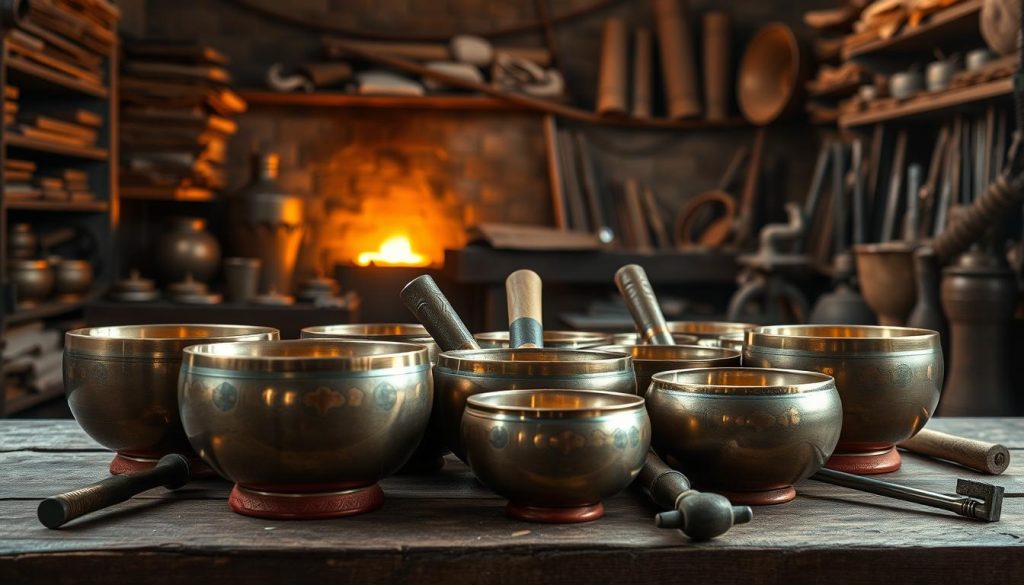
Handcrafting and industrial production
Traditional production relies on hand hammering. Sometimes five artisans take part in cutting, heating, hammering, turning and finishing.
The work distributes tension and tunes the bowl wall; each hammer blow affects the evenness of the base and the stability of the vibrations.
The season plays a role: bowls made in winter often hold their sound better. Summer heat can affect the metal’s molecular structure and the hammering process.
| Criterion | Handcrafted | Industrial |
|---|---|---|
| Alloy and purity | Traditional quality control, subtle variations | Rolled metal, standardized composition |
| Sound quality | Rich tone, long sustain | Short sustain, less balanced overtones |
| Visual clues | Hammer marks, visible variations in thickness | Uniform surface, even rims |
“You can hear a good composition: a clear attack, steady sustain and effortless vibration.”
To explore these technical aspects further, read a specialist blog before buying a bowl.
Age, origin and the authenticity of “antique bowls”
A bowl’s age can often be seen in the texture of its metal and the depth of its oxidation.
An older example is generally at least 30 years old. This estimate rests mainly on visible craftsmanship: hammering, thickness and variations in the bowl wall. The patina should extend into the material; it differs from a superficial chemical patina.
Practical clues for identifying a bowl
- Base and shape: a flat base and straight sides often point to Odisha.
- Inward-curving sides: more enclosed shapes suggest Bengal or Nepal.
- Double wall: rare today, it is often associated with Odisha and older craft traditions.
Many pieces come from local markets in India and Nepal. Their exact place of manufacture often remains unknown because supply chains pass through collection points and traders. Several historic workshops in Odisha and Assam have closed, making attribution difficult.
“Trust the metal and the sound: hammer marks and sustained vibration tell you more than claims do.”
If in doubt, listen to the bowl. A gentle attack and long sustain often confirm what you have seen. Ask the seller questions and, if possible, request recordings so you can compare bowls remotely.
Frequently asked questions about Tibetan singing bowls: benefits, massage and energy
During a session, the practitioner creates a soundscape that guides breathing and relaxes the nervous system.
Effects on the body and well-being
Vibrational massage: bowls are placed on and around the body to release tension. Pressure, striking and circular movements create deep relaxation.
Reported results: better sleep, reduced muscle tension and a feeling of release.
Emotional and mental effects
Vibrations help reduce stress. They improve concentration and mental clarity.
Many people report a sense of safety and a lasting ability to let go.
Cleansing a space and balancing the chakras
Singing bowls are also used to set stagnant energy in a space in motion again.
For balancing, specific notes are used: C (root), D (sacral), E (solar plexus), F (heart), G (throat), A (forehead), B (crown).

| Use | Technique | Main effect |
|---|---|---|
| Massage on the body | Placement and circular movements | Muscle relaxation |
| Emotional wellness session | Pressure and pauses | Stress reduction |
| Cleansing a space | Moving notes through the space | Getting energy moving again |
“The bowl’s intensity and quality influence the effect more than loudness does.”
To learn more about the benefits and methods, read our guide to the benefits of singing bowls.
Care, cleaning products and good everyday habits
A clean bowl can vibrate more freely.
How to clean a bowl without damaging it
Use simple cleaning products: soapy water, white vinegar or lemon juice, applied with a soft, nonabrasive cloth.
Always rinse with clean water and dry immediately to prevent oxidation. Never leave the surface wet, as this could affect its tone.
Avoid abrasives and harsh solvents: they alter the bowl wall and reduce sustain. If in doubt, test the gentlest method on a small area.

Storage, oxidation and precautions for different environments
Store your bowls on suitable cushions, away from changes in temperature and humidity. A ventilated space helps preserve the patina and purity of the sound.
- Keep bowls separate to protect their rims from small knocks.
- In humid places, add moisture-absorbing packets and watch for spots.
- After cleaning, play the bowl to check its attack and sustain.
“Clean sparingly but thoroughly: the patina tells the metal’s story and does not prevent beautiful vibrations.”
Regular care also improves the listening experience: a clean surface lets the harmonics ring out and makes it easier to set the bowl vibrating.
Conclusion
In closing, remember that a Tibetan singing bowl’s tuning and a steady movement are essential.
Choose a handcrafted piece and learn the technique with a leather or wooden mallet. Consistent contact produces a steady, rich vibration. During massage, place the bowls and play them attentively: this encourages relaxation, better sleep and the release of bodily tension.
The benefits include emotional balance, mental clarity and a real sense of peace. To preserve the tone, clean with soapy water, vinegar or lemon juice, then rinse and dry immediately. Store the bowls somewhere dry, on suitable cushions.
Invest in a well-matched set and practise regularly: each session sharpens your listening and strengthens the instrument’s energy.