
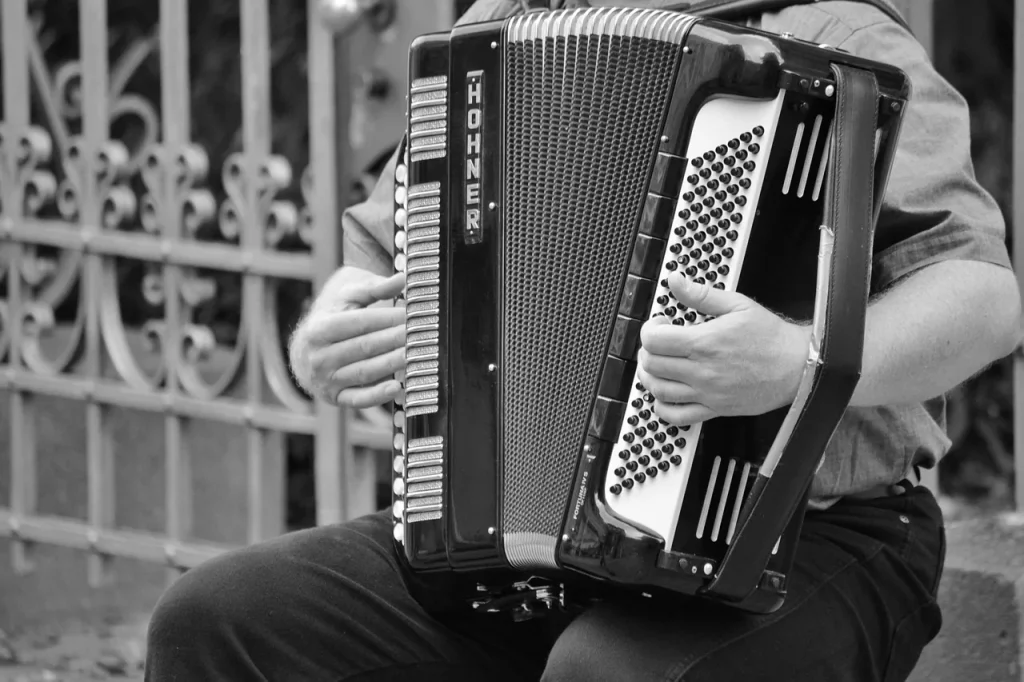
André Verchuren, born on December 28, 1920, left his mark on the history of French music. With more than 70 million records sold, he was the greatest accordionist of his time. Nicknamed “Verchu” and “the king of musette,” he won the hearts of millions of fans.
His career spanned more than 80 years. He recorded 777 albums and performed at more than 10,000 shows. His signature piece, “Les Fiancés d’Auvergne,” sold more than 10 million copies, a testament to his immense popularity.
Beyond these impressive figures, Verchuren reinvented the genre with his “bal-music-hall” format. This blend of music and entertainment brought generations onto the dance floor. In this article, we explore his life, the hardships he endured, and his legacy.
1. André Verchuren’s origins and youth: the making of a legend
André Verchuren, whose family had deep Belgian roots, was surrounded by music from childhood. Born on December 28, 1920, he grew up in a family where the accordion was far more than just an instrument. His grandfather, Petrus Verschuere, was already a well-known accordionist, and his father, Raymond Verschuere, carried on the tradition.
Raymond, a professional accordionist, founded an accordion school in Neuilly-sous-Clermont. The school welcomed up to 180 students, reflecting his desire to share his passion. André began learning the accordion from his father at age 4: the first step toward an exceptional musical career.
At age 6, he earned his first performance fee playing at a dance in Ponchon, accompanied by his mother on drums. This marked the beginning of his life on stage. He earned 11.50 francs. As a teenager, he divided his time between various odd jobs and teaching accordion at his father’s school.
In 1936, at just 16, he won the prestigious international accordion competition in Soignies. By playing the overture to Les Saltimbanques while standing, he challenged the conventions of the day. King Leopold III of Belgium presented him with the trophy. That same year, he placed eighth at the International Accordion Competition in Paris, held at the Moulin de la Galette.
The Second World War marked a turning point in his life. André joined the Resistance and helped downed Allied airmen hide. Denounced in June 1944, he was arrested by the Gestapo and sent to Dachau. On July 14, 1944, he showed immense courage by singing La Marseillaise with his fellow prisoners, defying their captors.
After these terrible ordeals, he was transferred to the Neckarelz camp. His story is also one of deep commitment to freedom. He became a naturalized French citizen on April 5, 1957, another milestone in his remarkable life.
2. André Verchuren’s musical career: the journey of a musette maestro
After the war, André Verchuren had to regain his dexterity to pursue his musical passion despite the lasting effects of his deportation. In 1948, he resumed playing dances in the Oise department and neighboring areas. That year, he also opened an accordion school that attracted up to 180 students.
A decisive turning point came in 1950. Thanks to his friend Tony Murena, he appeared on the popular Radio Luxembourg program “Swing contre musette.” This appearance launched his rise to fame. In a memorable musical contest on the Moulin-Rouge stage, he faced a jazz orchestra before an audience of ten million radio listeners. His success was resounding.
With the help of Louis Merlin, he signed with Decca, his first record label. He recorded his first three 78 rpm records and his first 45 rpm single. On December 16, 1951, he became a full member of SACEM, a sign of his recognition in the music world.
In 1956, he made a landmark appearance at the Olympia in Paris. He became the first accordionist to perform there as a supporting act for three weeks. His presence on the radio was equally significant: he hosted programs for seventeen years on RTL and thirteen years on Europe 1. He became a familiar voice to many listeners.
Throughout his career, he traveled across France and gave an average of 150 shows a year. He invented the “bal-music-hall” format, combining music and entertainment. André Verchuren also ventured into cinema, appearing in films such as “Gueule d’ange” (1955) and “Les femmes joyeuses du Tyrol” (1964).
In 1968, he published his memoirs, “Mon accordéon et moi,” written with his friend and fellow accordionist Lucien Millot. The book tells the story of his exceptional journey and his passion for music.
| Year | Event | Impact |
|---|---|---|
| 1948 | Resumed playing dances and opened an accordion school | Taught 180 students |
| 1950 | Appeared on “Swing contre musette” | National fame |
| 1956 | First performance at the Olympia | Pioneered accordion performances on stage |
| 1968 | Published “Mon accordéon et moi” | Passed on his musical legacy |
3. Why André Verchuren remains a musette accordion legend: contributions and legacy
André Verchuren’s musical legacy spans generations. His contribution to French popular music is immeasurable. He modernized the genre and made it accessible to a wider, younger audience.
3.1. Musical innovation and the popularization of musette
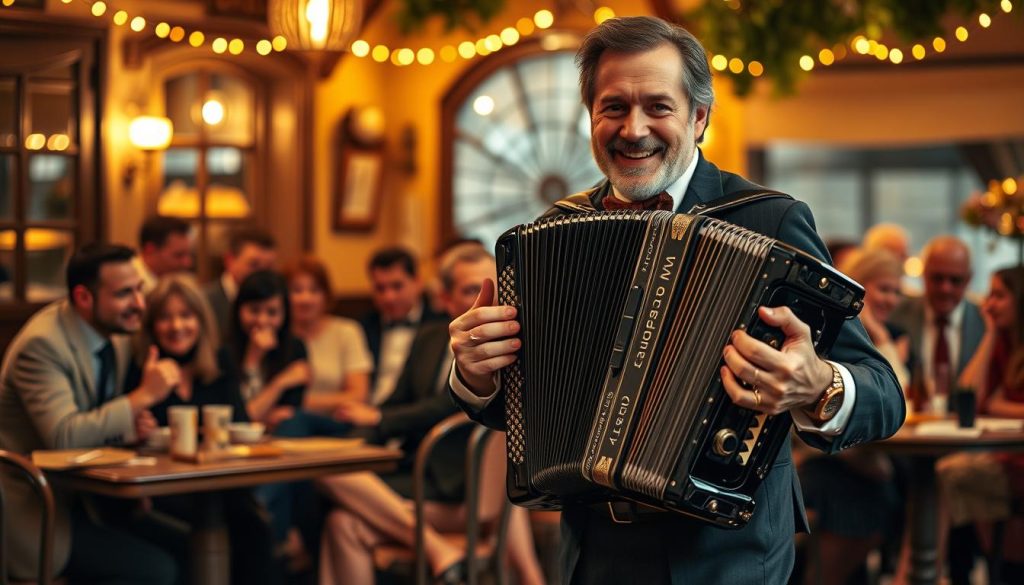
André Verchuren redefined traditional musette. By incorporating contemporary elements, he won over a new audience. His “bal-music-hall” format revitalized dances by blending dancing with stage entertainment.
3.2. Enormous success: record sales and a lasting mark on music
André Verchuren’s success was phenomenal. His signature piece, “Les Fiancés d’Auvergne,” sold more than 10 million copies and topped the charts for 11 months. In March 1958, he celebrated his first gold record for one million records sold.
In all, he recorded 777 albums and sold more than 70 million records. His shows drew more than 40 million audience members and brought 17 million couples onto dance floors around the world.
3.3. Cultural influence and the celebrated “bal-music-hall” format
The “bal-music-hall” format set Verchuren apart. He created an experience that brought every generation together on the dance floor. This blend of music and comedy sketches revitalized traditional dances.
By becoming the first accordionist to release a compact disc, he also showed his ability to adapt to technological change. His concert on January 3, 2007, at the Elispace in Beauvais celebrated 80 years of his career and demonstrated his artistic longevity.
4. Awards and recognition: honoring a life devoted to musette
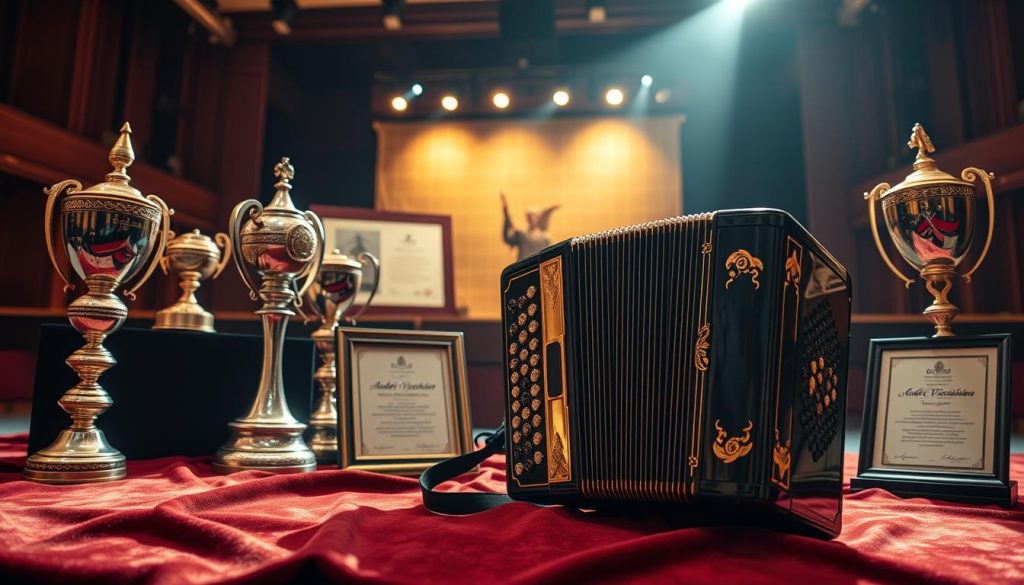
André Verchuren’s career was marked by awards that attest to his exceptional talent. Over the years, he received numerous prizes recognizing his influence on French music. Among them, the prestigious Académie Charles-Cros award and the Francis Carco Prize for his album “Parade des Succès 1960” stand out.
4.1. National and international awards
André Verchuren won several awards that shaped his career. His victories in international competitions, including first prize in Brussels and first prize in Paris, were key milestones on his path as a virtuoso accordionist. These successes helped him gain recognition and establish his reputation in the music world.
- Grand Prize for Jukebox Popularity, reflecting his success with the public.
- Grand Prize of the French Record Academy, recognizing the importance of his work.
- SACEM Grand Prize for Instrumental Popular Music, honoring his talent as a composer.
4.2. Honors for his Resistance service and musical career
Alongside his musical achievements, Verchuren was honored for his service during the war. He was made an Officer of the Legion of Honour after being named a Knight on May 5, 1986, then promoted to Officer on November 4, 1997. This recognition was tied to his experience as a former deportee and Resistance member.
He also received a certificate from President Eisenhower for his bravery. His promotion to Commander of the National Order of Merit on November 17, 2006, by President Jacques Chirac underscored his exceptional life.
4.3. His legacy after death and place in collective memory
André Verchuren left a lasting legacy. His memory lives on in French culture, notably through the tributes paid at his funeral on July 17, 2013, at the Church of Notre-Dame-de-l’Assomption in Chantilly. His two sons, Harry Williams and André Verchuren Junior, carry on his musical legacy.
“Music is a universal language, and I have always wanted my notes to speak to people’s hearts,” he said. This quotation sums up his devotion to music and his desire to move people.
5. Conclusion: André Verchuren’s lasting mark on French music
André Verchuren left an indelible mark on French music. He died on July 10, 2013, at age 92, and thousands of fans gathered to pay tribute at his funeral on July 17, 2013.
During his career, he traveled 7 million kilometers by car and one million by plane, touching millions of hearts. With more than 70 million albums sold and 777 recordings, his success was unparalleled. His final concert at the Olympia, in September 2003, celebrated his 10,000th show, a memorable milestone.
André passed his passion on to his sons, Harry and André Junior, who carry on his musical legacy. His music continues to inspire new generations and bring them onto the dance floor: his influence lives on long after his death.