
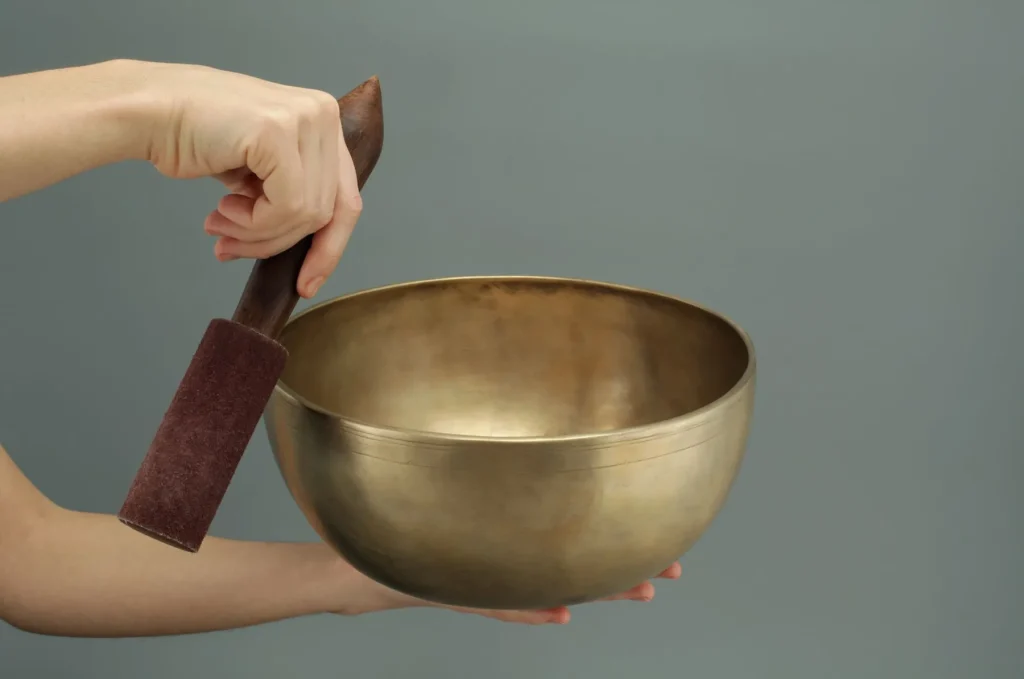
Goal: this guide explains, step by step, how to produce a steady, harmonious sound with a singing bowl. It covers the two main methods and the adjustments that make all the difference.
What is it? A Tibetan singing bowl is a musical instrument that vibrates when it is rubbed or struck with a measured touch. Understanding this mechanism speeds up learning.
There are two approaches: striking for an immediate sound and rubbing for a long resonance. How you hold the bowl matters: rest it on an open palm or a donut-shaped cushion without gripping its sides.
We will see how the angle of the stick (90°), steady pressure, even speed and contact point let you shape high and low tones. Avoid striking too hard, tilting the stick or gripping the mallet tightly.
Benefits: playing with the right technique produces a soothing sound that can help with relaxation and concentration. The guide follows a clear sequence: understanding the instrument, posture, striking, rubbing and fine adjustments.
Practice for a few minutes each day: patience and consistency are enough to steady your movements.
Understanding the Instrument and Your Purpose for Playing
Good sound begins with understanding the instrument and your purpose for playing it. The Tibetan singing bowl is a handcrafted instrument made from metal alloys with a long history. Traditional models often combine seven metals, each with its own symbolism.
It works through a process called stick-slip: friction between the stick and the bowl’s wall creates and sustains vibrations. Pressure and the consistency of your movement determine how steady the sound is.
- Nature of the instrument: its material, shape and alloy affect the richness of its harmonics and how easily it plays.
- Purpose of your practice: meditation, relaxation, purification or sound therapy influence your movements, intensity and playing time.
- Relationship between movement and body: alignment, breathing and relaxed shoulders improve the transfer of energy to the bowl.
Over the years, techniques have been refined to produce bowls known for their stable vibrations. Understanding their acoustics and the role of their materials helps you anticipate the adjustments needed.
Practical tip: choose short, regular sessions. A well-made Tibetan singing bowl is easier to make sing and offers a rich range of tones. To learn more about the movements and uses, consult this practical guide.
Guide to using Tibetan singing bowls
Prepare Your Tibetan Singing Bowl and Posture for a Harmonious Sound
A stable posture and proper hold produce clear, lasting vibrations.

Holding the instrument correctly reduces unwanted noise.
Hold It Without Damping the Vibrations
Place the bowl in your non-dominant hand, with your palm open and fingers relaxed. Do not close your hand around its wall: support the bowl without gripping it.
If you prefer not to hold it, use a donut-shaped cushion. This support allows air to circulate and promotes more resonance than a hard surface.
How to Grip the Stick and Mallet
Hold the stick like a pen, keeping your wrist relaxed. Hold the mallet the same way; for the rubbing technique, place your hand close to the leather.
Body Position and Alignment
Choose a comfortable position, sitting or standing, with your back straight and shoulders relaxed. Adjusting the height of your elbows makes a steady circular movement easier.
| Situation | Support | Advantage |
|---|---|---|
| Held in the hand | Open palm | Control and freedom of movement |
| Resting on a cushion | Donut or ring cushion | Stronger, steadier resonance |
| On a hard surface | Table | Risk of damping and unwanted noise |
How to Make a Tibetan Singing Bowl Sing Easily by Striking It
Striking produces an immediate sound: the timing of the movement and the rebound make all the difference.
The movement is a crisp tap on the outer wall near the rim, aimed at its upper section. Position the tool a few centimeters from the bowl, then make a small swinging motion with your wrist to strike it precisely.
The Right Movement
A brief, clean rebound prevents the vibration from being damped. Keep the force moderate to protect your ears and allow the resonance to develop.
- Position the tool a few centimeters from the rim to guide the strike.
- Aim near the rim: this area produces the longest-lasting sound and avoids a sharp clack.
- Control its path: make a small swinging movement with your wrist without moving your whole arm.
- Keep the tempo: wait until the sound fades before striking again.
Choosing Between a Stick and a Mallet
For bowls under 15 cm in diameter, choose a light stick. For larger models, a heavier mallet brings out richer harmonics.
“A good rebound followed by rich resonance shows that the tool and technique are well matched.”
To learn more about the movements and uses, consult this practical guide.
Make a Tibetan Singing Bowl Sing by Rubbing It: Step by Step
The rubbing technique turns simple friction into sustained resonance. If needed, begin with a light tap to start the vibration. Then hold the stick vertically, at 90° to the rim, and maintain contact.

Angle, Guidance and Speed
Keep your wrist steady and let your arm and shoulder guide the movement. Lead the rotation with your arm rather than your wrist. Move slowly and evenly to sustain the note without choking it.
Materials and Contact Points
For a lower tone, choose leather or felt. For a higher sound, use wood. Rub higher up for treble tones and lower down for bass tones.
Manage Overloading and Maintain a Continuous Sound
Keep the contact area as small as is effective. If the stick starts to jump, you have reached the point of overloading: reduce the pressure and slow the rotation.
- Start the vibration with a light tap, then keep the stick against the rim.
- Apply enough pressure without pressing too hard against the wall.
- Listen as the harmonics develop: the sound grows richer when your movement is right.
“A smooth, consistent rotation produces the steadiest note.”
Adjust the Sound and Solve Common Problems
Fine adjustments to angle, speed and pressure quickly clarify the tone.
To refine the note, keep the stick close to 90° and maintain steady speed and pressure.
For a higher sound, tilt the stick very slightly or move the contact point upward.
Adjust Speed, Pressure and Vertical Alignment
Keep the rotation and force of your movement steady. Small variations interrupt the resonance.
Try rotating in both directions; clockwise movement is often chosen in energy practices, but use whichever direction produces the best sound.
Why the Bowl Does Not Sing
Common causes include a hand gripping the wall, an overactive wrist or a tilted stick.
If your technique is correct but the sound remains weak, the quality of the alloy may be the cause.
Cleaning and Care for Clear Vibrations
Keep the surface clean: wipe the bowl’s wall and check the leather or felt on the mallet.
Avoid hard surfaces that dampen resonance, and record your settings (angle, position and tempo) for future sessions.
“Steadying your hand and listening without rushing often solves the simplest problems.”

| Problem | Likely cause | Simple solution |
|---|---|---|
| No lasting resonance | Gripping hand or uneven rotation | Open your palm, guide the movement with your arm and maintain a steady speed |
| Stick jumps | Excessive pressure or overloading | Reduce pressure, slow down, then begin again |
| Thin metallic sound | Unsuitable alloy or shape | Try another instrument or change mallets |
Include the Singing Bowl in Meditation and Wellness Practices
Introducing musical vibrations can help steady the mind and body during practice.
Suggested durations: allow 10 to 20 minutes for meditation and relaxation.
For daily personal practice, 5 to 15 minutes is enough.
Therapeutic sessions may last 20 to 60 minutes, depending on individual needs.
To purify a space, a few minutes per room is often effective.

Meditation, Relaxation and Sound Therapy
Give your sessions structure: begin with a gentle strike to focus your attention.
Continue by rubbing steadily to settle into a sustained state of awareness.
- Short daily session: 5 to 15 minutes to regain your focus.
- Longer meditation: 10 to 20 minutes for deep relaxation.
- Therapeutic session: up to 60 minutes, guided according to the person’s needs.
Purifying Spaces and Harmonizing Chakras
To purify a room, move through it slowly while striking and rubbing the bowl a few times.
Choose clockwise movement if your energy practice recommends it.
Opening a window slightly helps refresh the air and energy.
For harmonization, associate notes with energy centers: C (root), D (below the navel), E (solar plexus), F (heart), G (throat), A (forehead) and B (crown).
“Respect how your body feels: adjust the intensity and duration to your sensations.”
To learn more about using Tibetan singing bowls in meditation, see this guide to meditation and Tibetan singing bowls.
Conclusion
Here are the key points for producing a steady, musical sound.
Keep your palm open or rest the instrument on a donut-shaped cushion. Learn two methods: striking for a clear attack and rubbing for a long resonance.
Key rules: hold the stick at 90°, maintain steady pressure and speed, and choose leather or wood according to the part of the sound you want to shape.
Match the mallet to the bowl’s diameter and listen to the vibrations to adjust your movements. Practice for 5 to 15 minutes a day, 10 to 20 minutes for meditation and up to 60 minutes in a therapeutic session.
Record your adjustments and how you feel to make progress quickly. To learn more about the method and movements, consult this practical guide: how to use singing bowls.