
This article aims to guide you in 2025 through the choice between a large instrument and a compact one, according to your practice, budget and experience level.
Size affects pitch, sustain and vibrations. A large bowl produces deep low tones and a long resonance. Small bowls offer clear tones that are useful for rituals or charging stones.
The choice depends as much on technical factors (diameter, thickness, material) as on how the bowl feels in your hand and body. Try several bowls, listen to the depth of their sound and check for harshness.
Choose a handmade bowl with hammer marks and a credible place of origin (India, Nepal or Tibet). To compare sizes and uses, see this practical guide to singing bowl sizes.
Tip: one quality instrument that speaks to you is better than a mismatched collection. Take time to try and listen.
Buying guide: how to choose a Tibetan singing bowl in 2025
Before buying, define your main purpose so you can match the material, diameter and budget to it. This step helps you decide how to choose a bowl for meditation, energy work, travel or a range of uses.
Material makes a substantial difference: a traditional alloy offers rich harmonics, while a quartz crystal bowl can be tuned precisely (432 Hz or 528 Hz). Weight increases with diameter: a larger bowl produces more low tones but is harder to carry.
- Define your purpose to guide your choice of shape and pitch.
- Material: metal for a warm sound, quartz for a precise frequency.
- Quality: a credible origin, hammer marks and a clear sound without harshness.
- Budget: include the mallet, cushion and accessories in the final price.
- Testing: in a shop, listen to the resonance; online, request a recording of each instrument.
Record the size, pitch, material and how each bowl feels so you can compare them. This short buying guide helps you choose a Tibetan singing bowl from the instruments discussed in this article.
Large, medium or mini: how size affects pitch, vibration and resonance
An instrument’s size shapes its tone and how long it resonates. Diameter affects perceived pitch: wide bowls produce lower notes, while small ones produce higher notes.
Diameter and frequency
As diameter increases, pitch generally falls and the sound projects more strongly. Small bowls have a crisp attack, but their resonance fades more quickly.
Wall thickness and sustain
A thick wall strengthens the fundamental note and extends the resonance. It provides stability and power for sound baths.
Practical examples
| Diameter (cm) | Sound character | Suggested use |
|---|---|---|
| 10 to 15 | Bright high notes, short resonance | Focus, rituals, cleansing |
| 15 to 24 | Balance of low and high notes | Daily meditation, energy work |
| 25 and above | Layered low tones, long resonance | Sound baths, deep grounding |
“Listen to the fundamental note, then the harmonics: the richness of the tone depends on the hammering as well as the diameter.”
- Choose a mallet suited to a large bowl so it does not muffle the note.
- A set of bowls in different sizes lets you create a full soundscape.
Energy associations: sizes, notes and chakras
In energy practices, the frequencies an instrument produces are associated with the body’s energy centers. Understanding these associations can help you focus your practice.
For the lower chakras, large bowls (25 cm and above) produce low tones associated with grounding and stability. They can draw attention to the pelvis and legs.
Center and expression
Medium bowls (15 to 24 cm) are associated with the heart and throat. They offer a warm tone for emotional balance and a clear attack for expression.
Clarity and intuition
Small instruments are associated with clarity and intuition.
“Choose the dominant note according to the center you want to focus on, then check it using a recording.”
- First, identify the chakra you want to prioritize.
- Match the Tibetan singing bowl’s size and note to your intention.
- Focus on one center per session, then progress from the bottom upward.
- Metal alloys produce harmonics valued in subtle energy practices.
Meditation and relaxation: which bowl should you use to calm mind and body?
A suitable soundscape can support physical relaxation and mental focus. For deep meditation, bowls measuring 20 to 30 cm or more create enveloping low tones. Their sound can encourage slower breathing and a sense of calm.
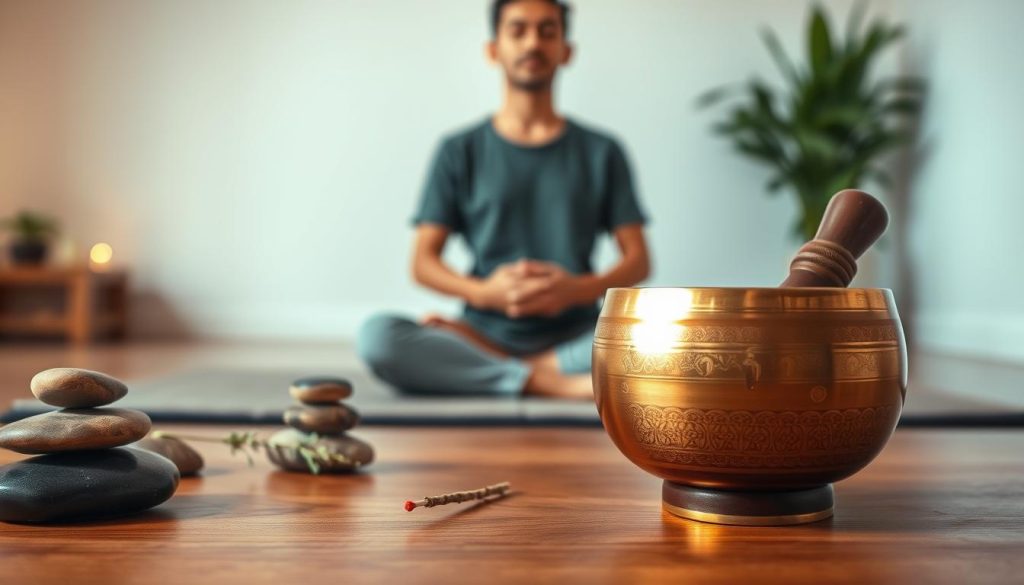
Large bowls and sound baths: immersion and calm
During a sound bath, layer the sounds of several instruments to create an enveloping experience. Their extended resonance invites you to let go.
Medium bowls remain practical for daily use: their weight is manageable and their range of sounds is broad.
Playing techniques: striking or circling the rim
Striking produces a clear attack and immediate harmonics. Circling the rim sustains the note and helps steady your attention.
- Suggested sequence: begin briefly with a small bowl, continue with an extended passage on a large bowl, then close gently with a medium bowl.
- Hold the bowl in a relaxed hand or place it on a cushion; do not grip it tightly, as this can muffle the vibration.
- Accessories: a felt mallet for a gentle strike; a wooden or leather covered striker to bring out the fundamental note when circling the rim.
- Daily use: 5 to 10 minutes of attentive playing can provide a noticeable sense of relaxation.
Follow the fading sound as you meditate: attentive listening brings the mind into the present. To refine your choice, learn more about the Tibetan singing bowl.
Energy work and harmonization: uses focused on the body and chakras
Working with the body’s energy centers combines careful placement of the instrument with attentive listening to its vibrations.

Safe placement and suitable areas
Always put a small cushion under the bowl to protect the skin and distribute its vibrations.
Avoid prominent bones; start with the abdomen or solar plexus for a gentler sensation.
Possible areas include the lower abdomen for grounding, the chest for heart opening, the throat for expression and the lower back for relaxation.
Precautions and method
Do not place the bowl on the head. Use caution with pregnant people and people with implants.
Always ask whether the vibrations feel comfortable and adjust their intensity.
Combining sizes and organizing a session
Work from the bottom upward, following the chakras. Strike the bowl lightly, then circle its rim to sustain the fundamental note.
Use a large bowl for layered low tones, a medium one for balance and a small one for precise work.
- Hold the bowl above a sensitive area if direct contact is uncomfortable.
- Suggested duration: 1 to 3 minutes per point, followed by a pause.
- Record immediate and later effects to refine your approach.
| Action | Area | Duration | Purpose |
|---|---|---|---|
| Gentle placement on a cushion | Lower abdomen | 1 to 3 min | Grounding, abdominal relaxation |
| Circling the rim | Chest | 1 to 3 min | Emotional openness |
| Precise work with the bowl held in the hand | Throat and lower back | 1 to 2 min | Clarity, muscle relaxation |
Practical tip: check that the instruments sound harmonious together. To compare models and materials, read this dedicated comparison.
Travel and rituals: mini bowls for cleansing a space and marking transitions
Small bowls appeal to practitioners who travel because they are easy to carry and have a crisp attack.
Transport: these 10 to 15 cm bowls are light, sturdy and easy to pack in a bag. A padded case protects the instrument in transit.
Ritual use: a clear ring can open a circle, refocus a group and mark the beginning or end of a session.
Cleansing: walk through each room, paying attention to corners, thresholds and passages as part of a ritual for clearing the energy of daily life.
Bring a small cushion to keep the bowl stable while traveling. It also protects delicate surfaces.
“Strike gently three times while breathing in, listen while breathing out, then walk mindfully to carry your intention through the space.”
- Suitable for small spaces (an office or bedroom) without disturbing others.
- Simple for teachers to use: a quiet sound can help mark time during a session.
- Lower starting cost than a large bowl, while remaining useful for rituals.
Metals, alloys and crystal: how materials affect sound and use
Material shapes an instrument’s sound character even more than diameter alone. Choosing between metal and crystal affects how you use the bowl, how long its sound lasts and your connection with it.
Seven metal alloy and hammering
Himalayan traditions are often associated with a seven metal alloy. Hand hammering creates complex harmonics and a warm tone.
Signs of craftsmanship: visible hammer marks, an uneven texture and a rich resonance. Metal accommodates small variations in playing technique and offers an organic sound that suits meditation.
- Rich harmonics
- Durability and a handmade character
- Wall thickness affects volume
Quartz crystal
Quartz crystal bowls, made using molds since the 1980s, offer a pure sound and precise tuning (432 or 528 Hz). Their sound projects more directly, so manage the volume in a small space.
Appearance, engravings and finish
Appearance can strengthen the player’s connection with the instrument. Engravings, patina and finish may encourage regular practice. Judge quality by listening for clarity, depth and an absence of harshness.
To compare models and materials, explore information about Tibetan singing bowls and refine your choice according to your intended use.
Quality and authenticity: how to recognize a genuine Tibetan singing bowl
Assessing an instrument’s authenticity takes a careful eye and a practiced ear. Begin by checking its origin. For traditionally made bowls, look for a documented origin in India, Nepal or Tibet.
Origin, marks and appearance
A handmade bowl has slight irregularities and hammer marks. These traces indicate handwork.
An unusually smooth, perfectly symmetrical object may have been machine made. Check the engravings, patina and finish.
Sound: clarity and sustain
The sound should be clear and deep, without aggressive harshness. Test the fundamental note and listen to the harmonics.
Check how it responds when you circle the rim: a good bowl should not shriek and should sustain its note under light pressure.
Be wary of very low prices
Consider what goes into the price: hammering time, metal alloy and finishing all affect value.
Ask for a recording of each instrument and listen on headphones. This helps you judge its sound before choosing.
- Check the origin: ask for the country and workshop.
- Inspect it: look for hammer marks, irregularities and patina.
- Listen: seek a stable fundamental note without harshness.
- Compare the price: check whether it reflects the alloy, metal and work involved.
| Criterion | Positive sign | Warning sign |
|---|---|---|
| Origin | India, Nepal or Tibet specified | Vague origin or factory production |
| Appearance | Hammer marks, patina | Overly smooth surface, perfect symmetry |
| Sound | Clear, rich in harmonics, long resonance | Harshness, resonance that fades quickly |
| Price | Consistent with the alloy and work involved | Very low price without details |
“Authenticity can be heard and seen: it is better to invest in one reliable bowl than to make several disappointing purchases.”
Try and test before buying: listening, feel and recordings
Before buying, there is no substitute for hearing and handling a bowl yourself. Testing lets you assess sustain, the depth of the harmonics and how the vibrations feel in your body.
In a shop: feel the vibrations in your hand and body
Hold the bowl in a relaxed hand, then strike it gently. Notice how the vibrations travel through your hand and the rest of your body.
Try circling the rim: the note should build without harshness, and the resonance should remain stable.
Online: request recordings of individual bowls
Request recordings of both striking and circling the rim, along with the diameter, weight and material. Listen on headphones to judge the depth of the harmonics.
Practical criteria: weight, grip and playing comfort
- Roughly time the resonance to compare several bowls.
- Assess the weight and grip if you plan to hold the bowl above the body.
- If permitted, record the sound on your smartphone so you can listen again later.
- Record how it feels (grounding, calming or clarifying) alongside the measurements.
Choose a seller who accepts returns if the bowl you receive sounds different from the recordings provided.
Large or mini Tibetan singing bowl: benefits and uses
The size you choose guides how you use the bowl: for extended immersion, rituals while traveling or daily practice.
Benefits of a large bowl
Deep low tones fill the room and support meditation. Sustained sound can accompany muscle relaxation.
This size suits group sound baths and whole body sessions: its layered harmonics support an immersive experience.
Strengths of a small bowl
Compact and precise, it can mark transitions in a session and accompany rituals for cleansing a space.
Easy to carry, it is practical for travel and short rituals.
When to choose a medium bowl
A medium bowl is a versatile choice for daily use.
It offers enough low tone to soothe and enough clarity to focus the heart of a regular practice.
Tip: if you buy only one bowl, choose a well made medium model. If you buy two, pair a medium and a large bowl to cover most uses.
“To choose a bowl, test its grip, weight and stability on a cushion: comfort affects everyday use.”
Budget, price and value: finding the right balance of quality and cost
Understanding why some bowls cost more than others helps you shop wisely. Price mainly depends on material, diameter, thickness and handwork.
Indicative price ranges
Entry level metal bowls can cost around €30 to €50. Be wary of very cheap pieces: the alloy and hammering may be of poor quality.
Small quartz crystal bowls often start at €100. They offer more precise tuning and stable frequencies.
Notes and frequencies of 432 or 528 Hz
Some practitioners seek frequencies of 432 or 528 Hz.
Quartz makes it easier to obtain a precise frequency, which may increase the price. A 440 Hz reference remains common for metal instruments.
Checklist for buying in France
- Define your main use.
- Choose the size, diameter and material (metal or quartz).
- Check the desired note and ask to try the bowl or hear a recording.
- Include accessories (mallet, cushion and case) in your budget.
- Prioritize sound quality over decoration.
| Factor | Effect on price | Guide |
|---|---|---|
| Material (metal or quartz) | High | Metal is more affordable; quartz costs more |
| Diameter and weight | Medium to high | A larger diameter usually costs more |
| Hammering and finish | High | Handwork increases the cost |
| Accessories | Low to medium | Check whether they are included |
“Start with a good medium bowl, then add to your collection according to how you use it: sound quality first, decoration second.”
Conclusion
In practice, size, material and feel determine how you use a bowl, how stable it is and how you play it.
Quick guide: large bowls suit deep immersion, medium bowls suit a range of practices and small bowls suit rituals while traveling. Material shapes the sound: metals offer abundant harmonics, while quartz offers precise tuning.
Try bowls in a shop or request recordings. Note their effects on your body and mind, and record your impressions to help choose an instrument for daily life.
Start with a versatile bowl, take time to get to know it, then add others as needed. The right Tibetan singing bowl is the one that speaks to you: listen and compare before choosing.