
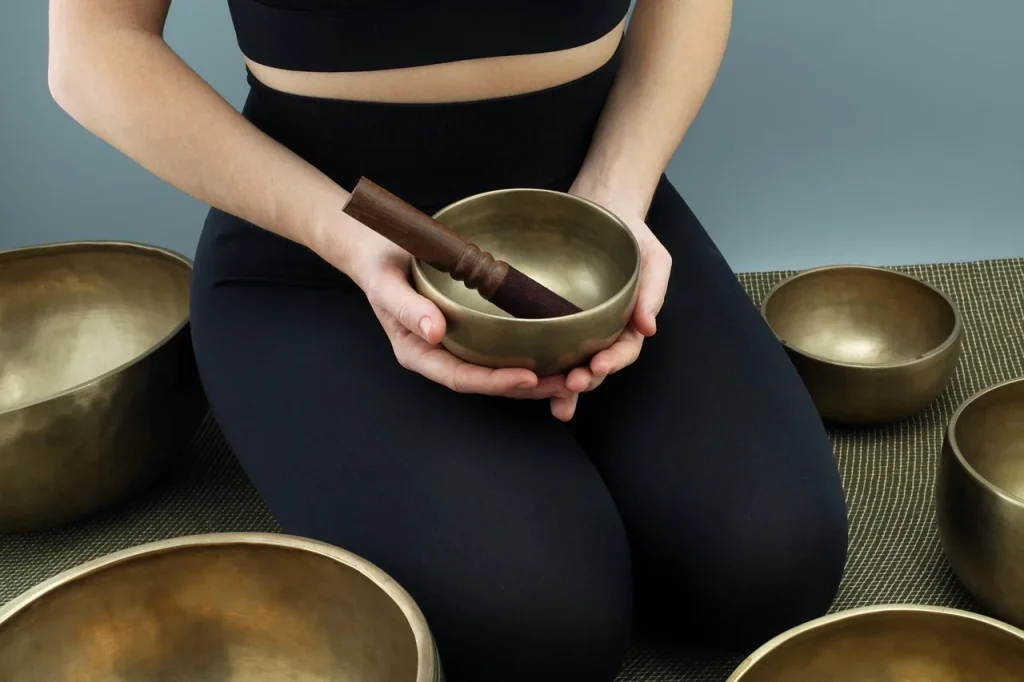
This guide helps beginners find a bowl suited to their practice. It explains the key criteria: material, size, note, frequency, manufacturing method, and budget.
Bowls are made from metal alloys or quartz crystal. Metal has a long Himalayan craft history. Crystal offers greater precision of note and frequency.
Size directly affects the character of the sound: a small diameter produces a bright, lively tone; a large diameter produces a deep, enveloping one. The modern standard for tuning is A at 440 Hz, but some crystal bowls are tuned with A at 432 Hz or are marketed with a frequency of 528 Hz.
Manufacturing matters: a cast bowl is more affordable, while a hand-hammered bowl offers rich overtones and longer sustain. Consider how it feels in your hands, its weight, and its portability.
Listening and feeling the vibrations are essential to avoid an impulse purchase. To proceed step by step, follow this roadmap and explore examples and recordings in our detailed guide.
Why this practical guide is for you today
With so many choices available, this article aims to simplify buying singing bowls. It offers clear pointers to save time and avoid common mistakes.
It combines history with contemporary uses: meditation, relaxation, sound therapy, and cleansing rituals. You will find practical advice on build quality, playing comfort, and portability.
We prioritize both objective criteria (diameter, weight, sustain, tuning) and subjective ones (how the bowl feels and its timbre). This makes the selection process simpler and faster.
The guide also explains how to compare bowls online through audio samples and in stores through hands-on tests. It describes simple striking and rim-rubbing techniques to produce a steady sound from the first time you play.
- Clarity: practical pointers to guide your experience.
- Practice: tests, accessories, and postures for comfortable playing.
- Confidence: insights from artisans and practitioners to help confirm your choice.
| Criterion | Online | In store |
|---|---|---|
| Listening | Audio samples and recordings | Hands-on playing and actual resonance |
| Feel | An impression from a distance | Immediate sense of vibration and comfort |
| Assurance | Standard return policies | Personal advice |
Beginner’s guide to choosing your first Tibetan singing bowl: a five-step roadmap
Before buying anything, decide how you will mainly use your instrument. This will help determine the diameter, material, and volume you need.

-
Define its purpose
Meditation: favor an enveloping timbre and a medium or large diameter.
Sound therapy: look for strong vibrations and long sustain.
-
Set a budget and priorities
Metal: accessible models start at around €100.
Prioritize tuning, sustain, or portability according to your practice.
-
Shortlist and listen
Choose a few models by diameter and material, listen to recordings, and try holding them.
-
Compare ease of playing
Cast bowls are easy to make sing. Hand-hammered bowls offer more overtones.
-
Confirm your choice with a mallet and your own senses
Felt softens the attack; wood emphasizes higher tones. Rub the rim to check for unwanted noises.
| Step | Key criterion | Practical recommendation |
|---|---|---|
| Purpose | Meditation / cleansing / sound therapy | Medium or large diameter for relaxation; very large for spaces and recharging stones (at least 15 cm for stones) |
| Budget | Metal or crystal | Metal: €100 |
| Quality | Sustain, overtones, stability | Rub the rim and check for unwanted noises |
Tip: listen several times, compare your options, and follow a buying guide to make your final purchase with confidence.
Metal or crystal: which material best suits your practice?
Between craftsmanship and precision, the material shapes how you use the bowl. Metal has a regional history spanning Tibet, India, and Nepal and a warm sound signature.
Metal-alloy singing bowls
Tibetan metal-alloy singing bowls embody tradition: hand hammering, engraving, and rich overtones. Compositions vary—brass, bronze, or the well-known so-called “seven-metal” formula—and each alloy colors the timbre.
Advantage: deep vibrations and an enveloping sound. They tolerate handling and remain suitable for frequent travel.
Quartz crystal bowls
Crystal bowls are recent instruments, with industrial production dating from the 1980s. They offer greater precision of note and frequency.
Their sound is often described as clear and powerful. At the same diameter, crystal is heavier and requires more care during transport.
Weight, transport, and durability
If portability matters, metal can be lighter and more resistant to knocks. Crystal offers the precise tuning sought for some practices, but it requires more careful handling.
- Appearance: engraving and a frosted or transparent finish can influence your final choice.
- Practicality: test the sustain, overtone balance, and playing comfort before buying.
Bowl size, weight, and shape: their effect on sound and vibration
Size and shape directly affect the character and reach of the vibrations produced. Diameter influences perceived pitch: a large bowl produces deep, soothing low tones, while a small one favors clear, stimulating high tones.
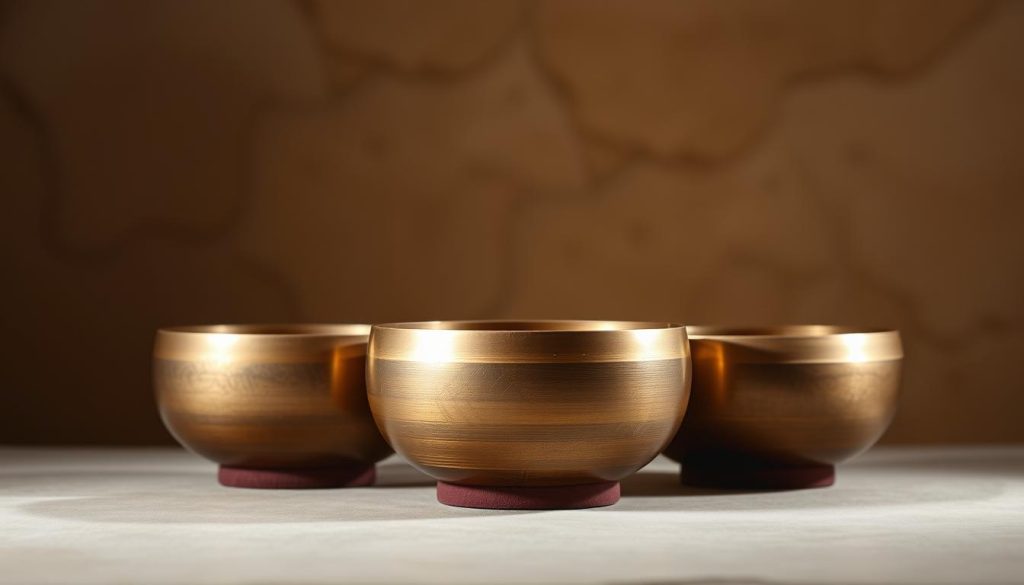
Weight does not increase in direct proportion to size. As diameter grows, the bowl becomes noticeably heavier. Holding a heavy instrument for a long time can be tiring, especially while moving or when letting someone feel its vibrations on their body.
The shape—its profile and wall thickness—affects sustain and sound projection. A thin wall favors a lively attack; a thicker wall can extend resonance and broaden sound dispersion.
Practical tip: for versatile use, favor a medium-sized model. A small bowl is easy to carry and can produce a lively sound; a large one may be preferable for cleansing a space and spreading sound more widely.
| Size | Typical use | Ease of handling |
|---|---|---|
| Small (≤ 10 cm) | Energizing, travel, high notes | Very easy to hold |
| Medium (11–15 cm) | Meditation, relaxation, versatile use | Comfortable and well balanced |
| Large (> 15 cm) | Space cleansing, deep sustain | Heavier; requires a support |
Before buying, listen to the resonance and check that the bowl is comfortable to handle. The best combination of size and shape is personal and depends on your preferences and intended uses.
Notes, frequencies, and chakras: making an informed choice
Understanding the relationship between notes and chakras can help you focus your sound practice. A suitable note may support a meditation session or energy work.
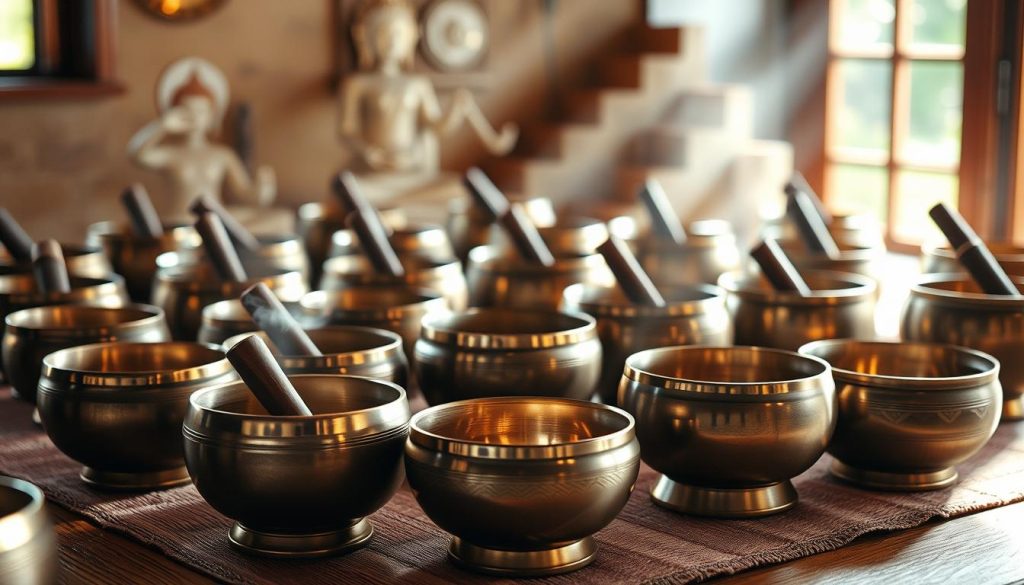
- C → root chakra
- D → sacral chakra
- E → solar plexus chakra
- F → heart chakra
- G → throat chakra
- A → third-eye chakra
- B → crown chakra
Choosing a note for a particular practice can help focus your intention. For example, C may suggest grounding, while F may invite openness of the heart.
Frequencies and tuning: modern standard tuning sets A at 440 Hz. Some practitioners prefer A at 432 Hz for what they perceive as a more “natural” sound, or seek 528 Hz for its perceived benefits.
Quartz crystal bowls often offer more precise tuning. Metal bowls vary according to their alloy and how they are made.
“Listen for accurate tuning and overtones: timbre and your own response remain your best guides.”
| Criterion | Effect | Advice |
|---|---|---|
| Note | Focus for energy work | Try notes associated with your chosen chakra |
| Frequency | Perceived sound quality | Listen and compare 440, 432, and 528 Hz |
| Material | Tuning precision | Favor crystal when exact tuning matters |
In practice, listen to recordings and try several models. A bowl that sounds harmonious and inspires you will suit your preferences better than one chosen only for its frequency.
Build quality: casting, hand hammering, alloys, and finishes
Whether a bowl is cast or hammered can dramatically change its sound.
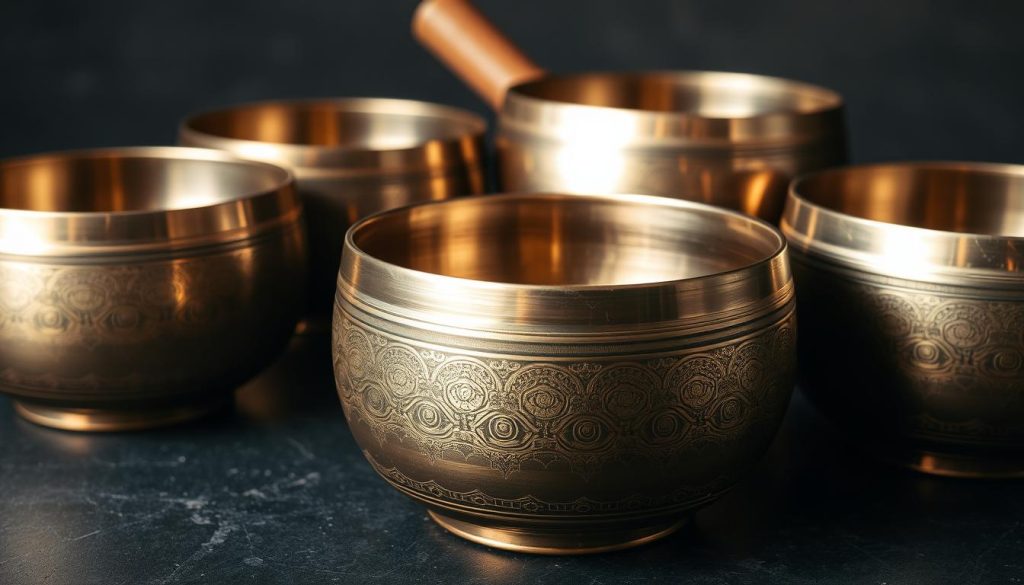
Cast bowls: the alloy is poured into a sand mold. The surface is very smooth, the timbre even, and the sustain shorter. This method produces affordable models that are stable to handle.
Hand-hammered bowls: an artisan shapes a metal disc by hammering it. Irregularities create rich overtones and longer sustain. This craft tradition gives each instrument its own character.
Alloys and their effect on timbre
Compositions vary: brass, bronze, or the well-known seven-metal formula. Each metal changes the color of the timbre and the perceived energy.
- Accessibility: cast bowls are easy for beginners to play.
- Expressiveness: hand-hammered bowls reveal more complex partials.
- Finishes: even thickness, a well-finished rim, and polishing affect note stability.
“A good hand-hammered bowl lets you hear overlapping overtones without harshness.”
| Type | Advantage | Sound |
|---|---|---|
| Cast | Even and affordable | Short sustain, consistent timbre |
| Hammered | Unique and rich | Long sustain, multiple overtones |
| Alloy | Variations in timbre | Brass, bronze, and seven-metal alloys affect the color of the sound |
Tip: test the response with different mallets, such as wood or felt, to assess how it suits your playing style and how long the sound lasts.
Artisans, origins, and exceptional series
An instrument’s origin often shapes its voice and finish.
Nepal and India: Nepalese workshops emphasize a strict craft tradition. Nepalese artisans work with high-quality metals and apply rigorous quality control. In India, more industrialized processes produce consistent and often more affordable series.
Origin influences the sound signature, alloy consistency, and finish. This helps explain why some bowls reveal a distinct personality from the first strike.
Notable series
Full Moon (Santa Ratna Shakya): made on full-moon nights, with a high tin content, premium positioning, and high quality.
PATAN (Kalyan Tamrakar): carefully formulated alloy, meticulous hammering and polishing, and a strong sound presence.
OM (Sajan Tapalyia): an alloy similar to that of Full Moon bowls and excellent performance for the price.
- Check that a seller’s product range is consistent.
- Ask for sound samples or an in-store trial.
- A recognized artisan’s name is a useful indicator, but always listen to each bowl.
To learn more before buying, consult our practical guide.
“Listen to each piece: an artisan’s signature can be heard as well as read.”
Match the bowl to its purpose: meditation, sound therapy, cleansing, and recharging
Your intended use guides the choice of timbre and diameter.
Meditation and relaxation
For meditation, favor finely hammered bowls. They offer a gentle timbre and enveloping sustain.
Tip: you do not need a premium therapeutic series for a quiet session. A well-balanced model is enough.
Sound therapy and bodywork
For work on the body, choose larger diameters. They produce strong vibrations that can fill the space and be felt through the body.
Projection is essential: a large instrument makes it easier to feel the vibrations when it is placed on or near the body.
Cleansing spaces and recharging crystals
To cleanse a space, choose wider bowls that spread sound readily.
For recharging stones, a model at least 15 cm across with rich overtones is recommended. An exceptionally large bowl is unnecessary.
Techniques and adjustments: choose your mallet to suit the sound you want—felt for a softer tone, wood for a brighter one—and vary the force you use. Experiment with gentle strikes and rubbing the rim to bring out the most soothing overtones.
| Use | Characteristic | Recommendation |
|---|---|---|
| Meditation | Gentle timbre, enveloping sustain | Finely hammered, medium-sized bowls |
| Sound therapy | Strong vibrations | Large diameters, long sustain |
| Cleansing / recharging | Spread of overtones | At least 15 cm across, with rich overtones |
Antique Tibetan bowls: sonic treasures, authenticity, and precautions
A well-aged bowl can surprise you with its rich overtones and personality. Antique Tibetan bowls are highly sought after for this distinctive quality.
However, quality varies greatly from one example to another. Some bowls have unique overtones and a depth that newer instruments do not achieve.
Recognizing a quality antique bowl: sound, overtones, and condition
Listen carefully and at length: seek a rich, gentle sound and balanced resonance. Check for cracks or dents that could disturb its partials.
Age alone is not enough: the alloy, the artisan’s work, and the bowl’s condition determine its actual musical quality.
Authentication and market risks: seek expert help
Origins can vary—Tibet, Nepal, India, or Bhutan—and each region contributes nuances. The market includes overpriced pieces and reproductions.
- Request detailed recordings when buying remotely.
- Try the bowl in person whenever possible.
- Consult reliable specialists for authentication.
“Patina and signs of use tell a story; they do not necessarily reduce acoustic quality.”
| Criterion | What to look for | Recommendation |
|---|---|---|
| Overtones | Rich and stable, without unwanted noises | Listen for an extended period and strike several times |
| Condition | Patina, cracks, dents | Accept patina; avoid structural damage |
| Authenticity | Origin, artisan’s mark | Certification or an expert opinion |
Budget, accessories, and value for money
Sometimes the accessories matter more to your experience than the price of the bowl itself. An entry-level metal bowl can cost less than €50, while a small crystal model often costs more than €100.
Perceived quality depends on more than price. Suitability for your intended use, tuning, and sustain remain decisive when judging value for money.
When the right mallet and cushion make all the difference
A good accessory can transform the experience in very little time. A felt mallet softens and enriches the timbre.
A wooden mallet emphasizes brightness. Leather offers a balance between a clear attack and a rounded tone.
A cushion or ring steadies the instrument and prevents unwanted noises.
- Money-saving tip: replacing the mallet or adding a cushion may be enough before buying a new bowl.
- Set aside part of your budget for basic accessories: a cushion, a main mallet, and a second mallet.
- Compare recordings made with different mallets to hear their real effect on timbre and projection.
Thoughtful spending on accessories improves the overall experience and encourages regular practice.
Buying online or in store: a testing method and final checklist
Testing an instrument takes a methodical approach: listen carefully, handle it, and check its overtones. Online, favor high-quality recordings and listen through headphones. Compare several recordings to assess the consistency of the sustain and partials.
Audio samples, hands-on trials, and deciding factors
In a store, gently strike the bowl and rub its rim to reveal the overtones. Feel the vibration in your hand and check for unwanted noises.
Caution: crystal bowls can be very loud; adjust your pressure and slow your movement around the rim to maintain control.
Pre-purchase checklist: sound, sustain, tuning, comfort, and appearance
- Tuning: a stable note suited to your practice.
- Sustain & overtones: their duration and balance.
- Controllable volume: suitable for the body and the space.
- Comfort in the hand: an easy grip and manageable weight.
- Accessories: try different mallets (wood, felt, leather).
| Stage | Action | Why |
|---|---|---|
| Online | Listen to several recordings through headphones | Check overtone consistency |
| In store | Try striking and rubbing the rim; feel the vibration in your hand | Confirm comfort and the absence of unwanted noises |
| Before buying | Follow the checklist before purchasing a bowl | Save time and choose with confidence |
“Take time to listen to several options: the best decision comes from your own response to the sound.”
Conclusion
The best approach combines listening, hands-on testing, and practical criteria before you decide. Start by defining its purpose—meditation, sound therapy, or cleansing—set a budget, then shortlist a material and size.
Metal and crystal offer complementary approaches: metal emphasizes craftsmanship, rich overtones, and sound dispersion; crystal emphasizes precise notes and frequencies. Size and weight shape both the physical sensation and the sound according to your practice.
Check build quality, origin, and series by recognized artisans. Follow a simple checklist—tuning, sustain, appearance, comfort, accessories—and trust your ears. The instrument can then become a faithful companion for meditation and well-being.